
Hotel AI comparison · 2026
MAIIA vs AskSuite: a booking form inside a chat is still a booking form.
AskSuite has a mature hospitality platform and extensive booking-engine connectivity. But when we tested its public website implementations, the decisive question was not how many features existed. It was whether the guest journey became easier.
Reservation-focused website chat, omnichannel inbox, WhatsApp and social messaging, lead management, booking-engine integrations and automated follow-up.
Website Sales Agent, Guest App, Business Assistant, automated commercial knowledge, CMS intelligence and A2A access for external AI assistants.
The short answer
More steps inside the widget do not create a better sales journey.
Fair-comparison scope: this article does not compare AskSuite’s entire platform with one MAIIA module. It compares the equivalent website layer: AskSuite’s AI Reservation Assistant as experienced on hotel websites, and MAIIA Website Sales Agent.
AskSuite’s wider operational platform is credible. Its tested website experiences, however, ranged from a textual Q&A bot to a multi-step booking interface compressed into chat. MAIIA WSA uses the conversation for understanding, recommendation and merchandising, then sends the guest to the booking system built to complete the transaction.
Scope of this review
AskSuite can connect chat to availability, rates and booking. In the tested implementations, that capability often increased friction. MAIIA WSA removes the unnecessary steps before booking: understand the guest, show the right product, preserve context and open the correct destination.
Choose AskSuite website chat when…
- the priority is reservation messaging across website, WhatsApp and social channels;
- you want the chat itself to collect dates, guests and child ages;
- the booking-engine integration can reliably return appropriate inventory;
- your team values the wider inbox and lead-management platform.
Choose MAIIA WSA when…
- the website agent must recommend before it redirects;
- rooms, facilities, tours and wellness should be sold visually;
- guest context must survive the full conversation;
- the booking engine should complete booking instead of being recreated inside chat.
Side-by-side
What happens in a real guest journey
| Website-sales criterion | AskSuite AI Reservation Assistant | MAIIA Website Sales Agent |
|---|---|---|
| Core website job | Answer reservation questions, collect booking parameters, return availability where integrated and route to booking or staff. | Understand intent, recommend the best-fit products, cross-sell relevant experiences and move the guest to the correct next action. |
| Discovery UX | Observed AfriCamps delivered predominantly text. ATKV added selectors, calendars, forms and one result card — but only after a long in-chat workflow. | Rich cards appear throughout discovery: rooms, hotel facilities, pet policy, activities, destination experiences, tours and wellness. |
| Personalisation | Observed Remembered some family details, yet suggested horse riding without knowing whether a three-year-old could participate. | Uses family composition, ages, pet and preferences to recommend suitable rooms and age-relevant activities. |
| Context continuity | Observed ATKV required property selection, then restarted the conversation and later recollected dates, guest counts and children’s ages. | Maintains one context across rooms, children, pet policy, activities, pet sitting, contact capture, tours and wellness. |
| Invalid-fit handling | Observed After stating that Hartenbos did not accept pets, the flow continued selling accommodation there rather than stopping or recommending another property. | Constraints shape the recommendation and remain part of the active sales context. |
| Booking path | Capabilities depend on the booking-engine integration. AfriCamps explained how to navigate the website; ATKV ran dates and occupancy forms inside the chat. | Qualified room cards link directly to the relevant booking-engine destination, where inventory, rates and checkout belong. |
| Result quality | Observed ATKV returned a “Camp Stand — NOT A ROOM” after a family requested accommodation with two sleeping areas. | The conversation selects appropriate product categories; the booking engine handles live inventory and rate selection. |
| Flexible availability | Observed Could not answer “when do you have available rooms?” and returned the guest to the same date form. | Does not force the guest to guess dates through a small chat window; it hands off to the hotel’s booking search after product qualification. |
| Lead and service requests | The broader platform publicly includes lead management and human handoff; behavior depends on implementation. | Captures contact once, creates a contextual summary and routes complex or combined requests to the correct employee. |
| Commercial continuation | In tested journeys, the flow focused on answering or completing booking parameters. | Continues naturally from room fit to pet needs, family activities, tours, wellness and combined requests. |
| Knowledge and setup | AskSuite publicly describes AI training and property content; private setup and CMS configuration were not available for inspection. | Automatically ingests the hotel website, Booking.com, reviews and PDFs, structures unlimited knowledge and identifies gaps before launch. |
| Broader platform context | Strong omnichannel reservation desk: website, WhatsApp, social messaging, email, lead follow-up and abandoned-booking recovery. | Connected website, in-stay, analytics and A2A layer: WSA, Guest App, Business Assistant and shared CMS intelligence. |
What the screenshots reveal
Three AskSuite implementations. Three different website experiences.
AfriCamps could answer. It could not merchandise.
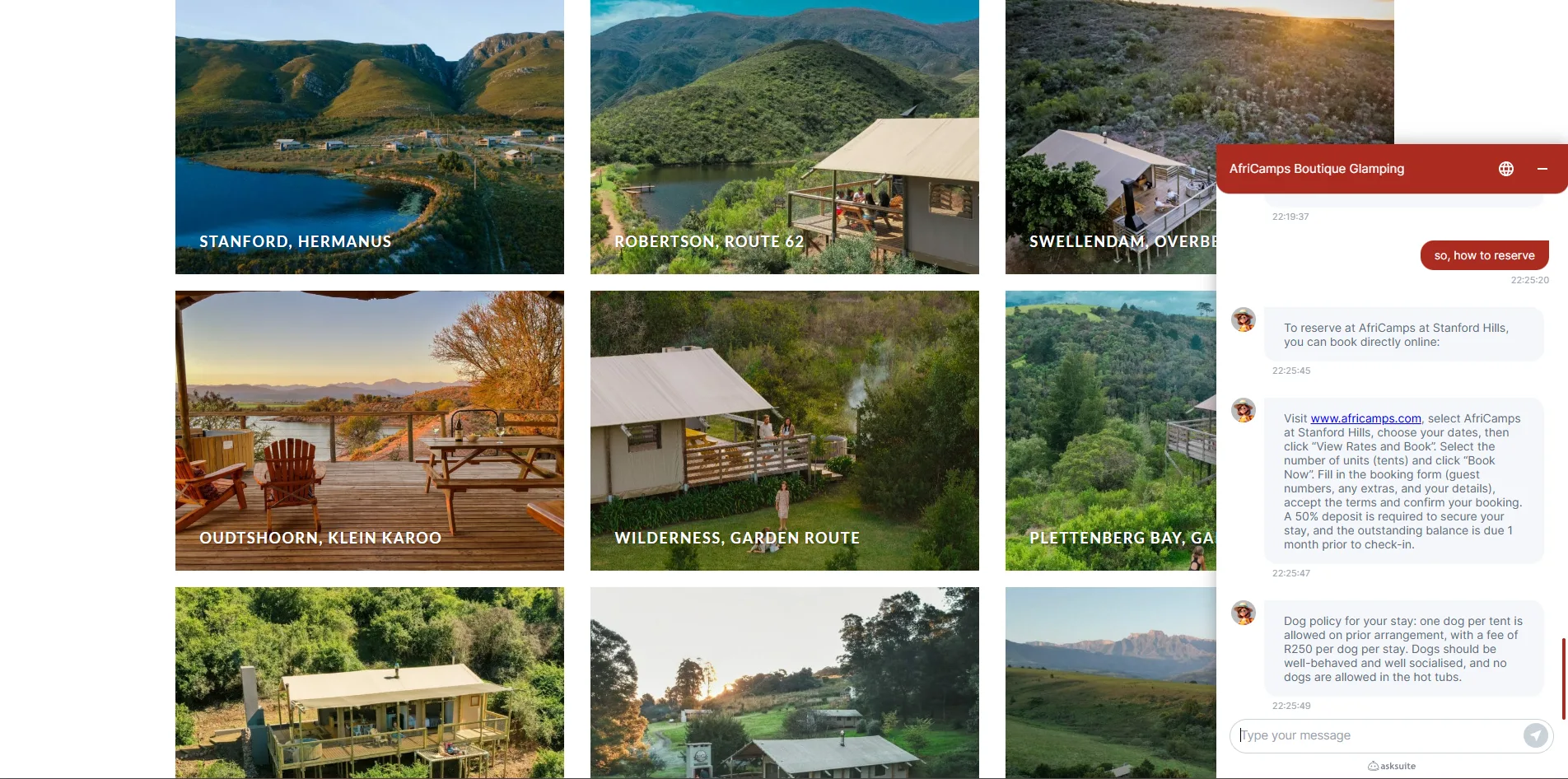
The bot remembered a family of four, children aged three and five, and a dog. It compared two locations and recommended the one with a restaurant. But the guest received long text blocks without room cards, visual choices, live availability or a relevant booking destination.
When asked how to reserve, the bot explained how to visit the site, select a camp, choose dates, open rates, complete the form and pay a deposit. The assistant described the customer journey instead of shortening it.
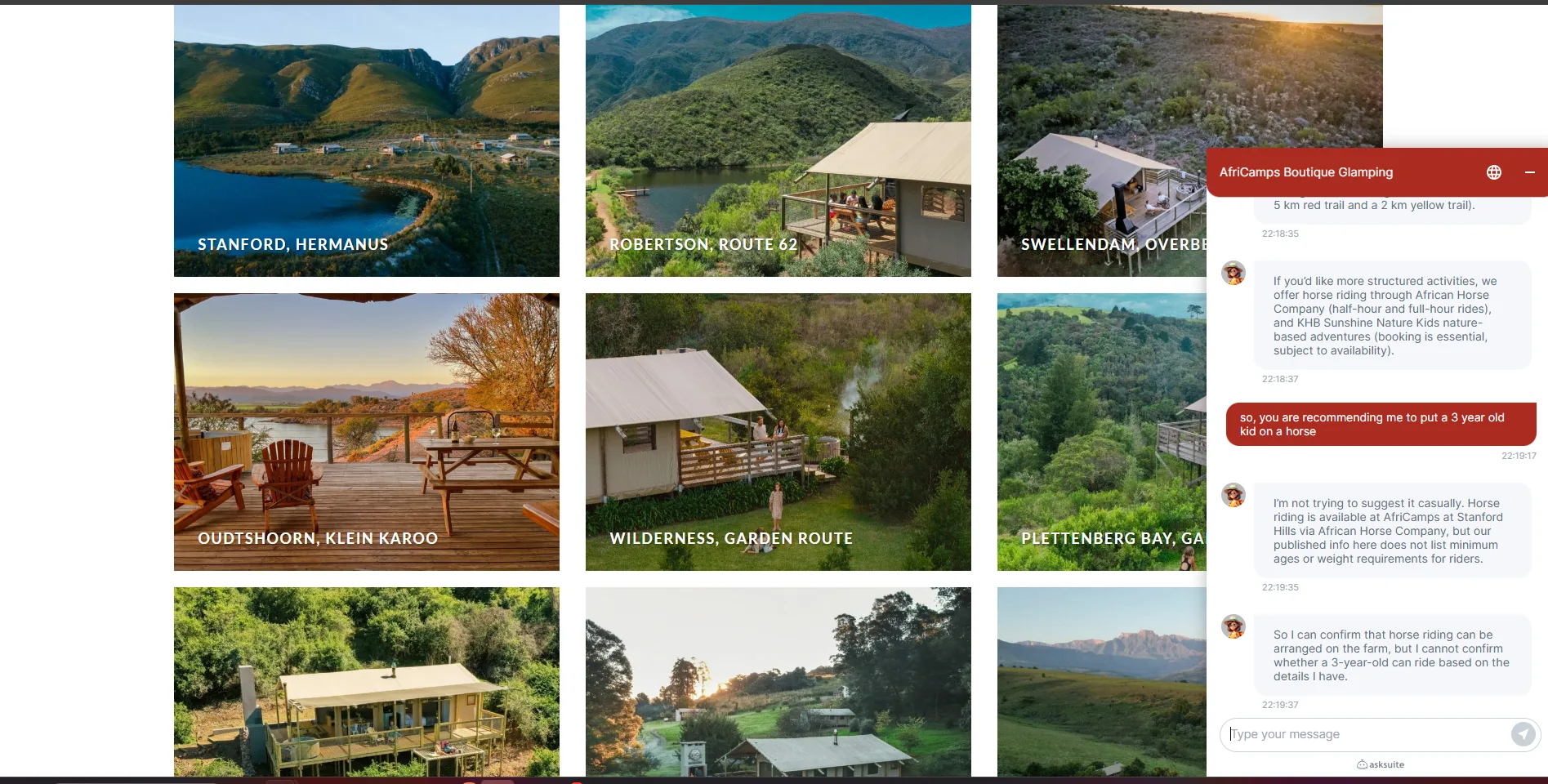
Remembering age is not enough. The recommendation must change because of it.
After the guest challenged the horse-riding suggestion, the bot admitted that the published information did not contain minimum ages or weight requirements. The knowledge gap was real; the problem was recommending the activity before resolving it.
Guest-visible assessment We cannot inspect AskSuite’s private configuration. We can evaluate whether the output used the known constraint safely and commercially.
ATKV had more functionality — and produced more friction.
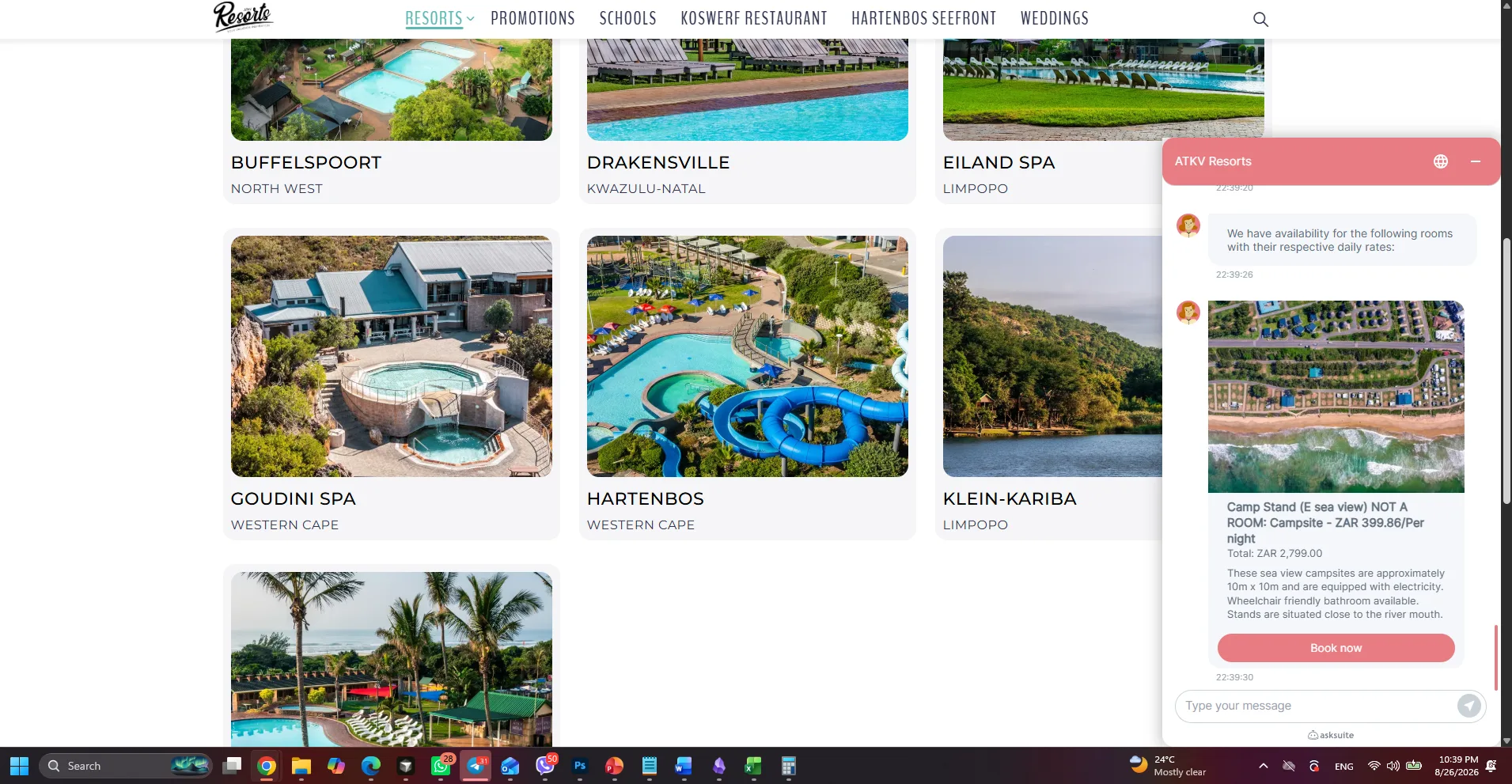
The assistant collected a resort, dates, adults, children and individual child ages. It displayed searching messages and eventually produced a rate card. Yet the returned product was a camp stand explicitly labelled “NOT A ROOM”, despite the request for family accommodation with two sleeping areas.
This is the difference between technical integration and usable sales judgment. A live rate is not useful when it belongs to the wrong product category.
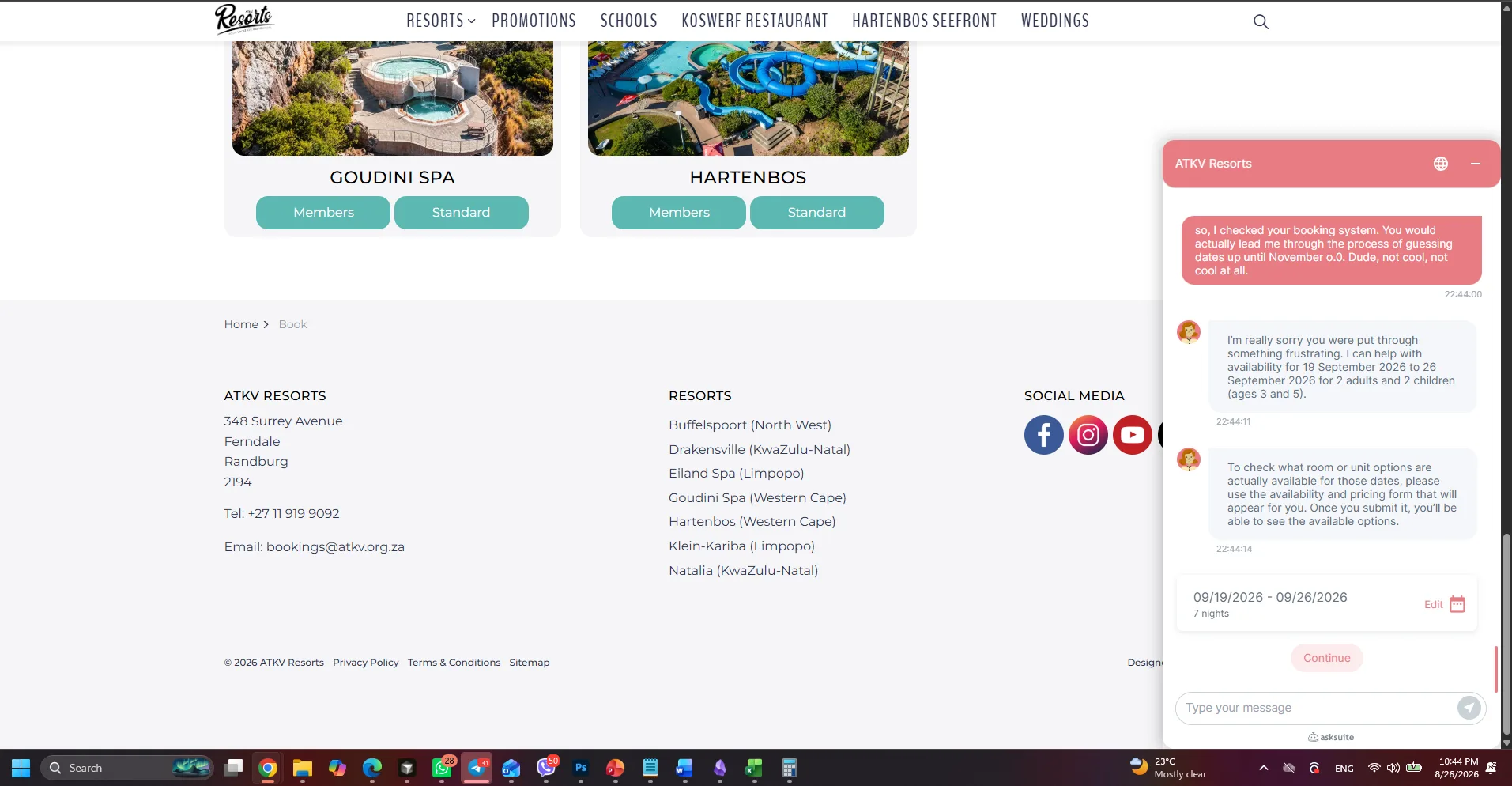
The guest should not have to guess dates until the hotel becomes available.
When the requested dates produced only camping inventory, the guest asked when rooms were available. The assistant could not search forward or offer alternatives. It re-presented the same dates and form, creating a manual trial-and-error loop inside the chat.
A visible widget is not evidence of an active AI sales agent.
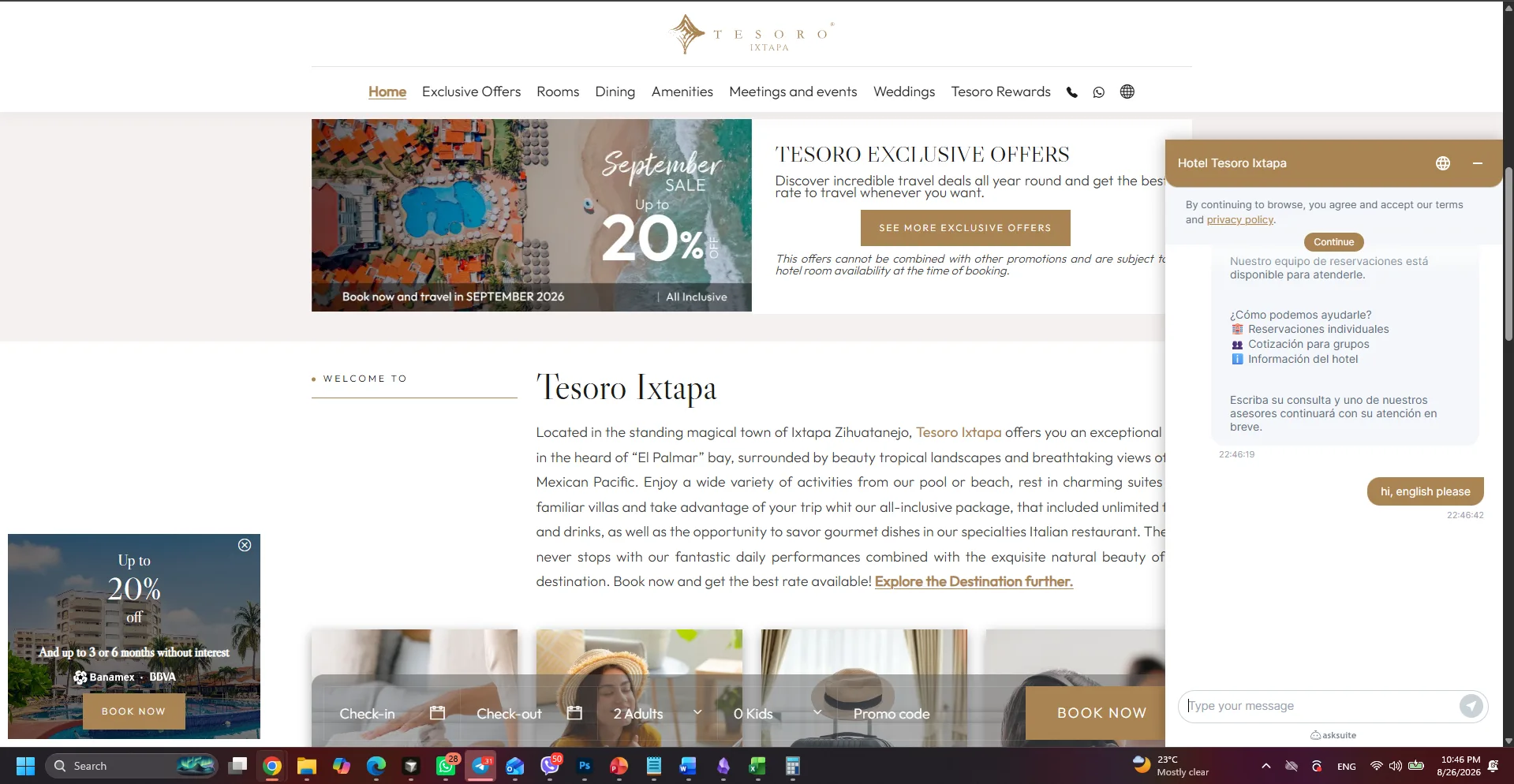
At Tesoro Ixtapa, the widget introduced an available reservation team in Spanish. After “hi, english please”, the tested conversation showed no answer. The language menu existed, but the guest-visible journey behaved like an inactive human inbox.
What MAIIA does differently
Use chat for judgment. Use the booking engine for booking.
MAIIA’s design starts from a simple boundary: conversation is excellent for understanding needs, explaining trade-offs and assembling a relevant offer. A full-size booking engine is better for dates, inventory, rate plans, policies and payment.
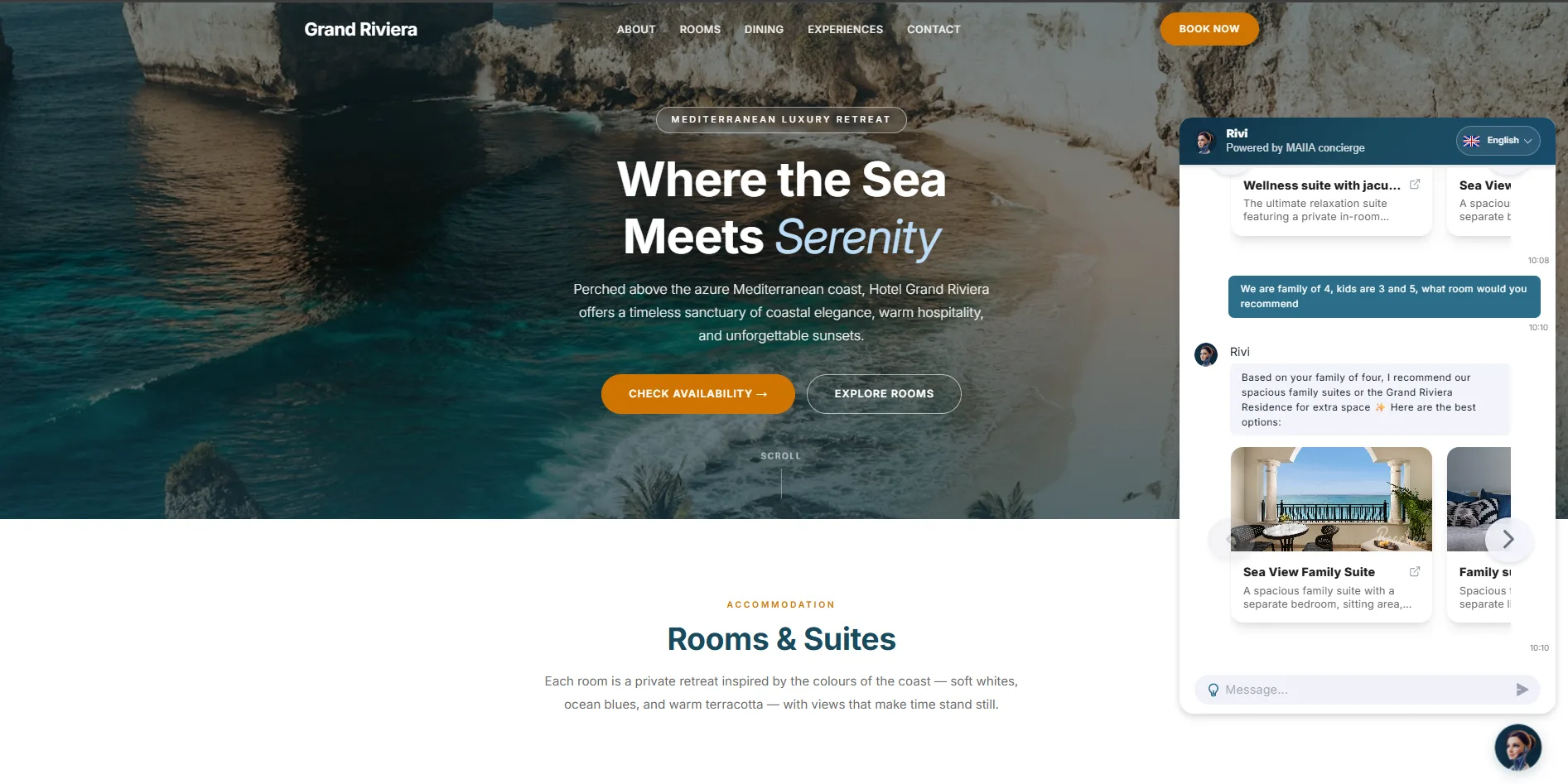
First identify the right product. Then open the right booking destination.
For a family of four with children aged three and five, MAIIA recommends family suites and the residence rather than asking the guest to search every room. Each card provides a visual, concise description and a direct product action.
The conversation is one commercial memory, not a sequence of disconnected forms.
The same context continues through the pet policy, child-appropriate hotel activities, pet sitting, contact capture, outside activities, tours and wellness. When the guest selects a couples treatment, MAIIA adds it to the earlier pet-sitting request without asking for the contact again.
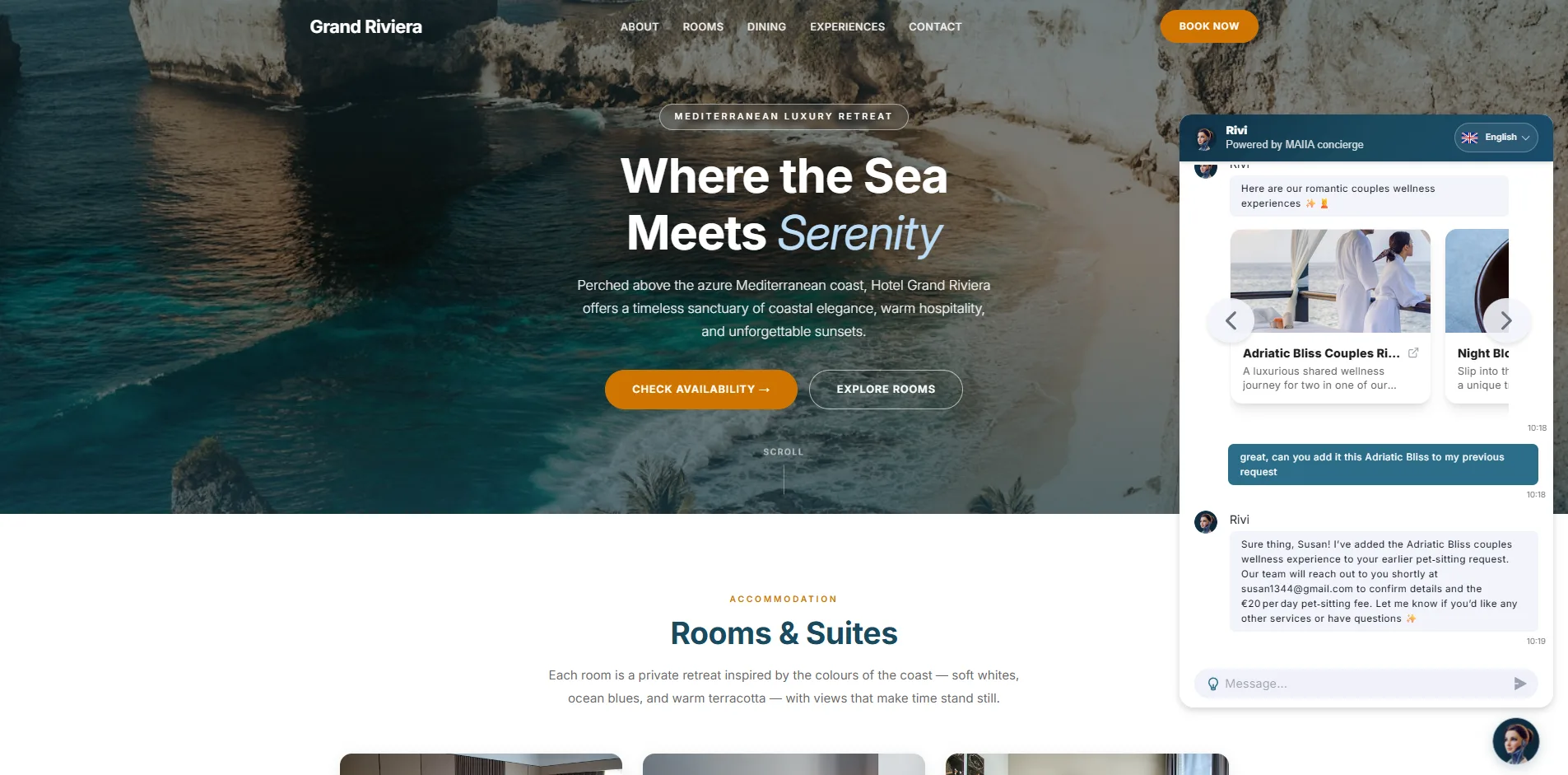
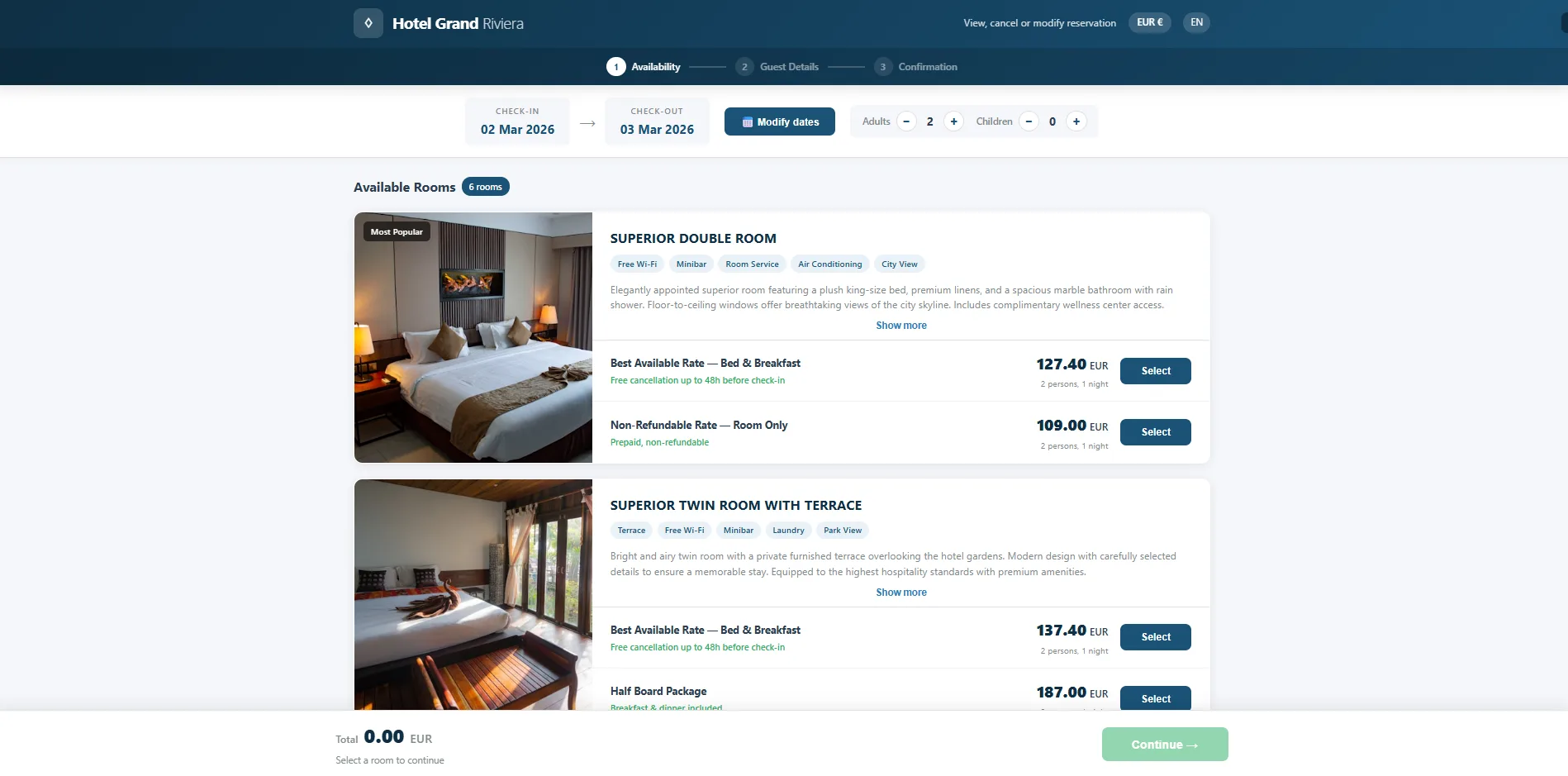
The booking engine is not a competitor to the agent. It is the agent’s checkout.
MAIIA does not make the guest repeat the entire reservation interface inside a narrow widget. The agent qualifies and recommends; the booking engine completes the transaction in the environment designed for it.
The implementation difference
A chat flow connects fields. A sales system connects meaning.
Booking workflow inside chat
- Select a property
- Re-establish what the guest wants
- Enter dates
- Enter adults and children
- Enter every child’s age
- Wait for the integration
- Hope the returned inventory fits
- Repeat when dates or results fail
MAIIA website sales workflow
- Understand the guest in natural language
- Apply constraints and property knowledge
- Recommend the right products visually
- Explain relevant differentiators
- Preserve intent for cross-sell and leads
- Open the correct booking destination
- Let the booking engine handle live commerce
The product principle
AskSuite puts the booking form inside the chat. MAIIA removes the steps before the booking. The goal is not to keep the guest inside the widget for as long as possible. It is to reduce uncertainty and deliver the shortest credible path to the right purchase.
Pricing context
AskSuite does not publish a standard price. MAIIA does.
AskSuite’s official commercial path is a custom quote. Independent hotel-technology sources place it broadly around US$100–300 per month, with several current comparison pages citing a starting point around US$300. Those figures are indicative, not an official AskSuite tariff, and the final price depends on the selected platform scope and property.
AskSuite
Custom quoteIndependent estimates commonly place entry pricing in the approximate US$100–300/month range.
Confirm inclusions, integrations, onboarding and channel scope directly with the vendor.MAIIA WSA
€100/monthSmall properties; €150 up to 150 rooms, then +€1 per additional room.
Unlimited knowledge, automated setup and no separate AI-training or per-data charge.Pricing is commercial context, not a claim that every package contains identical capabilities. AskSuite’s wider platform includes omnichannel reservation operations that are outside this website-layer test.
Commercial result
€160,000+
in additional requests and leads in six months
Generated by MAIIA WSA for a 170-room hotel. This excludes guests sent directly into the booking engine and represents additional requests/leads, not audited booked revenue.
The metric matters because website sales value is not the number of fields completed inside chat. It is the agent’s ability to discover demand, surface relevant inventory and services, capture complex intent and create measurable next actions.
Final decision
AskSuite can automate a reservation flow. MAIIA constructs a buying decision.
AskSuite should not be dismissed as a platform: it has substantial market adoption, broad reservation-channel coverage and valuable lead and follow-up tools. But in the website implementations tested here, more integrated steps did not consistently produce a better guest experience.
At the equivalent website-sales layer, MAIIA WSA is the stronger product when the hotel wants contextual recommendations, visual merchandising, safe constraint handling, cross-selling and a clean handoff to the booking engine — at a transparent price.
FAQ
Questions hotel owners should ask
Is AskSuite only a text chatbot?
No. The ATKV implementation demonstrated calendars, occupancy forms, live availability and a room-rate card. The issue was not absence of features; it was the amount of friction and the suitability of the returned result. Other tested implementations were much more limited or inactive.
Can AskSuite connect to booking engines?
Yes. Booking-engine connectivity is one of AskSuite’s public strengths. The practical procurement question is whether the specific integration returns appropriate inventory reliably and whether collecting the full booking query inside chat improves the journey.
Why does MAIIA redirect instead of completing everything in chat?
Because product recommendation and transaction processing are different jobs. MAIIA uses the conversation to establish fit and intent, then uses the booking engine for live availability, rate plans, terms and checkout.
Does AskSuite have strengths MAIIA WSA does not?
Yes. AskSuite’s broader platform emphasizes an omnichannel reservation inbox, WhatsApp and social messaging, lead management and abandoned-booking follow-up. Those capabilities should be assessed separately from the quality of its website sales experience.
Is this a comparison with AskSuite Concierge?
No. This article compares AskSuite’s website AI Reservation Assistant with MAIIA Website Sales Agent. MAIIA Concierge Guest App is a separate in-stay product and should be compared with AskSuite’s post-booking/concierge layer in a separate test.
Methodology & sources
How this comparison was built
We reviewed AskSuite’s public product information and tested guest-visible implementations at AfriCamps Boutique Glamping, ATKV Resorts and Tesoro Ixtapa in August 2026. Screenshots document the output at the time of testing. Individual hotel configurations, booking-engine connections and service availability differ; we do not claim access to AskSuite’s private setup or internal code.
Product scope: AskSuite AI Reservation Assistant versus MAIIA Website Sales Agent. Wider platform capabilities are described for context but are not treated as direct website-layer equivalence.
Public sources: AskSuite; MAIIA platform; MAIIA Website Sales Agent. Independent pricing estimates should be validated with AskSuite before procurement.
MAIIA commercial and implementation figures are first-party data and should be independently validated during procurement. No tested hotel or competitor was contacted for this article.