
Guest app comparison · 2026
Duve Guest App vs MAIIA Concierge Guest App: digital process or continuous journey companion?
Both applications accompany guests during their stay. The difference is whether the software primarily digitizes predefined steps—or remembers the guest’s evolving journey and actively helps them discover the best complementary experience next.
A branded web portal for check-in, information, messaging, requests, payments, upselling and checkout, connected to Duve’s broader guest-journey platform.
A journey-aware AI companion with a complete hotel and destination catalog, natural conversation, personalized recommendations and in-stay sales, connected to MAIIA CMS and Business Assistant.
The short answer
Both are full platforms. Here, we compare their equivalent guest-app layers.
Duve delivers clear value as a digital guest-journey and operational self-service system. MAIIA CGA has a different center of gravity: it is designed not only to help guests complete tasks, but to help them discover more relevant reasons to use the hotel’s and its partners’ offers throughout the stay.
Scope of this review
Duve digitizes the processes guests need to complete during their stay. MAIIA actively influences what guests discover, choose and buy throughout the journey — not only the next operational task.
Duve is a logical choice when…
- online check-in, documents, payments and checkout are the priority;
- the hotel wants predefined upsell offers and automated messages;
- operational self-service should reduce front-desk workload;
- the team has resources to prepare segments, content, rules and flows.
MAIIA CGA is a logical choice when…
- guests should browse, ask and book within one experience;
- recommendations should follow the guest profile, conversation and stay context;
- dining, wellness and the destination should become sales channels;
- the hotel wants AI to structure, enrich and translate content automatically.
Comparison
What the hotel is actually buying
| Criterion | Duve Guest App | MAIIA CGA / Guest App |
|---|---|---|
| Primary role | Digital guest journey and operational self-service. | Active AI concierge and in-stay sales/discovery layer. |
| Core value | Faster check-in, documents, payments, requests, messaging and predefined upsells. | Offer discovery, personalization, conversation, recommendations and sales during the stay. |
| Home screen | A portal with tasks, information, communications and offers. | A personalized hotel and destination overview with access to the complete catalog. |
| Personalization | Publicly documented Content and offer visibility can be configured by room, booking source, check-in answers, tags and rules. | MAIIA capability AI uses the guest profile and the accumulated context of questions, interests, clicks, requests, purchases and completed experiences to personalize what should be recommended next. |
| Catalog visibility | The hotel defines content, sections, widgets and visibility rules. | The complete catalog remains available to every guest. Personalization prioritizes relevant content without hiding the rest of the offer. |
| Conversation | Messaging and AI communication exist in the broader platform, but conversation is not the Guest App’s primary navigation logic. | Conversation is connected to the catalog: guests can combine needs, preserve context and receive relevant cards and actions. |
| Recommendations | Primarily driven by prepared products, segments, rules and communication timing. | AI connects the guest profile, full journey context, hotel offer and destination. It avoids repeatedly pushing an experience the guest already used and prioritizes complementary next experiences. |
| Content | The hotel creates sections, posts, banners, products, messages, conditions and segments. | MAIIA ingests sources, structures and enriches content, generates descriptions and cards, and presents the result for hotel review. |
| Dining | Digital content, mobile ordering and upselling; Duve has added dietary labels such as Vegan, Halal, Kosher and Gluten-Free. | Dishes, images, prices, ingredients, allergens, calories, nutritional data, diets, taste, preparation and personalized recommendations. |
| Wellness | Display and purchase of previously entered treatments and offers. | Explanations of treatments, benefits, effects and contraindications; need-based recommendations and equipment/sequence guidance. |
| Destination | Additional content and predefined offers can be included in the app. | The hotel becomes a destination guide; tours, attractions and partner offers feed personalized recommendations and revenue. |
| Next action | A preconfigured upsell, request, message, payment or external/operational flow. | A room, dish, treatment, tour or request leads to a concrete booking, purchase or the right staff member—with context. |
| Languages | Guests can communicate with reception in 20+ languages; full-content translation coverage depends on configuration. | The interface, content, menus, cards and conversation are available in the guest’s language. |
| Analytics | Completed processes, check-ins, payments, requests, upsells and guest-journey results. | Views, interests, questions, content offered, clicks, language, engagement, requests and purchases across the funnel. |
| Role of AI | Automation of communication and operational processes. | Continuous understanding of the guest, hotel offer and stay context across the journey—not only within one transaction. |
What guests actually see
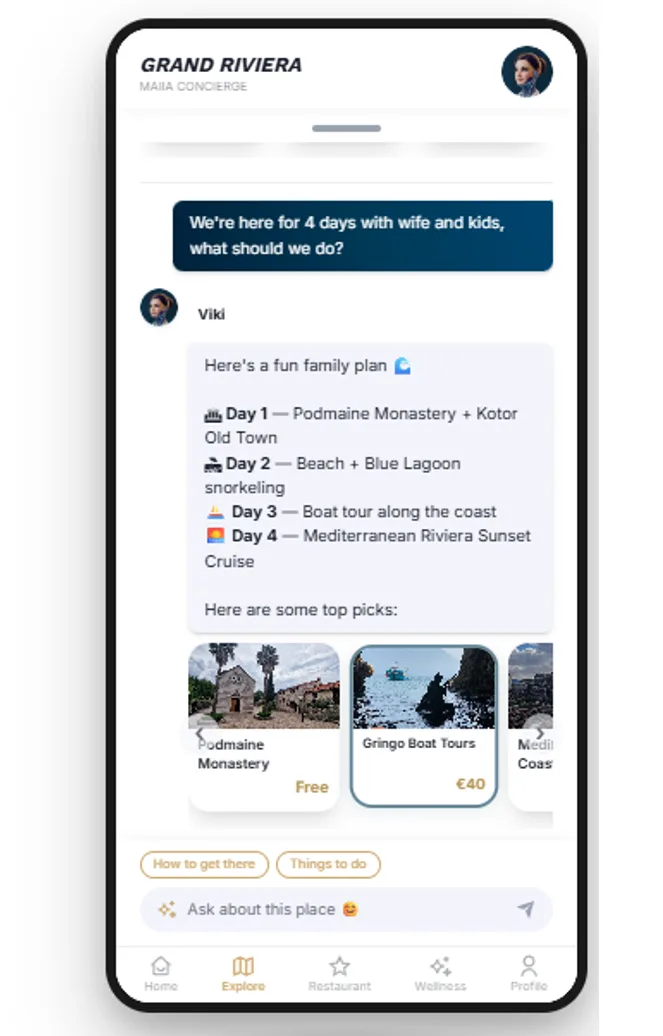
MAIIA connects three actions that conventional guest portals usually separate
Browse → Ask → Book
Guests can explore the entire catalog even when they do not know what to ask. They can then explain their situation—a family, a dog, dietary needs, back pain or an evening plan—and move to a booking or request without losing context.
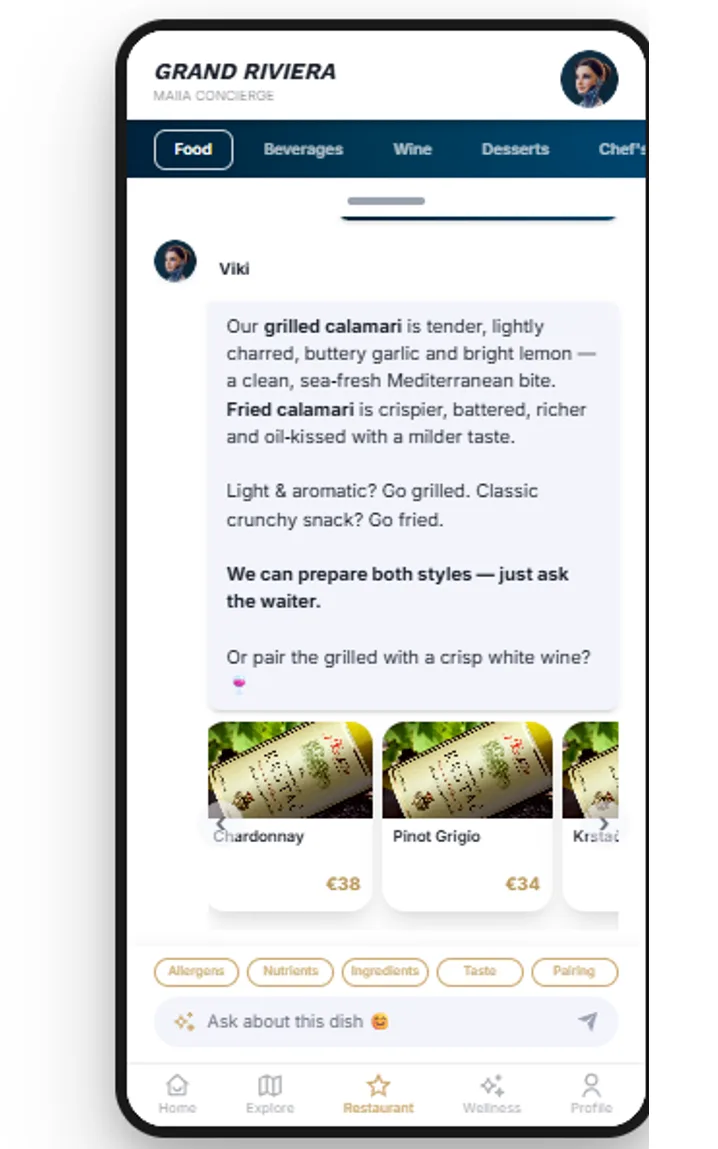
A digital menu shows what exists. An AI concierge helps the guest choose.
MAIIA can structure ingredients, allergens, nutritional data, compatible diets, flavor and preparation methods. This enables questions such as “What can I eat if I avoid gluten and lactose?” instead of forcing guests to inspect a PDF menu manually.
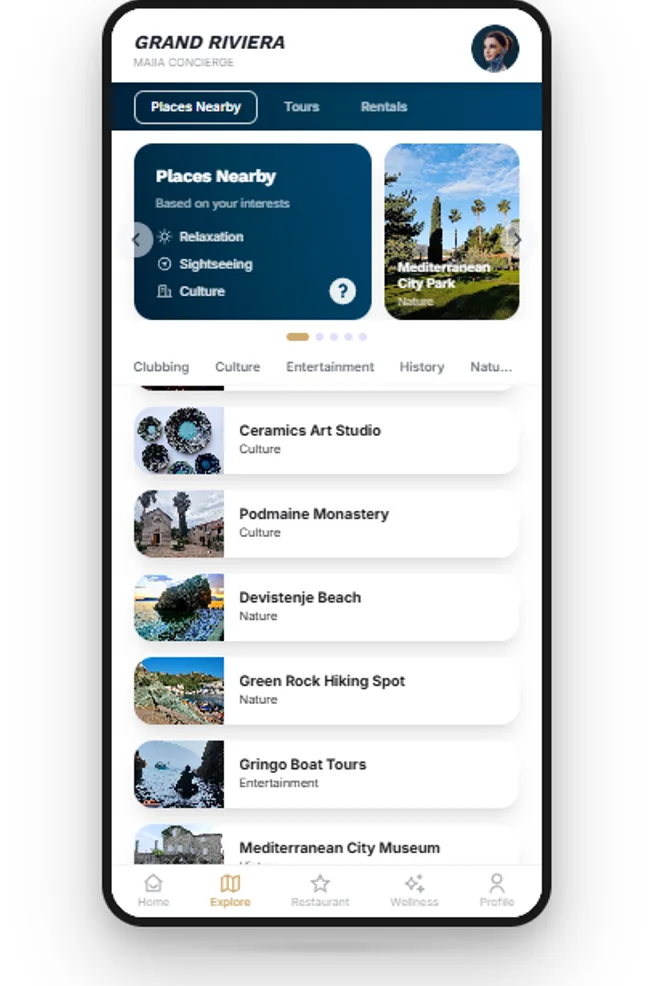
Personalization must not become a tunnel.
MAIIA Guest App gives every guest access to the complete catalog. Prominent sections, recommendations and cards shown in conversation are personalized, but the rest of the offer remains visible. The hotel therefore does not lose a sale simply because the guest did not think to select a particular interest during setup.
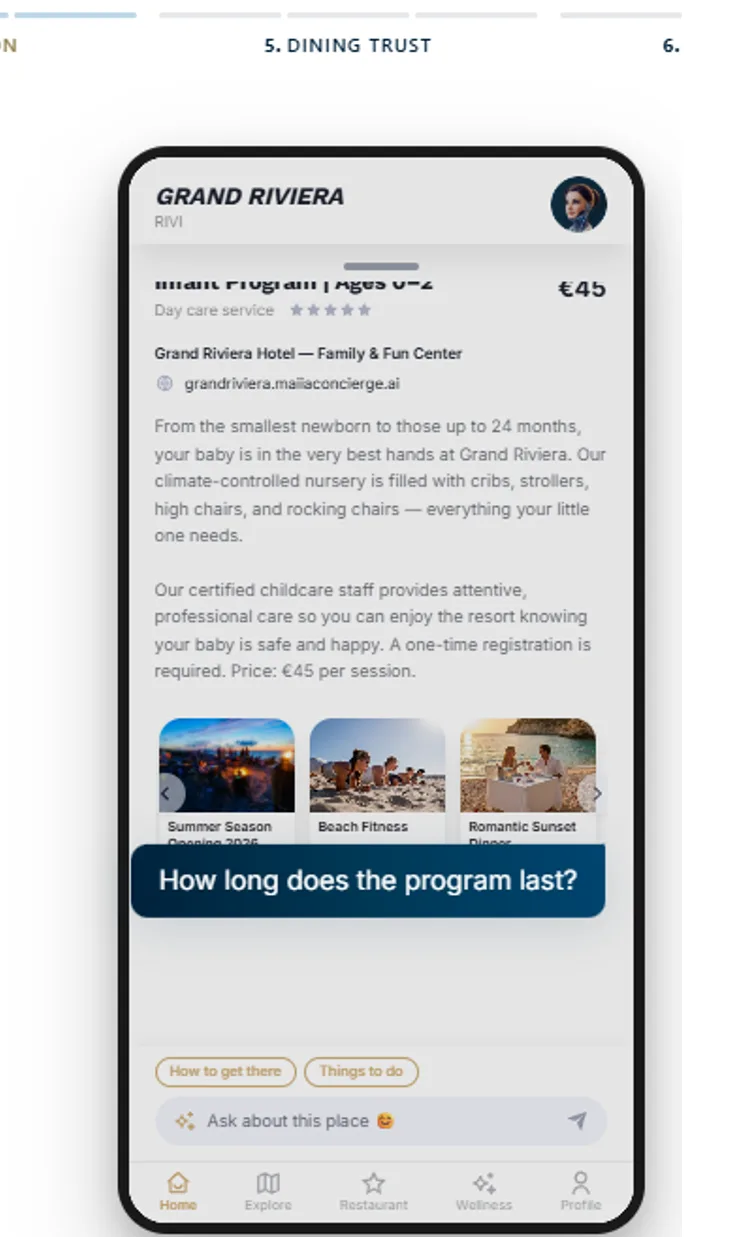
A good guest app does not end with “send it to reception.”
When a person is needed, MAIIA routes the specific request to the appropriate team. The guest is not asked for contact details again for every additional request, and staff receive the relevant conversation overview.
A different guest-app paradigm
MAIIA is a journey companion—not a sequence of transactions
Most guest apps react to the transaction in front of them: complete check-in, open a request, display an upsell or book a service. MAIIA CGA keeps what the guest asked, liked, clicked, requested, ordered and experienced in the AI context throughout the journey.
Transactional logic
The same massage, tour or upsell can remain eligible for promotion because the current screen or campaign does not understand the guest’s complete experience so far.
Journey-aware logic
If the guest had a massage or joined a tour yesterday, MAIIA does not simply push it again. It looks for a complementary next experience that improves the stay as a whole—while the full catalog remains available whenever the guest wants it.
Verdict
Why this matters: recommendations become part of thoughtful hospitality rather than repetitive promotion. The guest feels understood across the entire stay, creating a stronger experience and a more credible basis for loyalty.
MAIIA product position
MAIIA describes this continuous, journey-level use of guest context as a world-first guest-app
capability. This is a first-party product claim and should be validated against the precise scope
demonstrated during procurement.
The hidden implementation cost
A feature only has value if the hotel has time to configure it properly
Duve’s publicly documented Guest App Builder offers substantial control: the hotel creates sections, posts, banners and widgets and defines visibility by tags, brands and rooms. That is flexible—but it requires content, rules, translations, links and ongoing maintenance.
Conventional manual setup
- Collect products and hotel information
- Write descriptions, terms and messages
- Create segments and visibility rules
- Add images, prices, links and translations
- Test every flow and next action
- Maintain every change manually
MAIIA’s automated approach
- Ingest the website, Booking.com, reviews and PDFs
- Structure rooms, dishes, treatments and facilities
- Enrich missing data and images
- Generate descriptions, cards and translations
- Adapt recommendations and sales logic
- The hotel reviews and clicks Save—the AI knows immediately
This is not only about saving time
Hotels rarely have an internal team that simultaneously understands AI, sales, nutritional data, allergens, wellness contraindications, destination content and multilingual publishing. Automation therefore changes the quality of the outcome—not just the speed.
Pricing
Duve’s publicly listed pricing starts at $120 per month
Duve publishes minimum monthly prices; the final quote depends on the property and package. MAIIA Concierge Guest App (CGA) figures are direct commercial data for this comparison: pricing is per room and scales with catalog depth (facilities, restaurants, tours, treatments, spa). Because the packages do not bundle identical capabilities, this table provides procurement context rather than claiming that the tiers are fully equivalent.
Duve Basic
$120/mo.Minimum package: Online Check-in & Guest App.
Duve Pro
$150/mo.Basic + Communication Suite and 0% commission on in-house upsells.
Duve Premium
$200/mo.Pro + Upsells. Enterprise pricing is available by quote.
MAIIA CGA
from €2.5/room/mo.Guest App pricing ranges from €2.5 to €5 per room, depending on facilities, restaurants, tours, treatments, spa and overall catalog depth.
Example: a 50-room city hotel with one restaurant and no wellness → €2.5/room = €125/month. For an exact quote, contact MAIIA.Note: always confirm the exact CGA package scope and integrations in each vendor’s individual proposal.
The decision
Duve helps hotels digitize a predefined stay. MAIIA allows the stay to evolve around the actual guest.
If the primary challenge is check-in, documents, payments and standardized self-service, Duve offers a strong and mature operational answer. If the hotel wants guests to discover relevant dishes, treatments, facilities and destination offers during their stay—and wants every recommendation to reflect what the guest has already asked, liked and experienced—MAIIA CGA plays a broader commercial role.
Verdict
In one sentence: a transactional guest app helps complete the next task. A journey companion understands the stay so far and helps create the best experience next.
FAQ
Questions every hotelier should ask
Is Duve only a guest portal?
No. Duve is a broader guest-experience platform with online check-in, communication, AI agents, upselling, checkout and analytics. This article deliberately compares only the equivalent Guest App layer.
What does “journey companion” mean in practice?
MAIIA keeps the guest’s questions, interests, engagement, requests, orders and completed experiences in AI context. Recommendations therefore reflect the journey so far: after a massage or tour, the system can prioritize a complementary experience instead of repeatedly promoting the same one.
Does MAIIA hide offers that do not match the guest profile?
No. The complete catalog remains available. MAIIA personalizes featured positions, recommendations and the cards surfaced in conversation, giving relevant offers priority without removing other possibilities the guest may still want to explore.
Can Duve personalize content?
Yes. Duve supports segments, tags, conditions and visibility rules based on reservation and guest data. The key difference is how many of those rules the hotel must design and maintain in advance, compared with MAIIA’s contextual AI decision-making.
Can both systems sell additional services?
Yes. Duve is strong in prepared upsells and guest-journey automation. MAIIA adds journey-aware conversational discovery: a guest can explain a need, receive a relevant recommendation and continue to a booking or request without the system forgetting what has already happened during the stay.
What should a hotel ask to see in a demo?
Use a combined request the system has not received as a prepared script. Then ask the system to recommend something on the following day and verify whether it remembers the previous interaction, purchase and completed experience. Also check the full catalog, content translation, the action behind every card, handling of allergies, CMS update speed and analytics for clicks and recommendations.
Methodology and sources
How this comparison was produced
We compared publicly documented Duve capabilities with MAIIA functionality and supplied product screenshots. Duve was not tested through a private administrator account, so we do not draw conclusions about internal functions that are not publicly visible.
Duve sources: Guest App, Pricing, Guest App Builder, Product Updates.
MAIIA sources: MAIIA Guest App and product screenshots supplied for analysis. MAIIA timelines, pricing and automation scope are first-party data and should be confirmed during procurement. No third party was contacted.
Try the same guest scenario on MAIIA
Run your evaluation question on our Website Sales Agent — then compare answer depth, booking path, and setup effort side by side.