
Complete hospitality AI platform comparison · August 2026
Bring guests to the hotel. Help them leave satisfied.
That is the complete MAIIA proposition. Automatic GEO, A2A and the Website Sales Agent create visibility and qualified demand. The Concierge Guest App and Business Assistant help the hotel turn the stay into a relevant, well-delivered experience — increasing revenue while the guest is there and the likelihood that they will recommend the hotel after leaving.
Automatic GEO, A2A and MAIIA WSA make the hotel discoverable and turn intent into a qualified direct sales path.
MAIIA CGA remembers needs and interests, recommends relevant services and keeps the complete hotel experience actionable.
The Business Assistant routes concise, translated requests to the right employee so the hotel can deliver — not merely reply.
The short answer
Hospitality AI should create demand, revenue and recommendation — not just process messages.
The competitors are not interchangeable. Canary is a broad guest-operations suite. Duve is strong in digital check-in and self-service. Akia, AskSuite, HiJiffy and Chatlyn invest heavily in messaging. Quinta focuses on structured hotel information. DialogShift delivered the best competing website Q&A experience we tested. Chatislav offers a flexible no-code agent builder. Myma adds voice, email and inbox ambitions.
Those capabilities can improve operations after the guest has already arrived in the funnel. MAIIA addresses the larger commercial problem: whether the hotel is visible when travelers ask AI assistants where to stay, whether that interest becomes a qualified buying decision, whether the hotel sells more during the stay and whether the guest leaves satisfied enough to recommend it.
Scope of this review
MAIIA’s product position is not “another hotel chatbot.” It is a demand-generation, sales and guest-experience system connected by one governed commercial-intelligence layer. This page consolidates WSA-led live tests across the market; deep 1:1 posts sit beside it in the series.
The commercial outcome
From an AI recommendation to a guest recommendation
Automatic GEO is not a decorative SEO add-on. MAIIA turns approved CMS knowledge into crawlable, structured hotel content and machine-readable entities for rooms, facilities, restaurants, offers and experiences. A2A adds a callable layer: external AI assistants can discover declared capabilities and request structured hotel information and commercial actions instead of guessing from ungoverned web pages.
1. Visibility
The hotel becomes understandable to ChatGPT, Gemini, Claude and other AI discovery environments through automatic GEO publishing, structured content and A2A.
2. Acquisition
When a traveler shows intent, MAIIA presents the relevant hotel, room, offer or experience and moves that demand toward the hotel’s own sales path.
3. Revenue
WSA qualifies the buying decision before booking; CGA continues contextual cross-selling during the stay without repeatedly pushing what the guest already used.
4. Advocacy
Relevant recommendations, remembered preferences and correctly routed service create a more satisfying stay — increasing the conditions for reviews, recommendations and repeat business.
Measured commercial evidence
€160,000+
in additional requests and leads in six months
A 170-room hotel generated more than €160,000 in additional requests and qualified leads outside the booking engine in six months. This is first-party MAIIA performance evidence and should be validated during procurement.
What “automatic GEO” changes. A normal chatbot waits for traffic already on the hotel website. MAIIA also prepares approved hotel knowledge for discovery beyond the website, publishes crawlable content and exposes machine-callable capabilities. The hotel is no longer limited to optimizing the final steps of demand created elsewhere.
Market map
What each platform is actually best at
| Platform | Legitimate strength | Boundary observed in this research |
|---|---|---|
| MAIIA | Connected commercial intelligence across WSA, CGA, A2A and staff routing. | Does not replace a PMS, POS, payment gateway, mobile key, check-in kiosk or mass-messaging inbox. |
| Canary Technologies | Broad operational suite: check-in, payments, authorizations, tipping, messaging and digital compendium. | Tested AI Webchat deployments behaved mainly as slow website Q&A and generic-link navigation; hotel configuration burden remained visible. |
| Duve | Digital guest journey, operational self-service, check-in, payments, requests and predefined upsells. | Guest App logic remains largely hotel-configured content, rules and transactions rather than continuous experience reasoning. |
| AskSuite | Omnichannel reservation communication, integrations, AskFlow and abandoned-booking recovery. | Public WSA tests ranged from text Q&A to a repetitive booking form; no standalone guest app or public A2A layer was found. |
| Akia | Post-booking journeys, arrivals, requests, messaging and departmental workflows. | Public website experiences were inconsistent; one card flow produced failed booking links and several widgets did not complete an AI sales journey. |
| HiJiffy | Hotel Q&A, booking paths, omnichannel inbox, WhatsApp campaigns and plan-based automation. | Tested conversations stayed close to prepared topics and CTAs; a complete autonomous property sales strategy was not demonstrated. |
| Chatlyn | Central messaging workspace, guest journeys, campaigns and flexible hotel chatbot configuration. | Live WSA testing exposed unsupported recommendations, contradictory handoff and hallucinated hotel/tour claims; no standalone guest app or A2A equivalent was found. |
| DialogShift | The strongest competing website Q&A tested: good hotel facts, context, imagery and real links. | Following its own recommended links reset the conversation; room products and controlled knowledge-gap fallback remained incomplete. |
| Quinta | Structured hotel data and information distribution at substantial scale. | The tested interaction requested short single questions and did not demonstrate MAIIA-equivalent consultative selling or A2A execution. |
| Chatislav | Flexible no-code agents, actions, workflows, catalogs and booking add-ons. | Quality depends heavily on hotel/partner configuration; one live hotel agent understood English and then explicitly refused to serve the guest in it. |
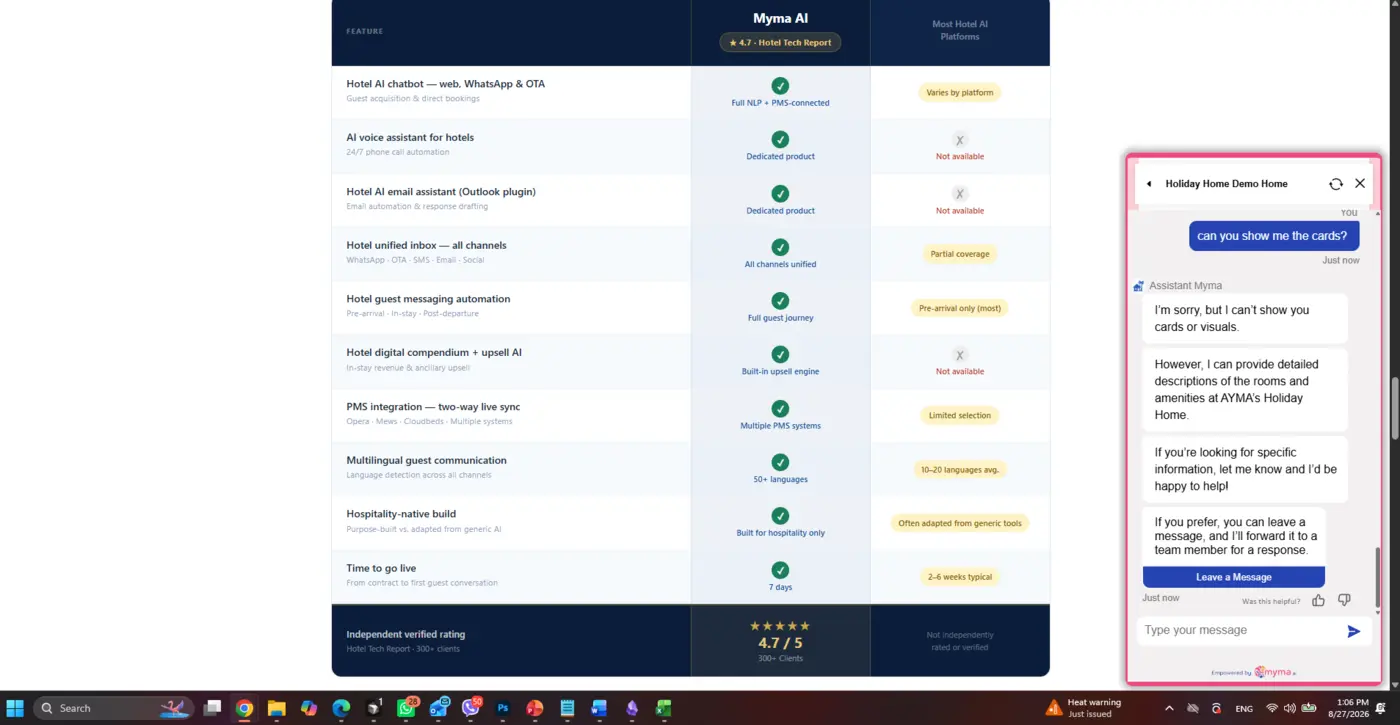
| Myma | Broad vendor proposition across chat, voice, email, inbox and digital compendium. | The reviewed vendor demo behaved as text Q&A, refused visual cards and did not demonstrate the claimed product depth in the tested scenario. |
Complete comparison · WSA-led evidence
Capability by capability — not slogan by slogan
This is a platform comparison built primarily from Website Sales Agent testing. Website-selling capabilities are therefore evaluated through live or vendor-demo interactions wherever possible. Guest apps, messaging, payments, check-in and other platform layers are included from available product evidence, but they were not tested with the same depth as the WSA layer.
The matrix distinguishes confirmed core capability, partial coverage, vendor claims not reproduced in the test, and capabilities for which no public equivalent was found. Scroll horizontally; the criterion and MAIIA columns remain visible on larger screens.
| Capability | MAIIA | Canary | Duve | AskSuite | Akia | HiJiffy | Chatlyn | DialogShift | Quinta | Chatislav | Myma |
|---|---|---|---|---|---|---|---|---|---|---|---|
| Website sales agent | Core WSA Intent → fit → visual offer → correct action. | Partially Q&A webchat Generic links in tested deployments. | Not the core layer | Partially reservation assistant Q&A or booking form depending on deployment. | Partially inconsistent live widgets | Partially Q&A and prepared paths | Partially hotel chatbot | Strong Q&A Closest WSA philosophy tested. | Partially structured answers | Partially configurable chatbot | Partially text Q&A demo |
| Complex context across products | Persistent Rooms, children, pets, dining, activities, wellness and requests. | Not demonstrated | Partially rules and journey data | Partially context lost/repeated in tested booking flow | Not reproduced publicly | Partially prepared topics | Partially remembered but not enforced | Partially one page only | Partially asks for single questions | Partially understood; configuration blocked conversion | Partially generic family response |
| Visual product cards | Rooms + full offer Translated cards for rooms, facilities, dining, wellness, tours and destination. | Not observed in WSA | Portal products Configured app content and upsells. | Partially late booking result card | Partially one tested listing flow | Partially text/CTAs dominate | Not observed in WSA | Partially navigation imagery, not room products | Limited in public test | Partially image, not structured card | Demo explicitly refused cards |
| Qualified booking handoff | Verified destination AI qualifies; booking engine owns inventory, rates and payment. | Partially reservation link | Operational booking/payment flows | Partially repetitive form; wrong inventory observed | Partially failed links in one test | Partially plan/integration dependent | Partially form returned unsuitable inventory | Partially generic form lost constraints | Partially booking flows claimed | Claimed; not reproduced live | Not demonstrated |
| Property-specific sales strategy | Built during setup Adapts hotel-type strategy to differentiators, priorities and constraints. | Partially hotel configures agent | Partially hotel rules and offers | Partially campaigns and reservation logic | Partially journeys and timed upsells | Not demonstrated autonomously | Not observed | Partially good local content | Q&A/data logic observed | Partially must be configured | Not demonstrated |
| Standalone in-stay guest app | CGA Personalized web app; no download required. | Partially digital compendium | Core Guest App | No public guest app found | Guest-experience portal | No equivalent found | Messaging, not guest app | No equivalent reviewed | No equivalent found | No equivalent demonstrated | Partially digital compendium claimed |
| Experience memory during stay | Continuous Questions, clicks, likes, bookings, orders and completed activities shape the next recommendation. | Partially PMS/CRM segmentation | Partially journey data and rules | Partially PMS/CRM journey triggers | Partially lifecycle workflows | Partially messaging history | Partially conversation/CRM data | Not applicable to tested layer | Not demonstrated | Not demonstrated | Not demonstrated |
| Avoid repeated offers + recommend the complementary next experience | Core CGA logic | Not publicly demonstrated | Partially suppression/rules, not lived-experience reasoning | Not publicly demonstrated | Partially journey rules | Not demonstrated | Not demonstrated | Not the tested layer | Not demonstrated | Not demonstrated | Not demonstrated |
| Proactive messaging + campaigns | Partially supported, not platform gravity | Competitor advantage | Competitor advantage | Competitor advantage AskFlow and abandoned-booking recovery. | Competitor advantage | Competitor advantage | Competitor advantage | Partially journey/channel modules separate | Not core | Partially integrations/workflows | Claimed suite strength |
| Automatic knowledge setup | 3–7 days Research, extraction, structure, enrichment, gap discovery, strategy and validation. | Partially builder; hotel authors intelligence | Partially hotel builds content/rules | Partially URL updating/onboarding; full build not established | Partially property knowledge/workflows | Partially plan/support dependent | Partially upload/configure | Partially shared onboarding | Partially hotel data collection | Partially hotel/partner configures | 7 days claimed; demo quality not equivalent |
| Pre-launch knowledge-gap detection | Explicit control Critical missing facts and contradictions identified before go-live. | Comparable workflow not found | Comparable workflow not found | Partially knowledge management; preflight not established | Not publicly established | Not publicly established | Gaps reached guests in test | Partially silence after missing wellness price | Not demonstrated | Not demonstrated | Not demonstrated |
| Governed anti-hallucination architecture | Verified boundaries Critical facts, suitability and allowed actions are structured — not left to fluent generation. | Partially configured Q&A | Partially controlled portal content | Partially knowledge grounding | Partially property KB/live data | Partially FAQ/knowledge grounding | Material unsafe claims observed | Strong in tested flow | Partially structured data | Partially source-trained, controls not equivalent | Partially generic Q&A |
| Correct-staff escalation | Situational routing Responsible employee/team receives the qualified request. | Partially tickets/workflows | Partially operational request routing | Partially human reservation inbox | Departmental workflows Strong operational routing; website qualification varied. | Partially escalation/inbox | Partially inbox; contradictory test handoff | Partially live-chat option | Partially front-desk referral | Partially Enterprise handoff / phone-email fallback | Partially leave a message |
| Automatic concise summary for staff | Built into escalation Guest, situation, request, contact and action — not the transcript. | Partially AI/ticket functions; equivalent package not demonstrated | Partially request records | Partially inbox context; equivalent routed summary not established | Partially structured tasks | Partially inbox tools | Comparable routed summary not found | Comparable routed summary not found | Comparable workflow not found | Partially €35 summary add-on Correct-person routing remains separate/Enterprise. | Not demonstrated |
| Translate conversation + summary into hotel staff language | Staff-language CMS view Staff do not need to understand the guest’s language. | Partially translation in higher bundles | Partially multilingual communication | Partially omnichannel translation capabilities | Partially multilingual messaging | Partially inbox conversation translation | Partially multilingual channels; staff-summary flow not shown | Partially guest languages; staff translation not shown | Not demonstrated | Partially multilingual model; deployment can block languages | 50+ languages claimed; staff workflow not demonstrated |
| Staff can act without reading the full chat | Designed outcome Translated summary + owner + contact + required action. | Partially tickets can reduce reading | Partially structured requests | Partially inbox/workflows | Strong for predefined tasks | Partially inbox escalation | Not demonstrated end-to-end | Not demonstrated | Not demonstrated | Partially summary add-on, routing separate | Not demonstrated |
| Automatic GEO publishing for AI-assistant visibility | Automatic GEO layer Approved CMS content becomes crawlable, structured hotel pages and machine-readable entities for rooms, facilities, restaurants, offers and experiences. | Partially public web content; automatic hotel-entity publishing not demonstrated | No equivalent demonstrated | Partially GEO guidance, not an automatic publishing layer | No equivalent demonstrated | No equivalent demonstrated | No equivalent demonstrated | No equivalent demonstrated | Partially structured information distribution | No equivalent demonstrated | No equivalent demonstrated |
| Public A2A / MCP-style external AI access | A2A Public agent card, declared skills and authenticated JSON-RPC endpoint. | No public equivalent found | No public equivalent found | No public equivalent found | No public equivalent found | No public equivalent found | No public equivalent found | No public equivalent found | Partially AI/data distribution, not callable agent interface | No public equivalent found | No public equivalent found |
| Published real-world commercial outcome | €160,000+ in six months Additional requests and qualified leads outside the booking engine at a 170-room hotel; first-party evidence. | Partially vendor ROI claims; not reproduced in this comparison | Partially upsell and efficiency claims | Partially conversion and recovery claims | Partially guest journey performance claims | Partially conversion claims by vendor | Partially campaign and conversion claims | Partially vendor case results | Partially information-performance claims | Partially vendor case claims | Partially vendor claims |
| Unified website + in-stay + external-AI demand analytics | Shared intelligence layer Questions, answers, language, cards, clicks, requests and engagement across WSA/CGA/A2A. | Partially broad suite analytics; no A2A | Partially guest journey analytics; no WSA/A2A equivalent | Partially platform analytics; no CGA/A2A equivalent | Partially lifecycle analytics; no A2A | Partially conversation/campaign reporting | Partially messaging analytics | Partially chat analytics | Partially data analytics | Partially agent analytics | Partially platform claims |
| Public buying logic | Transparent WSA €100 small / €150 to 150 rooms / +€1 above; CGA €2.50–€5 per room; A2A currently included, later separately priced. | Partially bundles named, quote required | Starts at $120/month Scope and add-ons matter. | Partially suite quote; third-party estimates not all-inclusive | Partially website-sales price not itemised | Public plan pricing Capability varies sharply by tier. | Partially custom quote | €300+ effective WSA minimum | Partially quote required | Partially public tiers + add-ons + hotel implementation quote | Partially quote / scope unclear |
A fair comparison of the guest layer
Duve Guest App vs MAIIA Concierge Guest App
Duve should not be judged as a weak Website Sales Agent: its genuine strength is the digital guest journey after booking. The comparison below therefore evaluates the equivalent product layers. Duve digitizes predefined stay processes particularly well; MAIIA CGA uses continuous guest context to drive discovery, personalization, service and in-stay revenue.
| Guest-app capability | Duve Guest App | MAIIA Concierge Guest App (CGA) |
|---|---|---|
| Primary role | Duve core Digital guest journey, check-in, documents, payments, requests, messaging and predefined upsells. | MAIIA CGA core AI concierge for in-stay discovery, personalization, recommendations, service and sales. |
| Where Duve is stronger | Operational advantage Dedicated check-in, payment, document and self-service workflows that MAIIA does not claim to replace. | Not the CGA role MAIIA connects with operational systems but is not a check-in, payment or mobile-key suite. |
| Guest onboarding | Partially booking and check-in data Content and offers can be segmented through booking data, answers, tags and rules. | Experience profile Language, name, interests, trip purpose, diet and allergies shape the experience before the home screen. |
| Catalog and navigation | Configured portal The hotel defines content, sections, widgets, products and visibility rules. | Full catalog + AI conversation Every guest can explore the complete hotel and destination offer; AI prioritizes relevance without hiding the rest. |
| Continuous journey context | Partially rules, segments and journey events Personalization is primarily configured through predefined products, conditions and timing. | MAIIA CGA memory Questions, interests, clicks, requests, purchases and completed experiences remain in context throughout the stay. |
| Next-best experience | Partially prepared upsells Offers are driven by hotel configuration, segments and automation rules. | Contextual recommendation CGA avoids repeatedly pushing an experience already used and recommends a complementary next experience. |
| Dining and wellness intelligence | Digital content and purchase flows Supports products, ordering/upselling and dietary labels where configured. | Deep product knowledge Ingredients, allergens, diets and taste for dining; benefits, effects, contraindications and sequence guidance for wellness. |
| Service reservation and action | Preconfigured flow Upsell, request, message, payment or connected operational action. | In-app commercial action Restaurants, wellness, tours and other services lead to booking, purchase or the correct employee with context. |
| Automatic content setup | Partially flexible builder The hotel creates and maintains sections, posts, products, conditions, segments and presentation. | MAIIA automated setup Sources are ingested, structured, enriched and prepared for hotel review, typically in 3–7 days. |
| Escalation to staff | Partially requests and workflows Strong for predefined operational processes. | MAIIA Business Assistant Situational analysis creates a concise, translated case and routes it to the employee responsible for the requested service. |
| Analytics | Process analytics Check-ins, payments, requests, upsells and guest-journey results. | Experience and revenue analytics Questions, interests, cards shown, clicks, language, engagement, requests and purchases across WSA, CGA and A2A. |
| Public starting price | From $120/month Final scope depends on plan, property and connected modules. | €2.50–€5 per room/month Depends on the number of facilities, restaurants, tours, treatments and operational complexity. |
Verdict
The distinction is not “good app versus bad app.” Duve is built to digitize a predefined guest journey. MAIIA CGA is built to let the journey evolve around the actual guest — while keeping the complete offer visible and commercially actionable.
MAIIA Business Assistant · shared by WSA and CGA
“Human handoff” is not useful if a human must reconstruct the entire conversation.
Hotels do not have employees waiting to read every guest transcript, work out what matters, translate it, identify the department and ask the guest to repeat missing details. A transfer button is only the beginning of escalation.
1. Detect
Sentiment and situational analysis determine whether the conversation requires staff action.
2. Summarize
The system extracts guest, contact, context, request, urgency, constraints and next action.
3. Translate
The original conversation and operational summary are available in the hotel’s selected staff language.
4. Route
The employee responsible for that service receives the actionable case — not a generic inbox dump.
Verdict
MAIIA’s operational unit is not a conversation. It is a translated, owned and actionable commercial event. That is why staff can act without reading the guest’s entire stream of questions.
Setup time is staff cost too
Many platforms advertise easy builders, templates, uploads and workflows. Those tools still require a hotel to inventory knowledge, clean sources, design categories, structure products, write rules, map links, translate, find contradictions, test edge cases and maintain the result. Prior MAIIA implementation experience estimates that this can absorb roughly three employees for 30+ days. MAIIA’s automated setup compresses that work into a typical 3–7 day review cycle.
What the tests exposed
Different products. The same missing architecture.
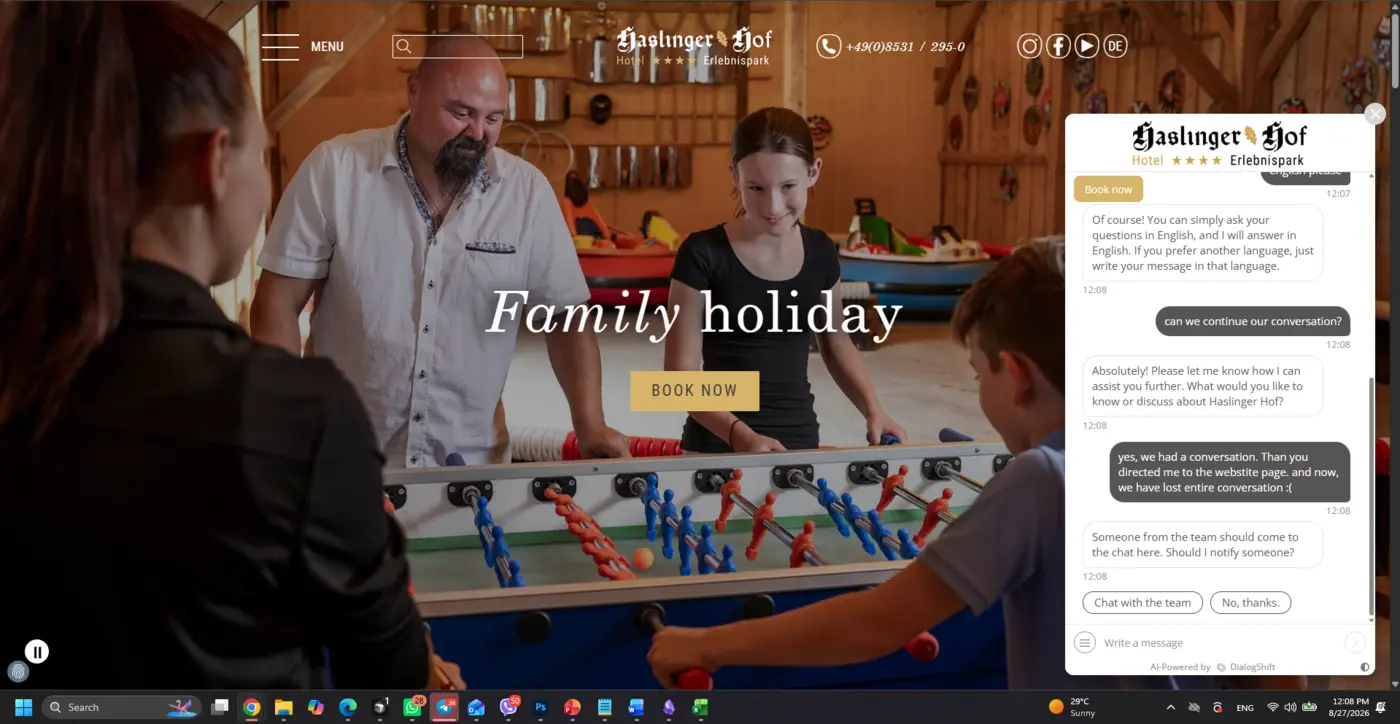
DialogShift: the best competitor — until navigation erased the customer
It understood the family and pet, used real hotel data and surfaced real links. Clicking a recommended link reopened the widget at the welcome state. A correct URL is not enough if the system forgets why the guest clicked it.
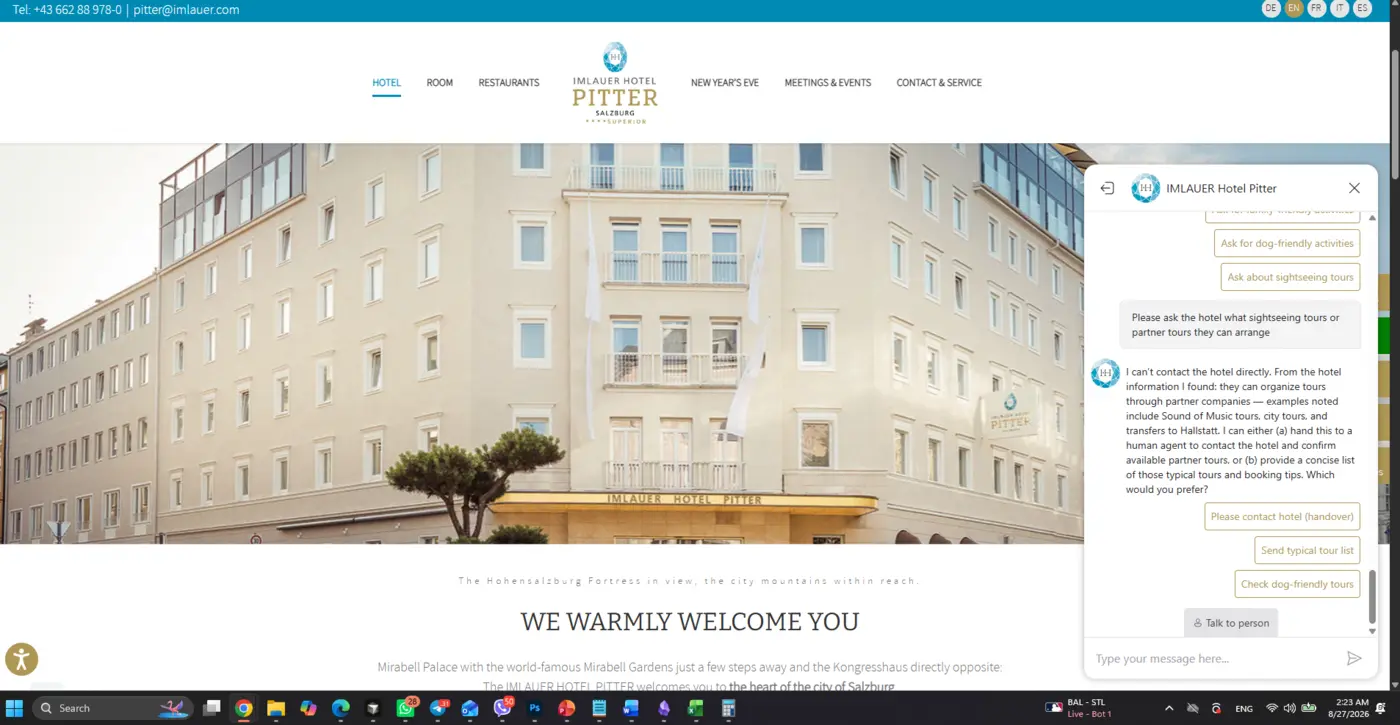
Canary: hotel-authored Q&A cannot become sales by branding it AI
Across tested properties, Canary was usually a website guide: text answers, generic links, no cards, no qualified booking journey, no captured lead and weak or absent escalation. The broad Canary operations suite is real; the tested website-sales layer did not match that breadth.
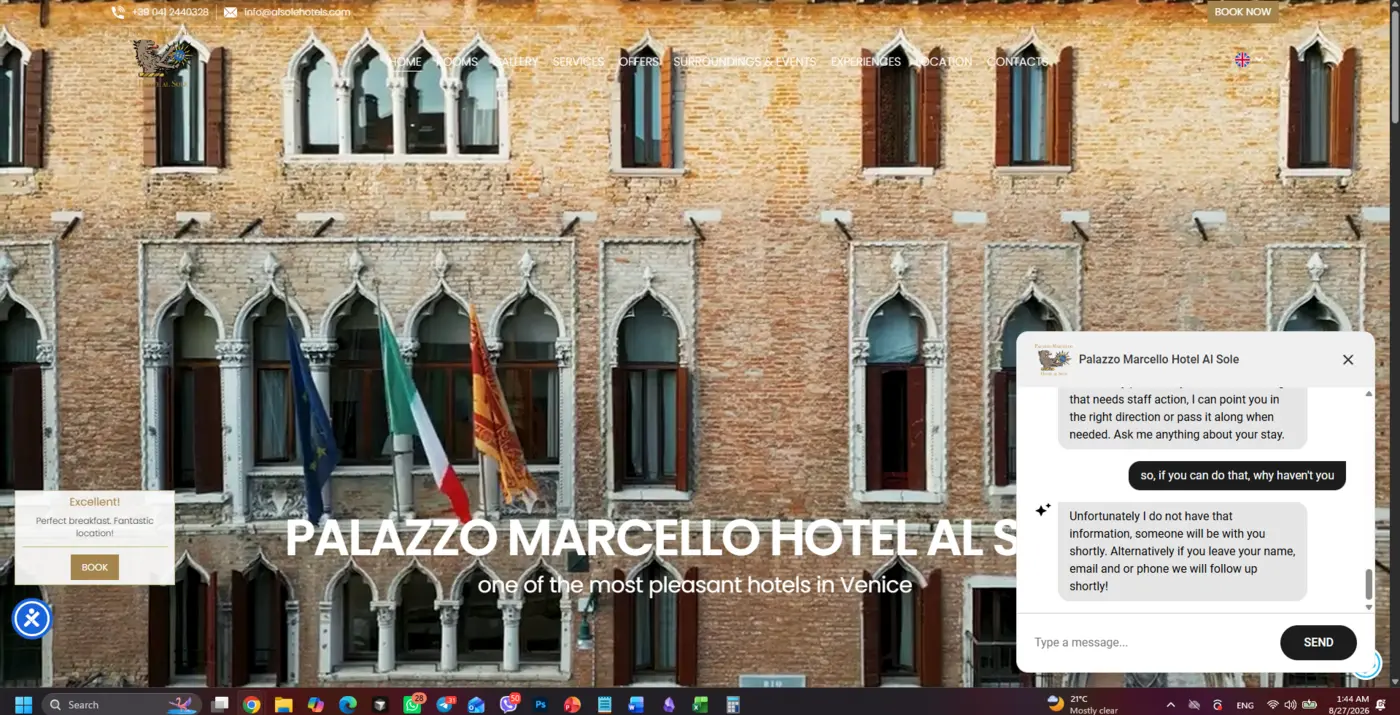
Chatlyn: fluent generation crossed the factual boundary
The agent entered “pool & wellness” without a confirmed pool, admitted it lacked a reliable activity/tour list, contradicted its own ability to contact the hotel and then generated generic partner tours as if they were hotel-arranged products.
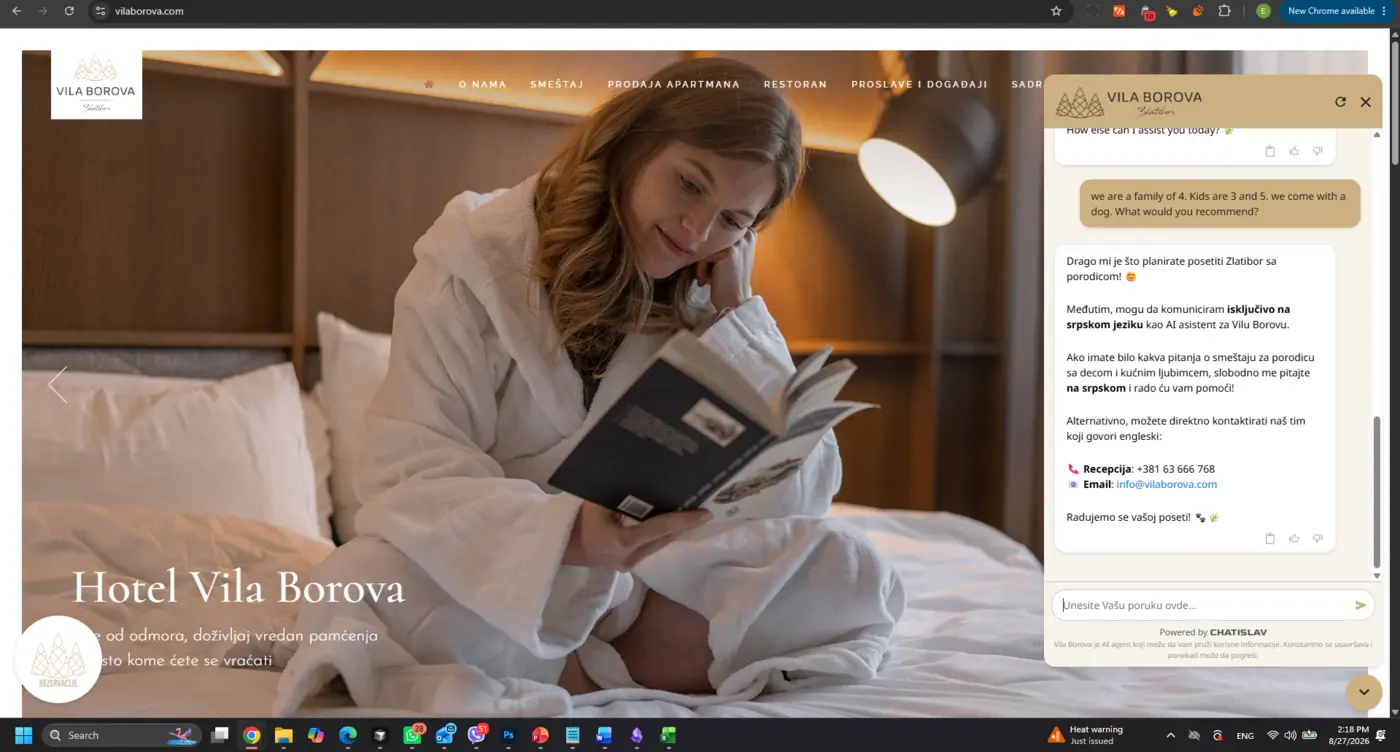
Chatislav: the model understood English; configuration refused the sale
The Vila Borova agent answered in fluent English but stated it could serve guests exclusively in Serbian. It then understood a family request with children aged three and five and a dog — and again refused to recommend in English.
Myma: a large comparison claim beside a small text bot
The vendor demo claimed PMS connectivity, direct bookings, a digital compendium and upsell AI. In the tested conversation the agent explicitly said it could not show cards or visuals and returned generic descriptions.
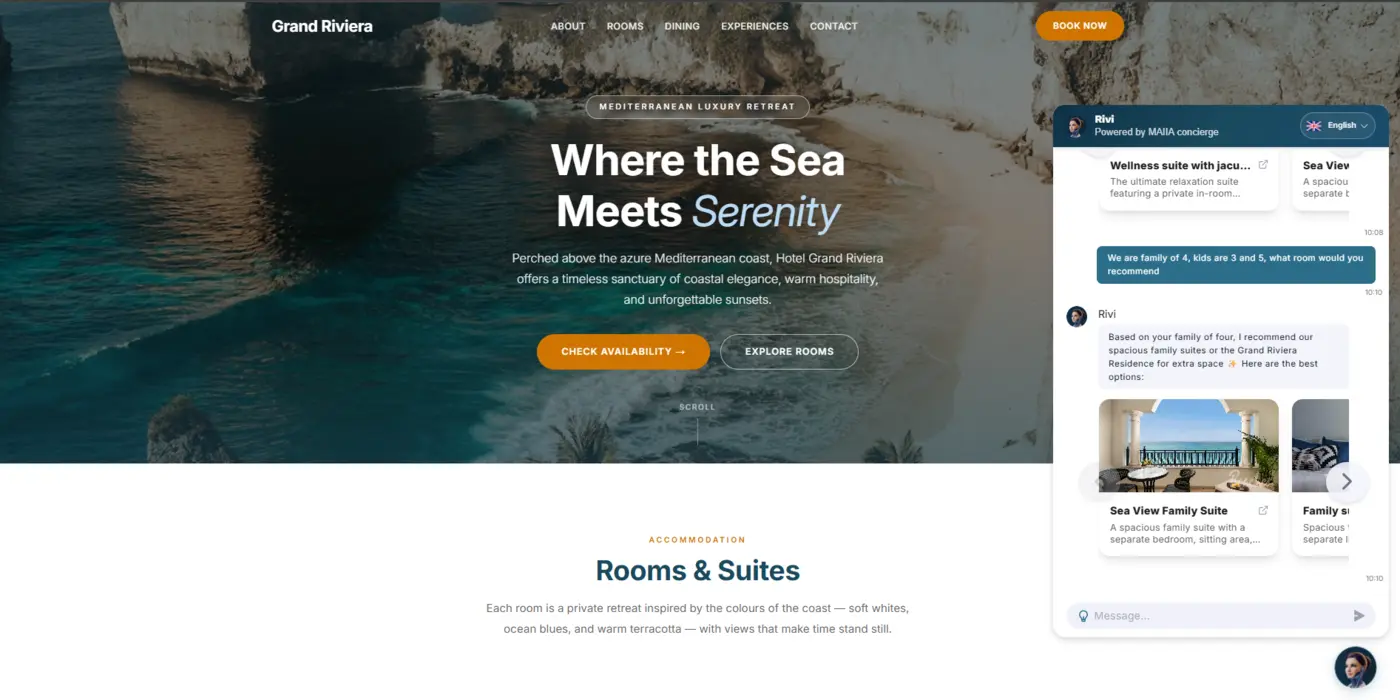
MAIIA Website Sales Agent: the same family becomes concrete products
The family composition and child ages become specific room recommendations, followed by verified pet policy, suitable activities, destination content and later services — all inside one persistent commercial context.
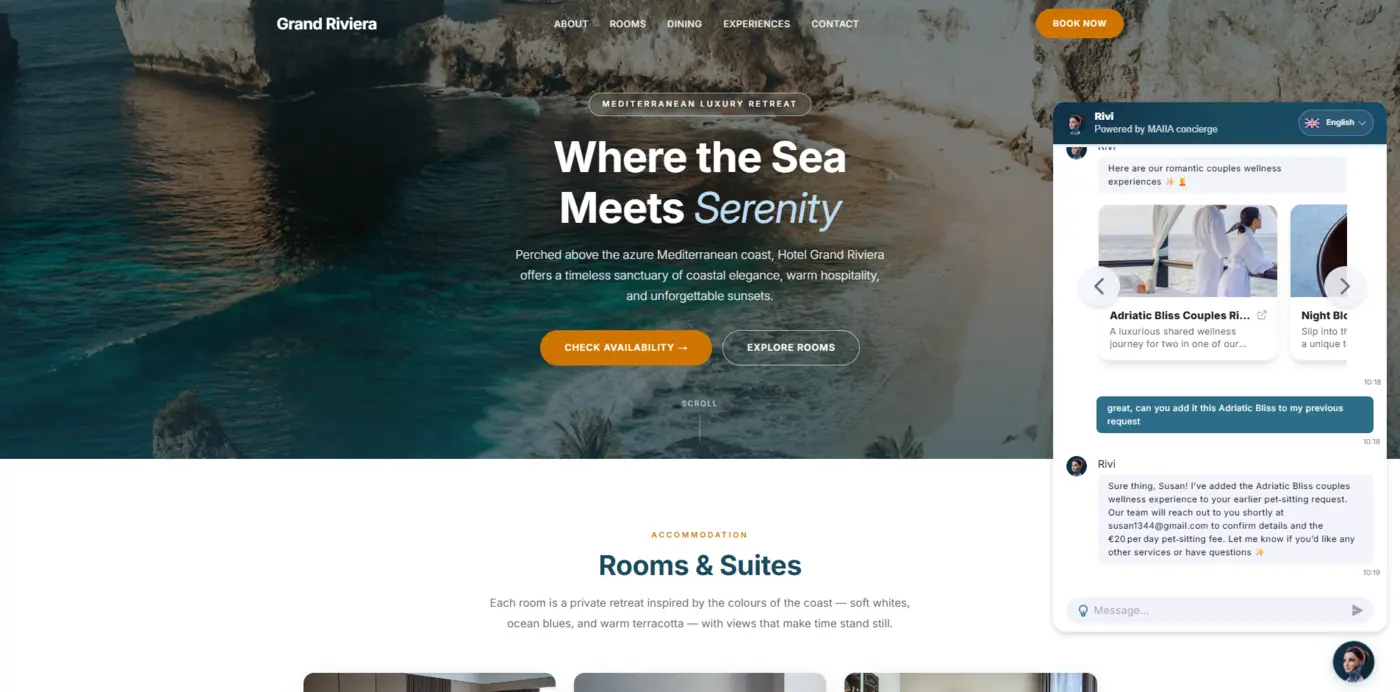
MAIIA Website Sales Agent + Business Assistant: the conversation becomes staff-ready work
A later wellness choice is added to the earlier pet-sitting request. Contact is not collected again. Staff receive one coherent request with the guest’s context, not separate transcripts they must manually join.
Price is architecture
A cheap chatbot can be the most expensive option in the building.
Licence price
Often only the visible base tier. Booking, catalog, API, resync, branding, channels, credits and implementation may be separate.
Hotel labour
Content collection, Q&A authoring, translation, testing, maintenance and transcript reading rarely appear on the vendor invoice.
Channel tolls
WhatsApp proactive templates are usage-priced by Meta, and BSP/vendor charges may also apply. A “guest journey” built mainly on paid messages creates a recurring distribution tax.
MAIIA WSA and CGA current pricing
WSA €100–€150+CGA: €2.50–€5 per room/month depending on facilities and operational complexity. A2A is currently included at no separate charge and is planned to be separately priced later.
Comparison caution
Canary, Akia, AskSuite, Chatlyn, Quinta and Myma require scope-specific quotes. HiJiffy, Duve, DialogShift and Chatislav publish at least part of their buying logic, but modules and integrations still determine comparability.
Do not compare one chatbot tier with an entire MAIIA suite — or a broad payments/check-in suite with WSA alone. Compare the layers the hotel actually needs.
The WhatsApp cost is not theoretical. Meta rates depend on market and template category; they are not universally $0.50 per message. But proactive marketing templates are usage-priced. The prior Chatlyn analysis illustrated 10,000 guests × 5 German-market marketing templates × €0.1131 = €5,655 in Meta delivery charges alone. Telegram’s Bot API is free to use, which is why MAIIA keeps it prominent and treats WhatsApp as an optional paid channel rather than the guest-experience architecture.
Final verdict
In 2026, hospitality AI should do two things that matter: bring guests to the hotel and help them leave satisfied.
Choose Canary when your priority is a broad operational suite with payments, check-in, keys, tipping and messaging. Choose Duve for digitized journey operations and self-service. Choose AskSuite, Akia, HiJiffy or Chatlyn when omnichannel messaging and campaigns dominate the requirement. DialogShift deserves consideration when a carefully configured website Q&A agent is the central need. Quinta is relevant when structured information distribution is the primary problem. Chatislav offers flexible building blocks for teams willing to design and maintain the agent themselves.
But those products mostly optimize an individual channel, workflow or transaction. MAIIA addresses both ends of the hotel outcome: automatic GEO, A2A and WSA help the hotel become visible and win the guest; CGA and the Business Assistant help the hotel understand, serve and sell to that guest throughout the stay.
With MAIIA, hyper-personalized recommendation is not the promise, but default
It is the result of a guest who received relevant offers, timely service and an experience worth recommending. Bring guests to the hotel. Help them leave satisfied.
FAQ
Questions hospitality buyers should ask
Is MAIIA broader than Canary Technologies?
No. Canary is broader in hotel operations and has dedicated products MAIIA does not claim to replace, including mobile check-in, payments, authorizations, tipping and related workflows. MAIIA is deeper in connected commercial intelligence across website selling, in-stay experience reasoning, A2A and staff-ready routing.
Do none of the competitors provide summaries or translation?
Several provide inbox tools, translation, tickets, tasks or summary-like functions. Chatislav publicly sells an AI Conversation Summary add-on. The differentiator identified here is the joined workflow: situational analysis → concise actionable summary → translation into staff language → correct-person routing, tied to the same guest and commercial context.
Why is automatic setup so important?
Because the quality of a hotel AI depends on knowledge structure, relationships, constraints, actions, strategy and testing — not on whether uploading a PDF is easy. MAIIA’s typical 3–7 day setup performs that architecture work and presents it for hotel review.
Does MAIIA replace a booking engine?
No. WSA qualifies the need, recommends the verified product and opens the correct booking destination. The booking engine remains authoritative for live inventory, rates, policies, payment and confirmation.
Why is A2A different from a normal PMS integration?
A PMS integration lets the vendor’s own product use hotel-system data. MAIIA A2A additionally lets external AI agents discover declared hotel-commercial capabilities and call them through a public agent card and authenticated protocol interface.
Is this a universal ranking of every deployment?
No. Public implementations vary. The comparison reports what was reproduced in named tests, what vendors publicly document and what was not found. “Not demonstrated” does not mean technically impossible; it means a buyer should require proof before purchasing.
Methodology & evidence boundary
How this comparison was assembled
This consolidated analysis uses the most recent versions of MAIIA comparison reports supplied for Akia, HiJiffy, AskSuite, Duve, Quinta, Canary Technologies, Chatlyn and DialogShift, plus the Chatislav live-installation analysis and Myma vendor-demo evidence. Duplicate HTML exports were ignored in favor of the latest or most complete version.
Evidence hierarchy: live guest-visible behavior; vendor demo behavior; official product documentation and pricing; clearly labelled first-party MAIIA product information. A capability not reproduced publicly is described as partial, claimed, not demonstrated or not found — not declared universally impossible.
Testing date: public tests and source checks were conducted in July–August 2026, with the consolidated comparison prepared on 27 August 2026. Product configuration varies by hotel and may change.
Official competitor sources: Akia; HiJiffy; AskSuite; Duve; Quinta; Canary Technologies; Chatlyn; DialogShift; Chatislav; Myma.
MAIIA sources: Website Sales Agent; Concierge Guest App; A2A; MAIIA Hospitality AI.
MAIIA scope, pricing, setup time, staff-time estimate and commercial figures are first-party information and should be validated during procurement. Competitors were not contacted for private demonstrations or quotations.
Try the same guest scenario on MAIIA
Run your evaluation question on our Website Sales Agent — then compare answer depth, booking path, and setup effort side by side.