
Hotel AI comparison · live test · August 2026
MAIIA vs Canary AI Webchat: when “ask me anything” means “read our FAQ for me.”
Canary markets instant answers, direct-booking guidance, 100+ languages, CRM lead capture and human routing. We tested four live hotel deployments. The website experience repeatedly behaved like a thin Q&A layer — and sometimes did not behave at all.
von Trapp Family Lodge, Oregon Garden Resort, Cambria Pines Lodge and Palazzo Marcello Hotel Al Sole.
Text responses and generic links replaced visual merchandising, qualified booking actions and real sales escalation.
None of the tested conversations completed recommendation → product card → booking or qualified human handoff.
The short answer
This is not a harsh interpretation. It is what the screenshots show.
Fair-comparison scope: this article compares Canary AI Webchat as deployed on hotel websites with MAIIA Website Sales Agent. Canary’s guest messaging, digital check-in, tipping, SMS, WhatsApp and wider operational platform are outside the test. A hotel buyer does not acquire a better website sales journey merely because the vendor also sells unrelated communication channels.
The test scenario was commercially ordinary: a family of four, children aged three and five, travelling with a dog, asking for a suitable room, activities, booking help and — where necessary — a staff escalation.
Scope of this review
Canary could retrieve fragments of property information. It did not assemble those fragments into a credible buying decision. In the strongest tested implementation it still returned generic text and a room-list link. In the weakest, the bot ignored repeated messages or loaded the wrong hotel and failed.
Canary AI Webchat, as observed
- answers common property questions from configured knowledge;
- returns plain-text links to existing website pages;
- may request contact details for later follow-up;
- quality depends heavily on what the hotel has configured.
MAIIA Website Sales Agent
- builds a hotel-specific sales strategy during automated setup;
- recommends and compares products visually;
- routes each card to the correct booking or provider destination;
- captures and translates a qualified request for the correct employee.
Complete comparison
Website Sales Agent vs website Q&A bot
A checkmark means the capability was confirmed. “Partial” states exactly what existed and where it stopped. No red X marks are needed: the observed behavior is more useful than an icon. Category winner is marked with .
| Website-sales criterion | Canary AI Webchat | MAIIA Website Sales Agent |
|---|---|---|
| Natural-language Q&A | Confirmed Can answer basic property questions when the relevant fact exists in its configured knowledge. | Confirmed Answers questions while maintaining the active commercial context. |
| Response speed | Partial — inconsistent Palazzo responded; Oregon required at least 45 seconds per answer and then left four messages unanswered. | Confirmed Designed for continuous real-time discovery and sales conversation. |
| Multilingual website experience | Partial — vendor claim, not visible in tested UI Canary advertises translation in 100+ languages. The tested US widgets offered no visible language control. | Confirmed Hotel selects supported languages; conversation and card content are served consistently in the guest language. |
| Family and pet context | Partial — facts repeated Could mention pet fees and room categories, but did not turn family size, child ages and dog into a validated offer. | Confirmed Hard constraints actively determine which rooms, activities and services are recommended. |
| Product recommendation | Partial — generic categories Palazzo suggested Superior, Deluxe or Suite without room sizes, confirmed occupancy or a meaningful comparison. | Confirmed Recommends specific best-fit options and explains why each fits. |
| Room comparison | Partial — incomplete facts At Palazzo, the only confirmed Classic/Deluxe difference was the view; at von Trapp, two pet rooms were named but not meaningfully compared. | Confirmed Structured product data supports side-by-side differences and commercially relevant trade-offs. |
| Rich cards | Not observed No room, activity, offer or experience cards appeared in any tested journey. | Confirmed Cards include imagery, concise selling points and a relevant action. |
| Booking-engine handoff | Partial — generic links von Trapp opened a general lodging page. Palazzo returned `/camere` or the homepage, requiring the guest to restart discovery. | Confirmed Room cards open the relevant booking-engine destination; the transactional system completes availability, rates and checkout. |
| Live availability and price | Not observed in tested deployments No tested conversation returned a qualified live room offer with price and booking action. | Qualified handoff WSA determines fit and hands the guest to the booking engine for authoritative live inventory and rates. |
| Lead capture | Partial — passive callback Palazzo offered to collect name, email or phone for an unspecified later follow-up. No contextual lead package was demonstrated. | Confirmed Collects contact once and attaches it to the complete qualified request. |
| Human escalation | Partial — contradictory The bot said it could pass a call or point the guest in the right direction, then admitted it lacked the information needed to do so. | Confirmed Sentiment and situational analysis route a translated summary and contact to the correct employee or department. |
| Sales strategy | Not observed The tested output answered isolated questions; it did not build a sales path, differentiate the hotel or continue into relevant cross-sell. | Confirmed Strategy is adapted to hotel type, positioning, constraints and actual differentiators during ingestion. |
| Anti-hallucination process | Partial — safe refusal The bot sometimes admitted missing information. We found no guest-visible evidence that gaps had been identified and resolved before launch. | Confirmed Knowledge-gap and contradiction scans run before go-live; unresolved critical facts do not become confident recommendations. |
| Setup burden | Partial — easy edits, hotel-owned knowledge work Canary’s von Trapp case study praises two-second knowledge-base edits. The live tests show why effortless editing is not the same as complete commercial setup. | 3–7 days MAIIA ingests the website, Booking.com, reviews and PDFs, structures content, builds selling logic and exposes missing knowledge. |
| Implementation consistency | Observed — highly inconsistent Working text Q&A, extreme delays, ignored messages, wrong-property branding and connection failure all appeared. | Shared implementation method Automated setup, validation, cards, escalation and analytics use the same governed product method. |
| A2A discoverability | No public equivalent found Canary integrations connect its own platform to hotel systems; no public A2A agent card or external-agent interface was found. | Confirmed External AI agents can discover MAIIA’s agent card and call declared hotel-commercial capabilities. |
| Price | Custom quote AI Webchat is included in Canary’s Pro bundle; no public monthly amount is displayed. | Transparent €100/month for small properties; €150 up to 150 rooms; then +€1 per additional room. |
Canary’s own procurement criteria
The product failed the checklist published by its own vendor.
Official claim: “instant answers”
Observed: Oregon answers took at least 45 seconds; four subsequent messages received no response.
Official criterion: CRS and booking-engine connection
Observed: generic pages and homepage links, not a qualified booking result.
Official Pro feature: CRM contact capture
Observed: only a generic request to leave contact details for an unspecified callback.
Official product flow: route complex inquiries to staff
Observed: Palazzo promised direction or transfer, then could not perform it.
Official criterion: customized, non-cookie-cutter interaction
Observed: category lists, facts and links that mirrored website Q&A rather than a sales decision.
Official claim: 100+ languages
Observed: no visible language selector in the tested US website widgets.
Live implementation evidence
Four hotels. Four ways not to complete the job.
von Trapp answered questions. It did not sell the stay.
The bot received the full family scenario. It could retrieve pet information, name rooms and describe activities. But the guest never received a visual product, a validated room recommendation, a price or a booking-engine result.
When asked about tours, it returned a paragraph and an activities-calendar link. When asked to book, it opened a generic lodging page — sending the guest back to manual navigation.
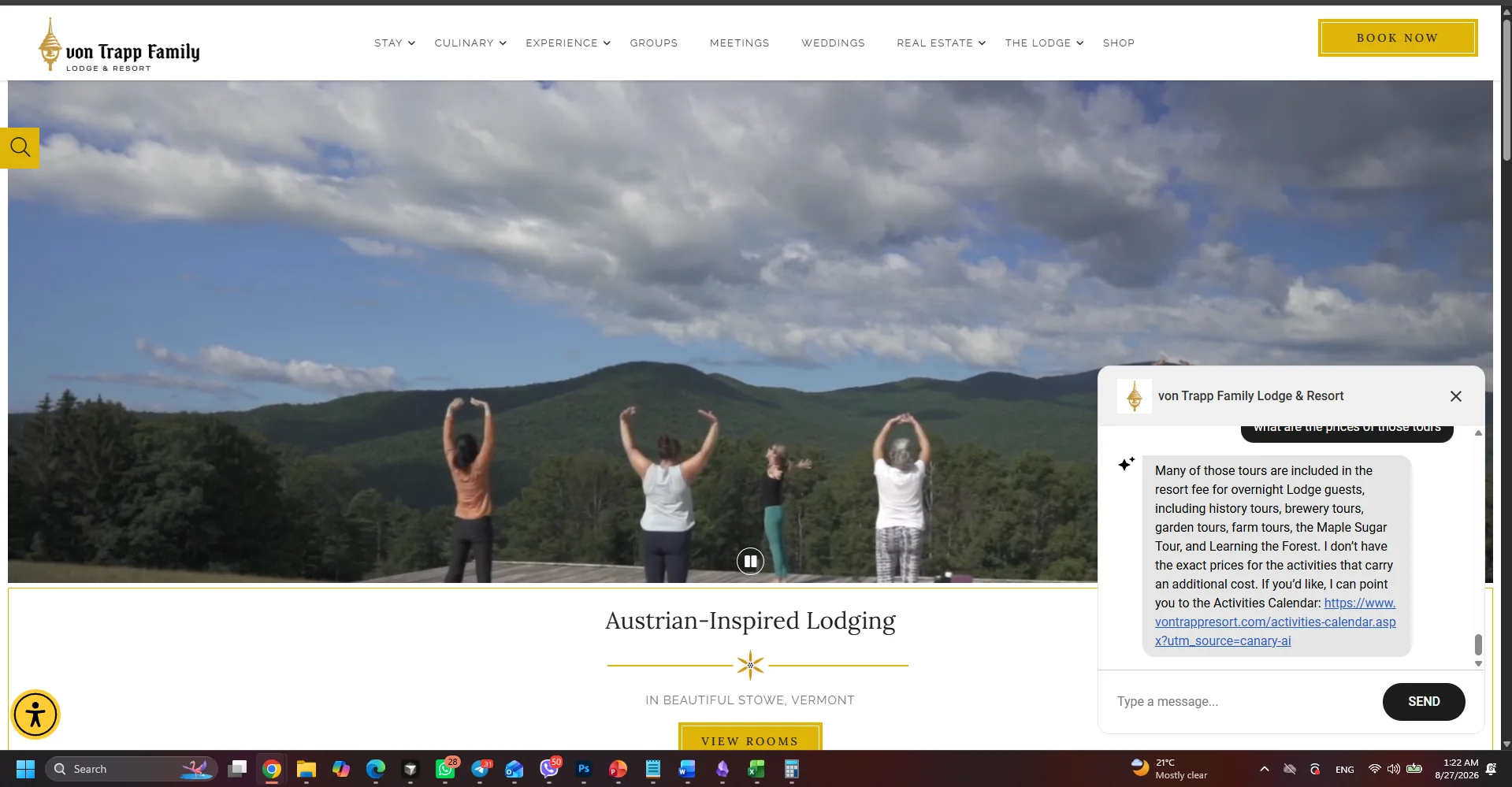
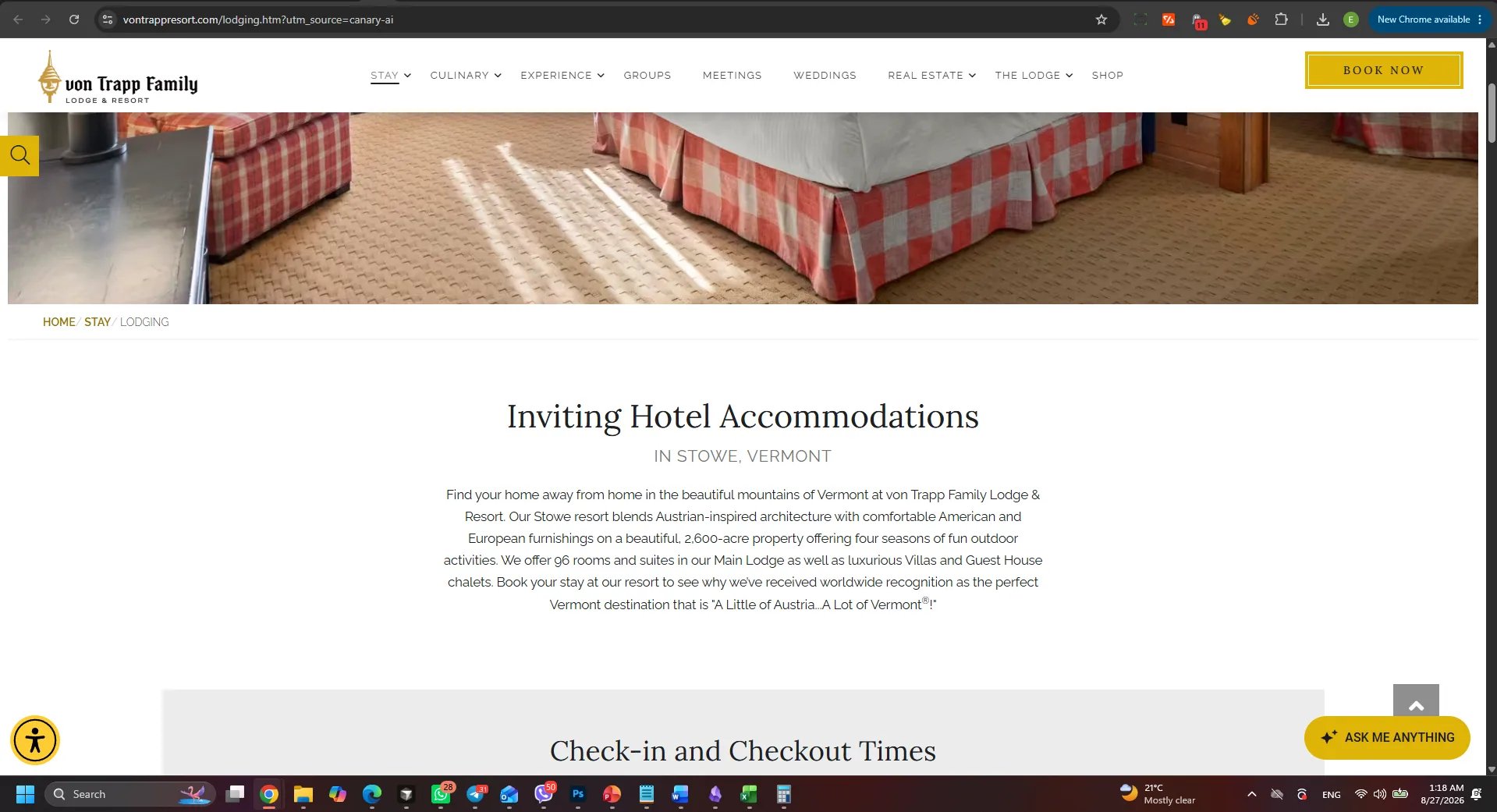
A link is not a product card. A category page is not a booking handoff.
The destination contains the information the bot should have used to construct the decision. Instead of presenting the relevant room with image, capacity, pet conditions and action, Canary returns the guest to the top of the catalogue.
Oregon Garden turned “instant” into 45 seconds — then silence.
The first responses required at least 45 seconds. After presenting “Double Queen room — tell me more” as a suggested action, the bot ignored that same request three times and then ignored “anything???”. There was no recovery, error explanation, lead capture or human handoff.
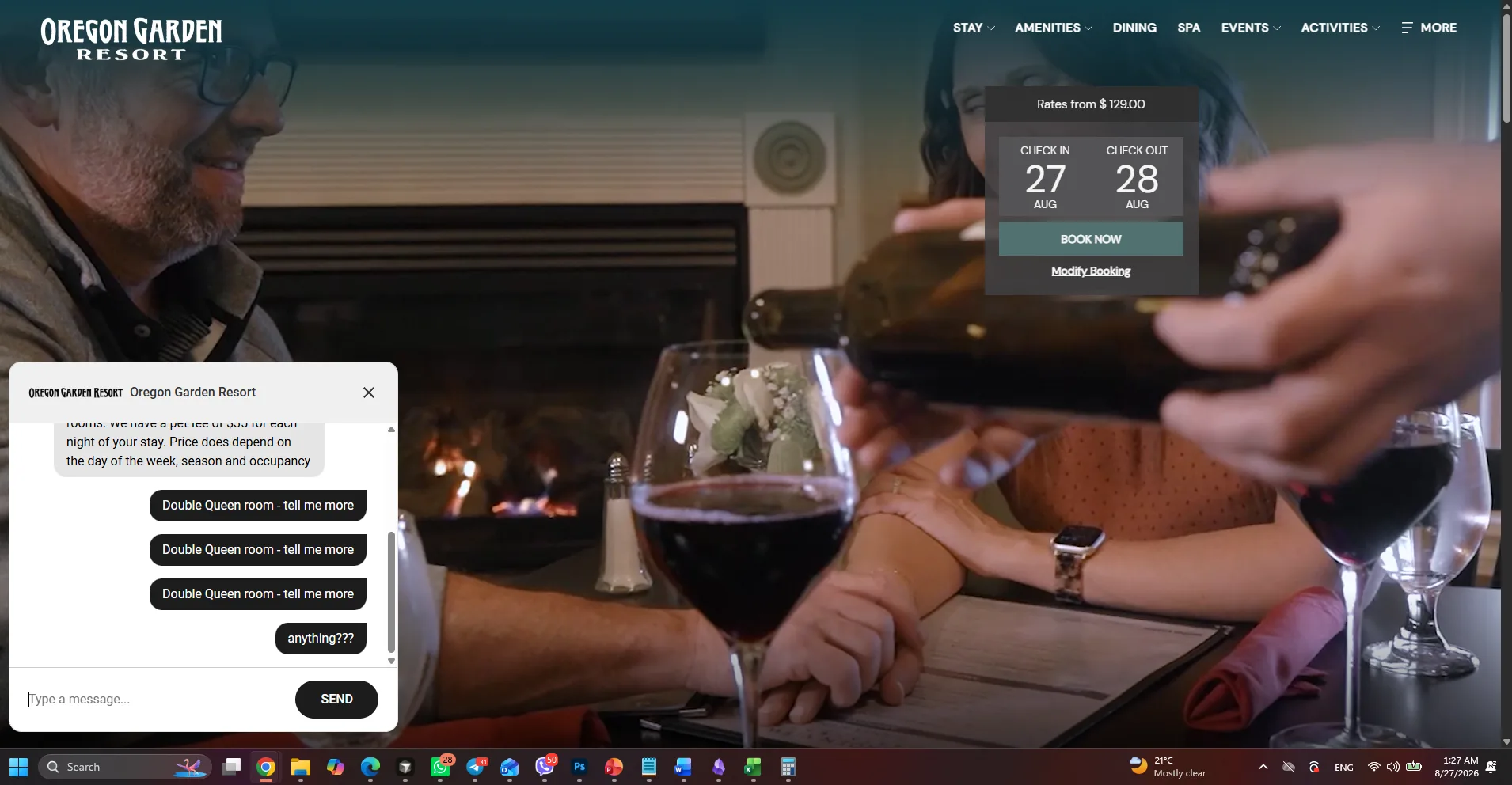
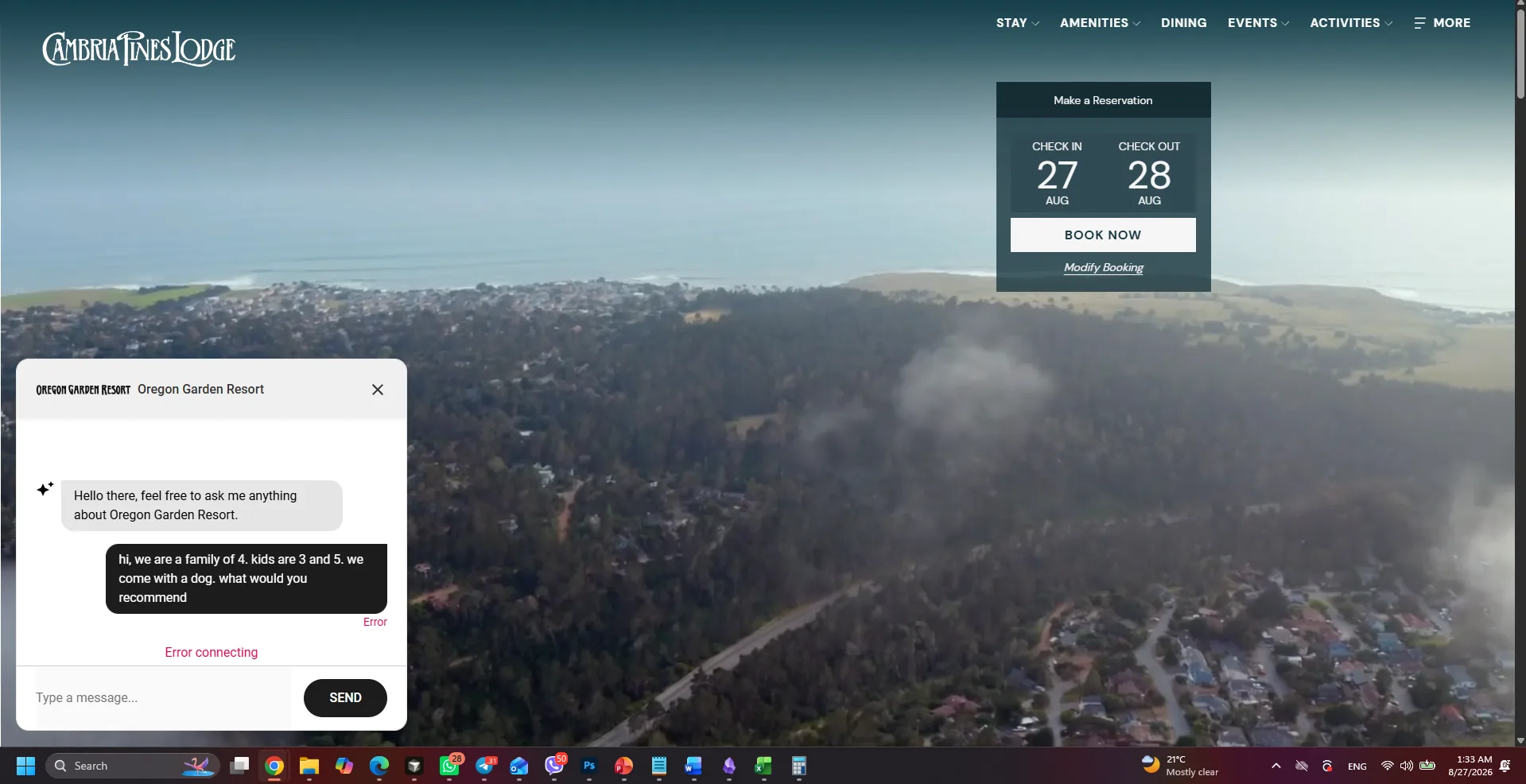
Cambria did not merely fail. It loaded another hotel.
On Cambria Pines Lodge, the widget was branded Oregon Garden Resort and greeted the guest as Oregon Garden Resort before returning a connection error. Both properties belong to the same hotel group, which may explain the configuration path. It does not excuse the production result.
This is a serious quality-control failure: the guest is asking one hotel while the AI identifies itself as another.
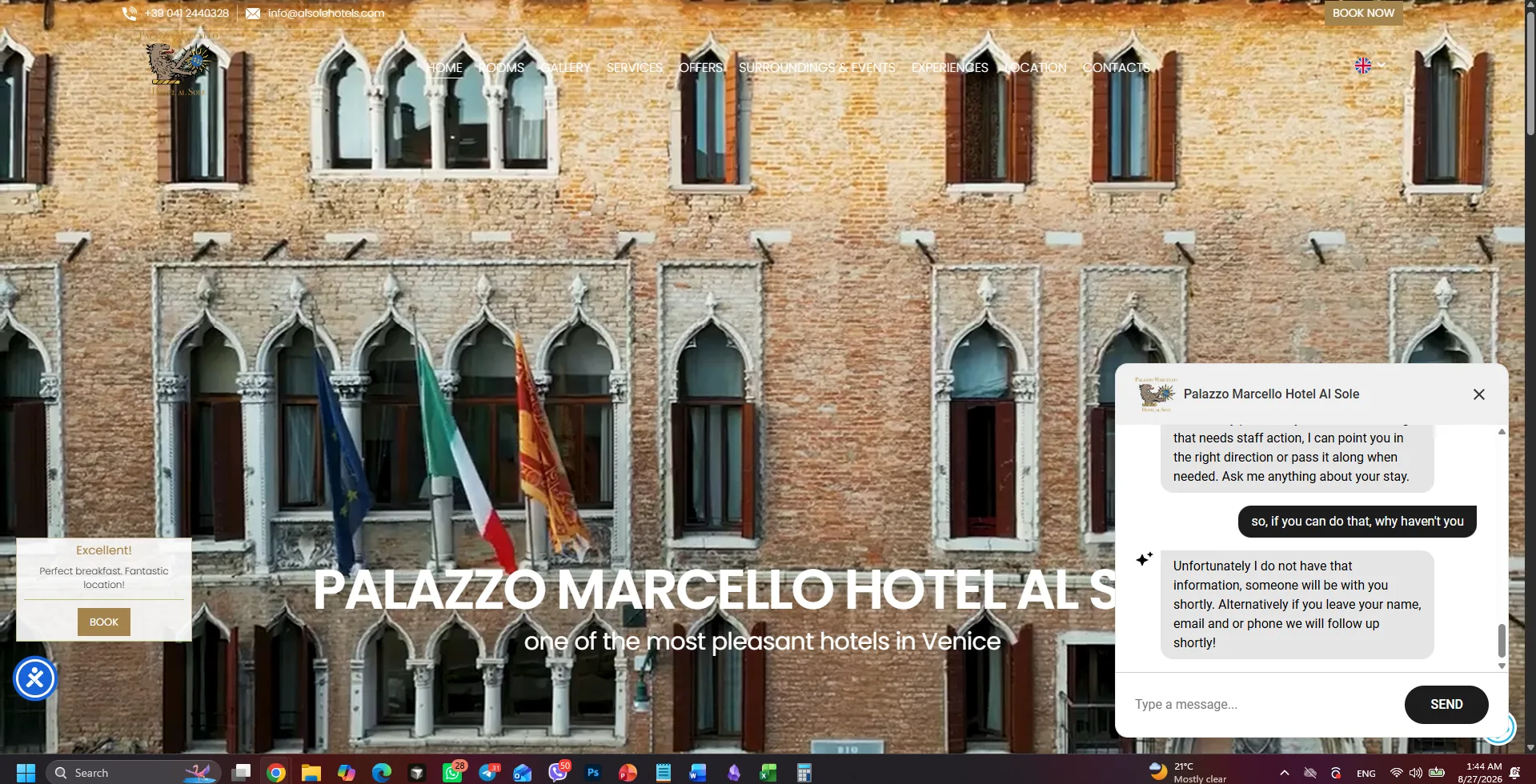
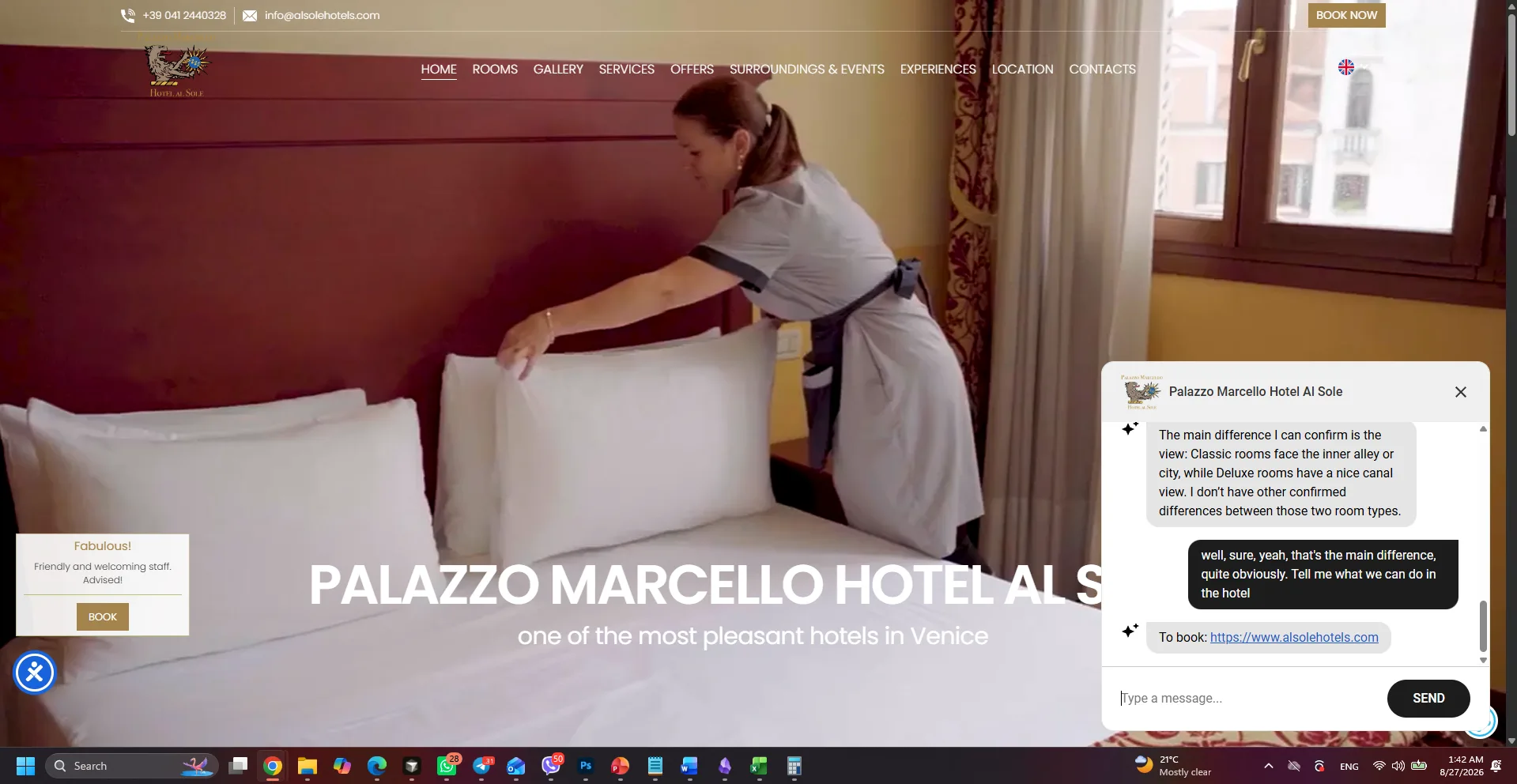
Palazzo Marcello is the best Canary example we found. It is still a dressed-up FAQ.
It responded, remembered the dog and named room categories. Yet it recommended Superior, Deluxe or Suite without confirmed capacity or size. When pressed to compare Classic and Deluxe, the only confirmed difference was the view. The booking action was a generic `/camere` link.
The bot claimed it could direct or pass a staff-dependent request, then said it did not have the information to do so and offered an unspecified future callback.
Easy Q&A editing solves the wrong setup problem.
Canary’s von Trapp case study celebrates updating a knowledge-base fact in two seconds. That is useful after the knowledge has been built. It does not create the missing room comparisons, suitability logic, selling points, escalation routes or cross-sell strategy.
If the hotel must know every question to enter, every distinction to encode and every operational gap to resolve, the supposedly easy setup transfers the hardest work back to already-busy hotel staff.
A benchmark that should worry Canary
Even the partially functioning Akia implementations we previously tested offered more operational structure than these Canary website journeys. That is not praise for Akia. It shows how low the tested Canary website-sales baseline was.
What MAIIA does differently
The hotel should not have to write an AI one question at a time.
Manual Q&A configuration
Hotel staff anticipate questions, enter facts, notice missing comparisons after launch, add links, test edge cases and keep correcting the knowledge base. The bot can only sell distinctions someone already thought to encode.
MAIIA automated commercial setup
MAIIA ingests public and private sources, structures rooms and services, detects contradictions and missing facts, builds the relevant sales method and validates the result before launch — typically in 3–7 days.
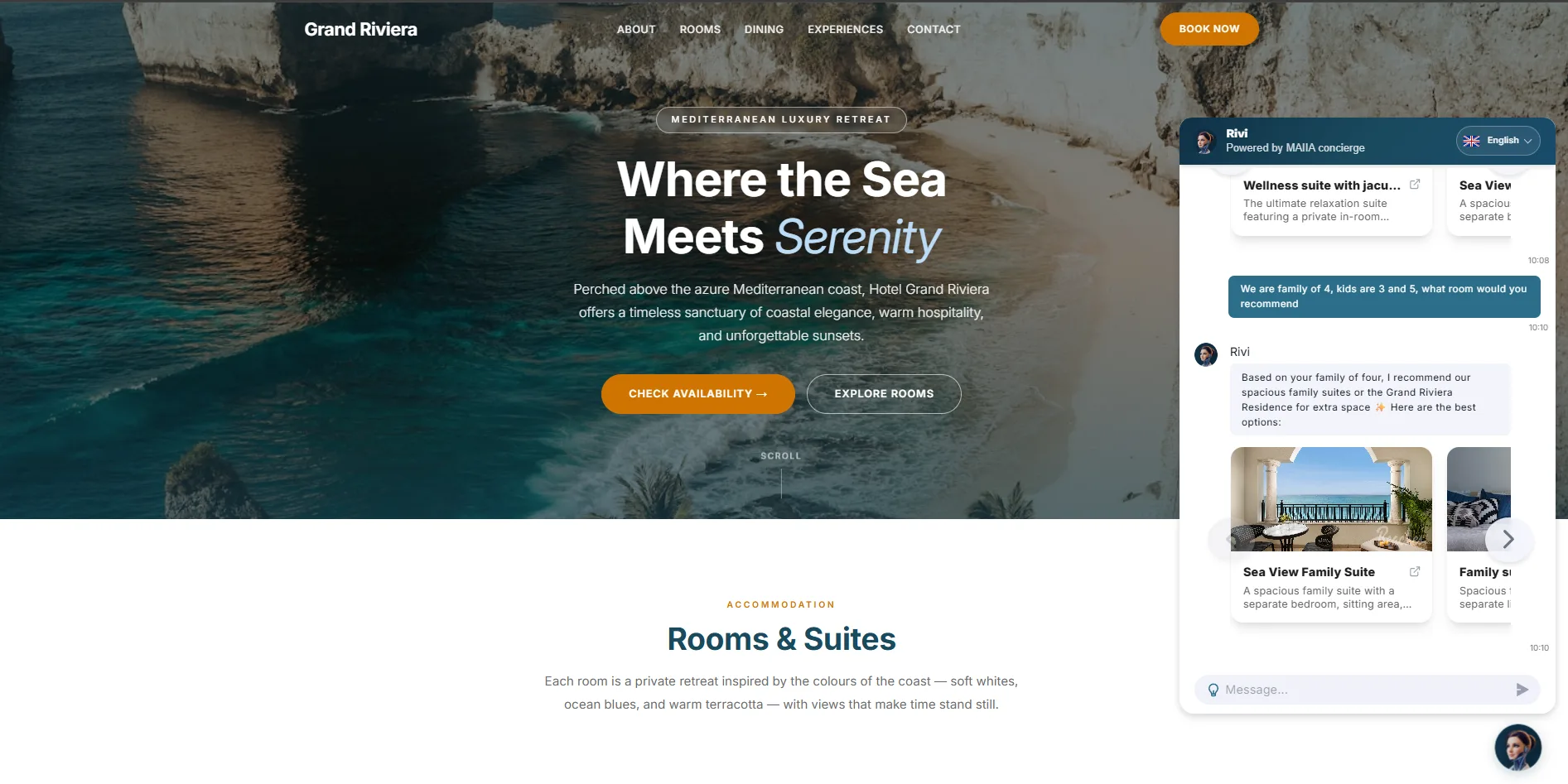
Recommendation must end in a product, not another page to investigate.
MAIIA turns the known family context into specific room recommendations. Each card presents the option visually and links to the correct booking destination. The booking engine remains authoritative for availability, rates, policies and payment.
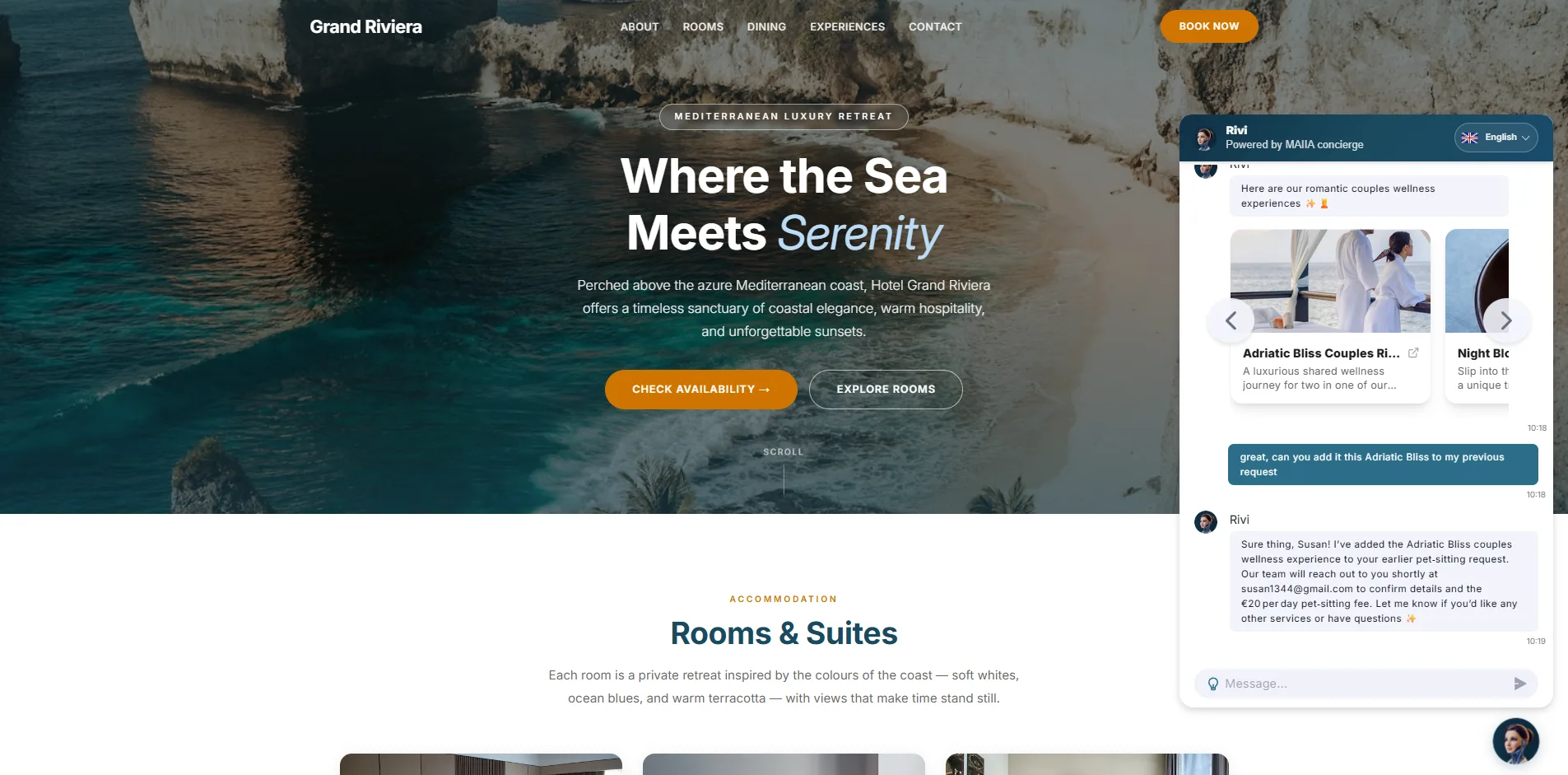
Escalation is a routing decision, not “leave your email.”
MAIIA performs sentiment and situational analysis, captures the contact once, creates a structured conversation summary, translates it into the staff language and sends it to the employee responsible for that exact request.
The employee does not need to read an entire foreign-language transcript or work out why the guest needs help.
Anti-hallucination before launch
Knowledge gaps, contradictions and critical unknowns are identified during setup. “I do not know” is a necessary fallback; discovering why the agent would have to say it before guests arrive is the product.
Sales strategy, not answer retrieval
MAIIA models the hotel’s real differentiators and determines what to recommend next. The goal is not to reproduce the FAQ but to construct a credible buying decision.
Pricing context
Canary hides the number. MAIIA publishes the buying logic.
Canary Technologies
Custom quoteAI Webchat is listed in the Pro bundle alongside other Canary products. No standard monthly price is publicly displayed.
Hotels should request the Webchat-only economics, onboarding work, integration scope and dependency on the wider bundle.MAIIA Website Sales Agent
€100–€150/month€100 for small properties; €150 up to 150 rooms; then +€1 per additional room.
Includes automated setup, unlimited structured knowledge, sales strategy, cards, anti-hallucination controls and qualified escalation.Canary’s broader bundle may deliver value for hotels purchasing digital check-in, guest messaging, tipping, upsells and other operational modules. Those modules do not demonstrate the quality of AI Webchat as a website sales product.
Commercial result
€160,000+
in additional requests and leads in six months
Generated by MAIIA WSA for a 170-room hotel. This excludes guests sent directly into the booking engine and represents additional requests/leads, not audited booked revenue.
The metric captures the missing layer in the Canary tests: discovery, cross-sell, complex intent and qualified human action — commercial demand that does not fit inside a static room-booking form.
Final decision
Canary calls it AI Webchat. The tested guest experience was website search with a typing delay.
The strongest charitable conclusion is that Canary can reduce repetitive questions when a hotel has configured the correct answers. But that is not the product Canary markets when it promises instant answers, direct-booking growth, personalization, lead capture and staff routing.
Across the tested deployments, we found no complete website sales journey. We found plain text, generic links, incomplete comparisons, passive callback collection, unanswered messages, a wrong-property bot and a connection error.
MAIIA is not a richer version of that Q&A widget. It is a different system: automated commercial knowledge → sales strategy → contextual recommendation → visual product → correct booking or staff action.
FAQ
Questions hotel buyers should ask
Does Canary AI Webchat work at all?
Yes, in the limited sense that some deployments answered property questions. Palazzo Marcello and von Trapp retrieved relevant facts. The issue is whether that capability constitutes a sales agent. In the tested journeys it did not produce a complete, qualified path to purchase or staff resolution.
Does Canary integrate with booking engines?
Canary publicly states that hotel chatbots should connect to CRS and booking engines. We did not observe live availability, price or a qualified room-booking result in the tested deployments. We observed generic website links.
Can Canary capture leads?
Its public Pro bundle includes CRM contact capture. Palazzo offered to collect name, email or phone for later follow-up, but did not demonstrate qualified lead routing with request summary and responsible department.
Why exclude SMS and guest messaging?
Because this is a WSA comparison. SMS, WhatsApp, digital check-in and in-stay guest messaging may be useful products, but they do not improve the recommendation and buying journey inside the hotel website widget.
Is easy manual knowledge editing a benefit?
Yes, for routine updates. It does not remove the need to discover missing data, build product comparisons, encode constraints, define escalation ownership and develop a sales strategy. MAIIA automates and validates that larger setup task.
Methodology & sources
How this comparison was built
We tested guest-visible Canary AI Webchat deployments at von Trapp Family Lodge & Resort, Oregon Garden Resort, Cambria Pines Lodge and Palazzo Marcello Hotel Al Sole in August 2026. The same family-and-pet scenario was used to examine recommendation, context, room selection, booking, response time, lead capture and escalation. Screenshots document the observed output.
Aura Hotel Times Square: a Canary-hosted endpoint with an Aura slug could be opened directly, but no Canary widget was installed on Aura’s official website at the time of verification. It is therefore excluded from the live implementation count and treated only as a stale or unembedded endpoint.
Limitations: hotel configurations vary. We do not claim access to Canary’s private code, contracts, dashboards or integration settings. A failed deployment may reflect hotel, group, website-vendor or Canary configuration. The guest-visible result remains the result a hotel visitor receives.
Official product sources: Canary AI Webchat; Canary pricing and bundle features; von Trapp case study; Canary chatbot procurement guide; MAIIA; MAIIA Website Sales Agent.
MAIIA pricing, setup time and commercial figures are first-party data and should be independently validated during procurement. No tested hotel or competitor was contacted for this article.