
Hotel AI comparison · live website test · August 2026
MAIIA vs Chatlyn: a chatbot that invents a pool is not a concierge. It is a liability.
Chatlyn says hotels can upload FAQs, website pages and guest directories and start answering within minutes. We tested a real deployment at IMLAUER Hotel Pitter. The bot assembled unsupported room products, moved the guest into an unqualified booking form, entered a pool-and-wellness path without a confirmed pool, generated hotel tour claims from generic destination language and offered escalation it could not complete.
IMLAUER Hotel Pitter on the hotel’s official website — not a vendor demo endpoint.
Two adults, children aged three and five, one dog, asking for a suitable stay.
Unsupported inventory, amenity confusion, improvised tours and contradictory handover.
The short answer
This is the architecture MAIIA spent three years refusing to ship.
In early 2023, a hospitality chatbot could reasonably be a language model placed over scraped hotel pages and a manually prepared FAQ. In 2026, presenting that pattern as an AI concierge or direct-booking agent is not innovation. It is an old prototype with a newer model behind it.
We do not have access to Chatlyn’s private code. But the guest-visible behavior is consistent with a thin retrieval-and-generation layer without a governed commercial product model: retrieve nearby text, let the model assemble an answer, and hope it remains inside the hotel’s reality.
Scope of this review
Once the source material became incomplete, Chatlyn did not consistently stop. It assembled accommodation, entered an amenity path unsupported by the source, turned the guest’s own tour examples into apparent hotel offers and promised a handover it then said it could not perform.
A hallucinated pool is not a harmless chatbot mistake.
A family may choose a hotel because its children can use a pool. If the family arrives and it does not exist, the hotel faces a complaint, refund or compensation request, a negative review and a front-desk conflict created entirely by the AI. The guest does not care that “the chatbot said it.” The chatbot carried the hotel’s name, logo and authority.
Complete comparison
Chatlyn website chatbot vs MAIIA Website Sales Agent
A checkmark means the capability exists. Where Chatlyn is partial, the table states exactly what appeared and where it stopped. Category winner is marked with .
| Website-sales criterion | Chatlyn at IMLAUER Hotel Pitter | MAIIA Website Sales Agent |
|---|---|---|
| Natural-language Q&A | Confirmed Answers free-text questions and can switch response language. | Confirmed Answers while preserving commercial context across products and requests. |
| Family and pet context | Partial — remembered, not enforced Repeated two adults, children aged three and five and one dog, but did not validate the recommendation against bookable inventory. | Confirmed Party composition, age and pet rules act as hard constraints. |
| Room recommendation | Observed — unsupported assembly Recommended a “family room or panorama suite” and said some family rooms have two bedrooms without presenting a verified product. | Confirmed Recommends specific structured products and explains why each fits. |
| Booking validation | Partial — form handoff Opened the booking engine. Its result showed double rooms with maximum occupancy two, not the promised family-room product. | Qualified handoff WSA qualifies fit; the booking engine remains authoritative for inventory, rates and payment. |
| Visual product cards | Not observed in chat No room, tour, activity, restaurant or wellness cards appeared. | Confirmed Rooms and services are shown as translated visual cards with relevant actions. |
| Structured hotel knowledge | Partial — retrieved fragments Described “entries” and “materials” it found, but could not assemble a reliable catalogue of facilities or children’s activities. | Confirmed Sources become structured entities, attributes, rules and relationships. |
| Knowledge-gap control | Observed — gaps reached guests Admitted specific facilities and activities were not listed only after entering recommendation paths. | Before go-live Critical gaps and contradictions are identified and constrained before launch. |
| Anti-hallucination | Observed — materially unsafe The sequence entered “pool & wellness” despite no confirmed pool and converted generic tour language into hotel-arranged offers. | Governed Critical claims require verified data; missing attributes cannot become amenities or offers. |
| Suitability | Partial — generic advice Remembered child ages and dog but returned checklists instead of verified suitable experiences. | Confirmed Age, diet, allergies, pet restrictions and operational conditions shape recommendations. |
| Tour discovery | Observed — generic generation Named Sound of Music, city and Hallstatt tours after admitting it lacked a detailed list; no verified provider or booking action appeared. | Confirmed Verified experiences include imagery, suitability, provider and correct action. |
| Lead capture | Partial — not completed Requested contact preferences and another confirmation; no completed qualified lead was demonstrated. | Confirmed Captures contact once and attaches it to the complete translated request. |
| Human escalation | Observed — contradictory Offered to ask the hotel, then said “I can’t contact the hotel directly,” then offered handover with further steps. | Routed Situational analysis routes summary, contact and reason to the correct employee. |
| Sales strategy | Not observed The flow searched isolated FAQ fragments; it did not build a credible sales or cross-sell path. | Hotel-specific Strategy adapts to hotel type, differentiators, priorities and constraints. |
| Setup burden | Fast upload, hotel-owned intelligence work Uploading PDFs, FAQs and URLs does not discover gaps, structure products or create safe selling logic. | 3–7 days MAIIA ingests sources, structures products, identifies gaps, builds strategy and validates. |
| A2A discoverability | No public equivalent found | Confirmed External AI agents can discover and call declared hotel-commercial capabilities. |
| Price | Custom quote No standard public monthly price was found. | Transparent €100 small properties; €150 up to 150 rooms; then +€1 per additional room. |
The missing half of the comparison
The same hotel-sales problem, solved in two different ways
The Chatlyn screenshots below this section document what went wrong. These MAIIA screenshots show the corresponding production method: preserve the guest’s constraints, merchandise verified products visually, send booking to the authoritative system and turn service intent into a routed request without resetting the conversation.
One continuous scenario
Two adults, children aged three and five, and one dog. The guest asks for a suitable room, confirms the pet policy, explores activities, needs pet sitting, provides contact details, continues to destination and wellness discovery, and adds a treatment to the existing request.
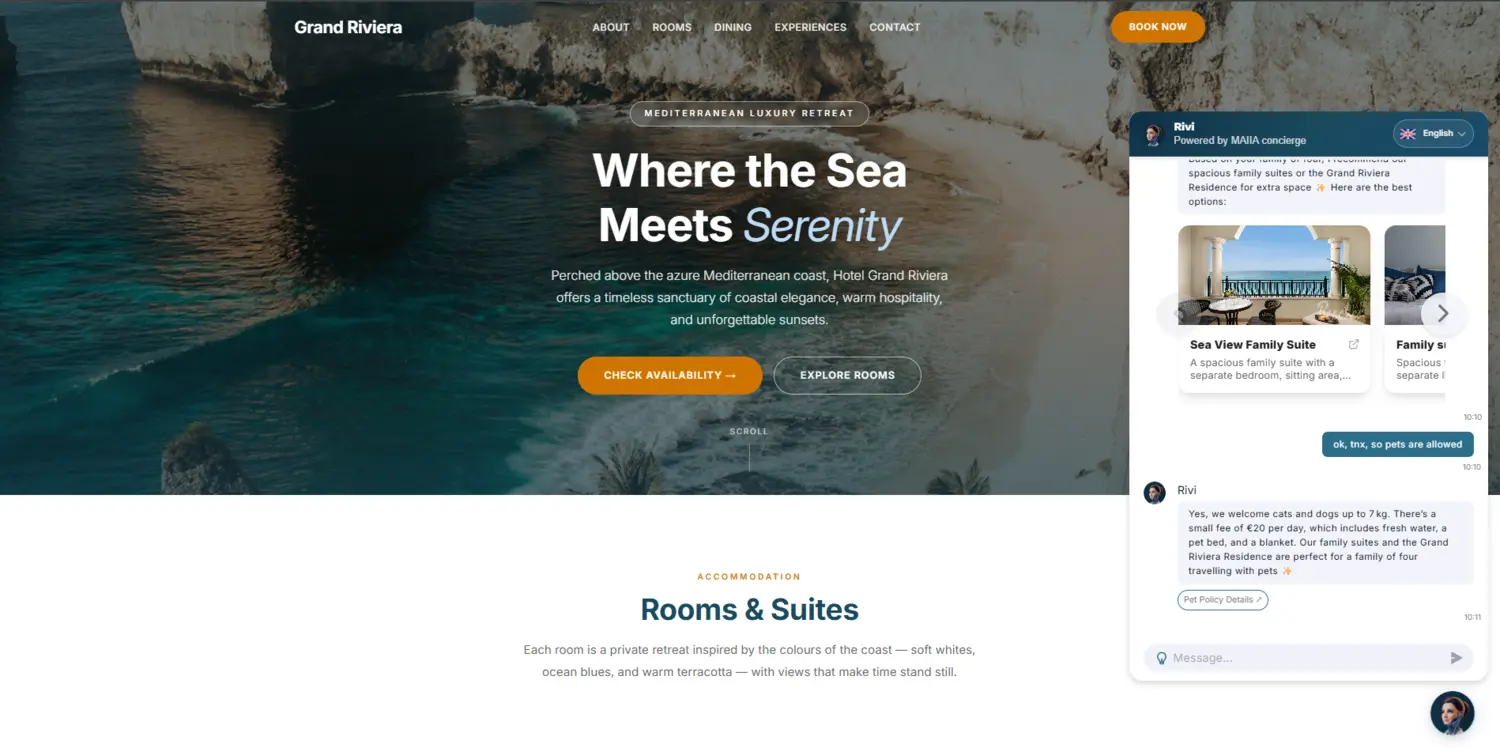
Not “a family room.” The actual family products.
Chatlyn recommended a “family room or panorama suite” without showing a verified product, then handed the guest to inventory that did not validate the promise.
MAIIA keeps the family composition in context and presents the specific Sea View Family Suite and relevant alternatives as visual cards.
- Named, structured products
- Images and sales descriptions
- Recommendation tied to the family’s real constraints
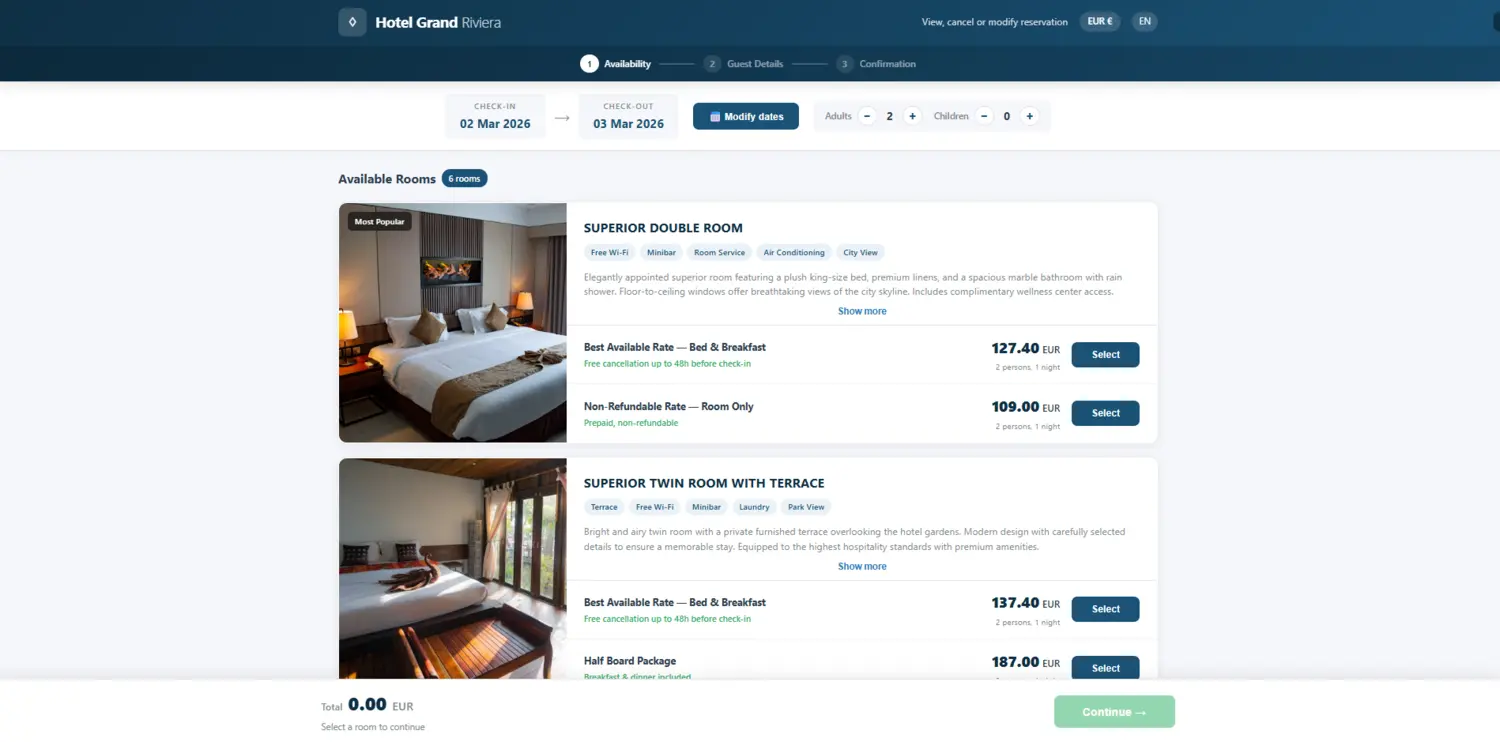
The AI recommends. The booking engine validates and transacts.
MAIIA does not improvise availability or squeeze a booking form into the conversation. The selected card leads to the authoritative booking system, where the guest sees actual dates, rates and available inventory.
This separation prevents a fluent answer from becoming a false commercial promise.
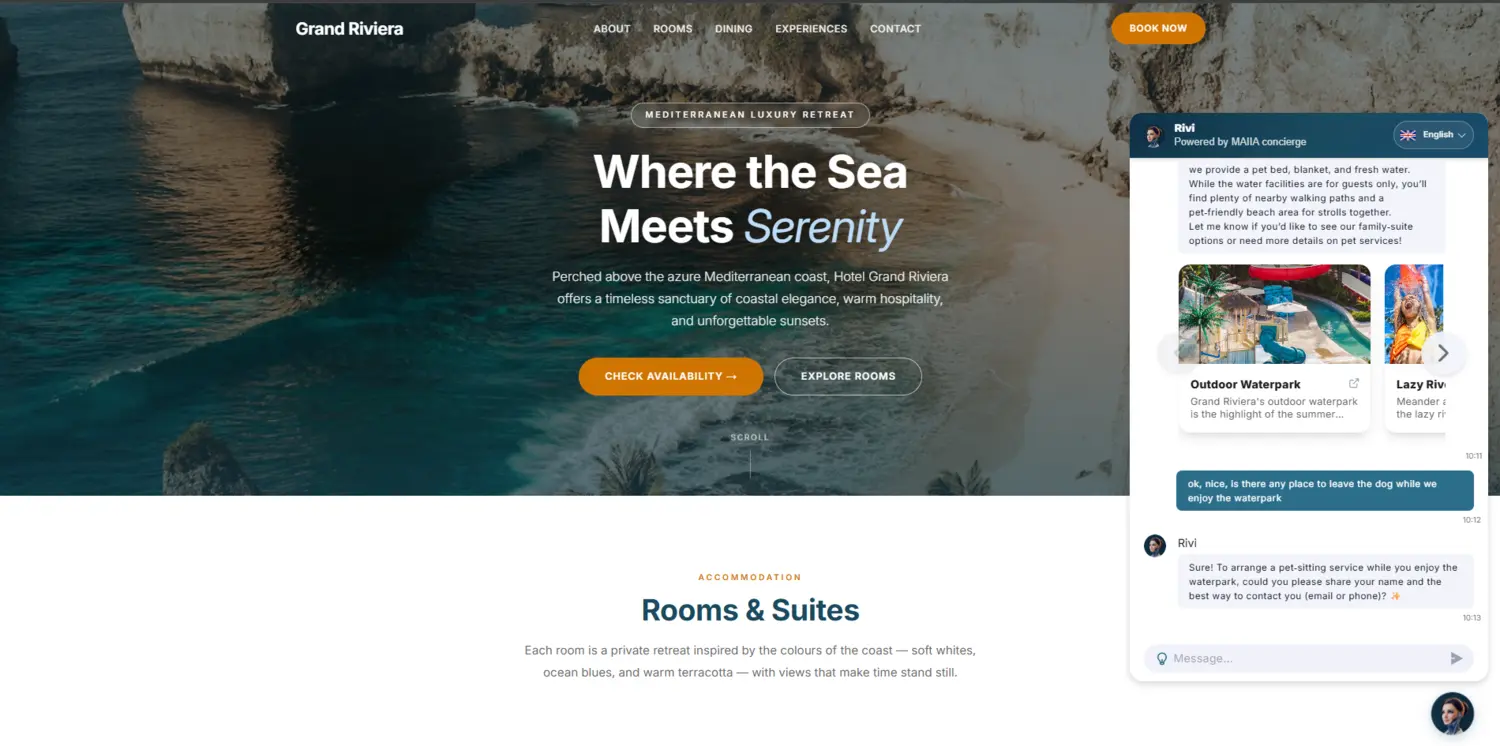
Pet policy is not decorative FAQ text.
MAIIA states the weight limit, daily fee and included pet provisions, connects those rules to the appropriate family products and distinguishes guest-only water facilities from places the dog can join the family.
A restriction changes the recommendation. It is not appended after the sale has already gone in the wrong direction.
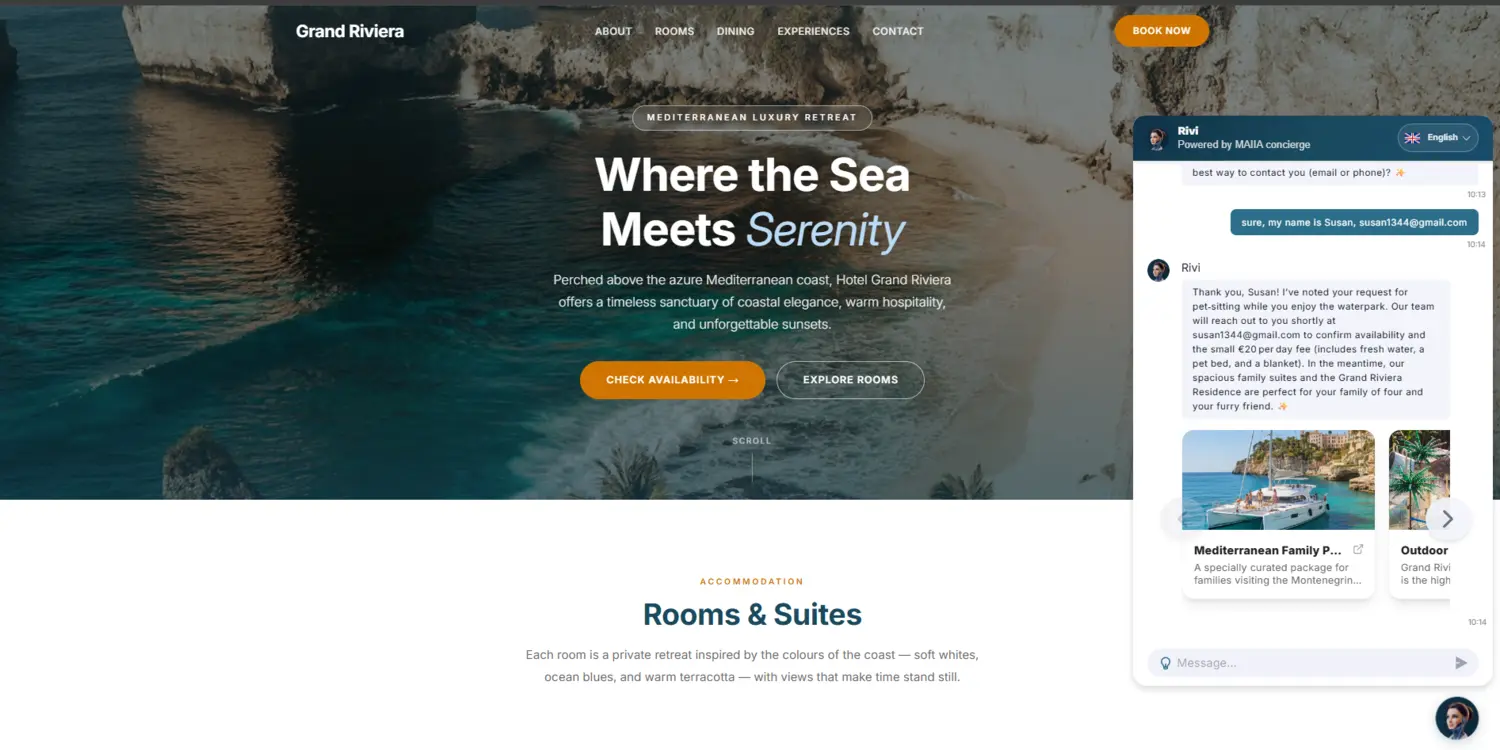
A service request becomes an operational event.
When the guest asks where to leave the dog during the waterpark visit, MAIIA identifies a pet-sitting need, collects contact once and confirms exactly what the team will follow up on.
The handoff contains the guest, contact, request, price context and relevant stay information. Staff do not have to reread the conversation or discover who owns it.
Nearby experiences are merchandised, not improvised.
Chatlyn named tours after admitting it lacked a detailed list. MAIIA shows verified nearby activities as cards with imagery, a concrete description and the correct external destination where appropriate.
The guest can compare options instead of receiving a plausible paragraph with no product, provider or action behind it.
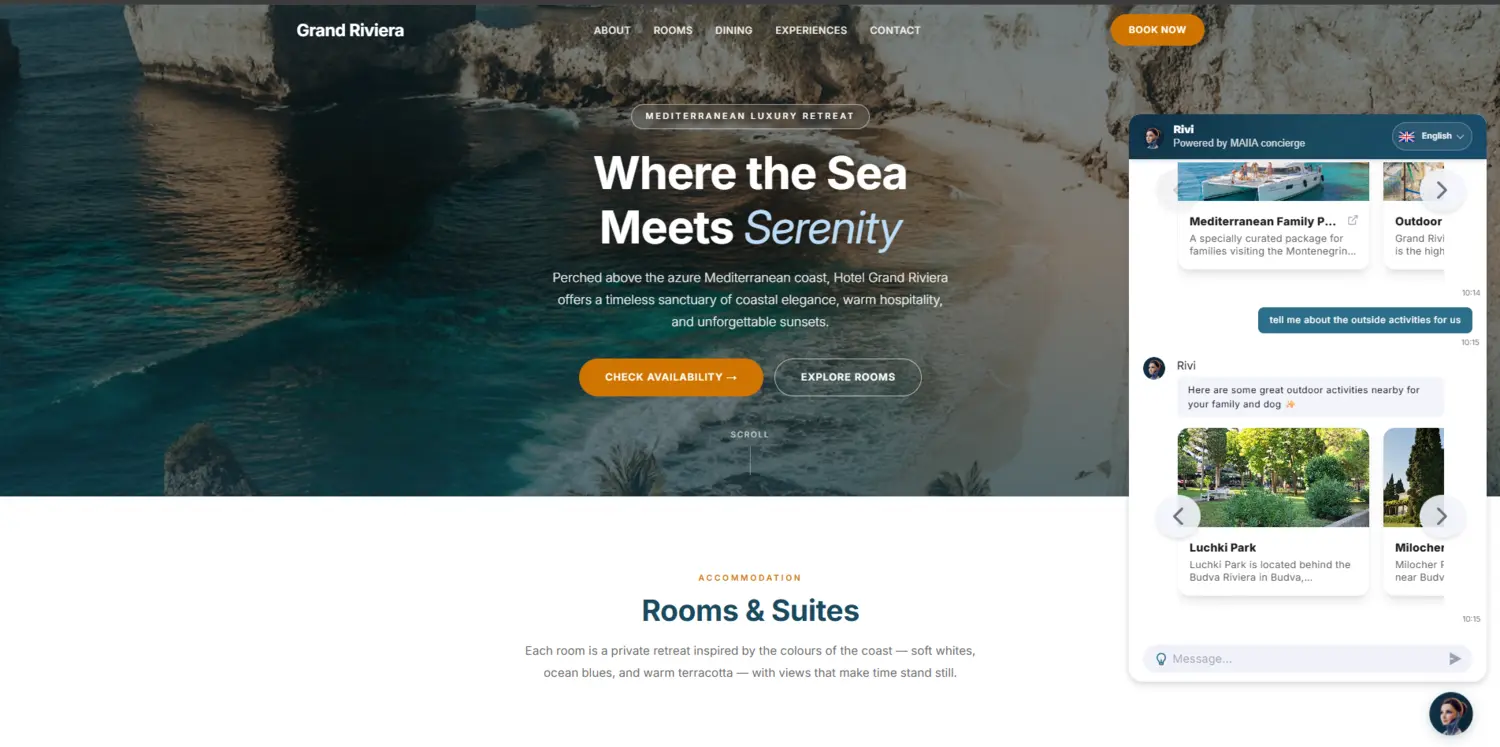
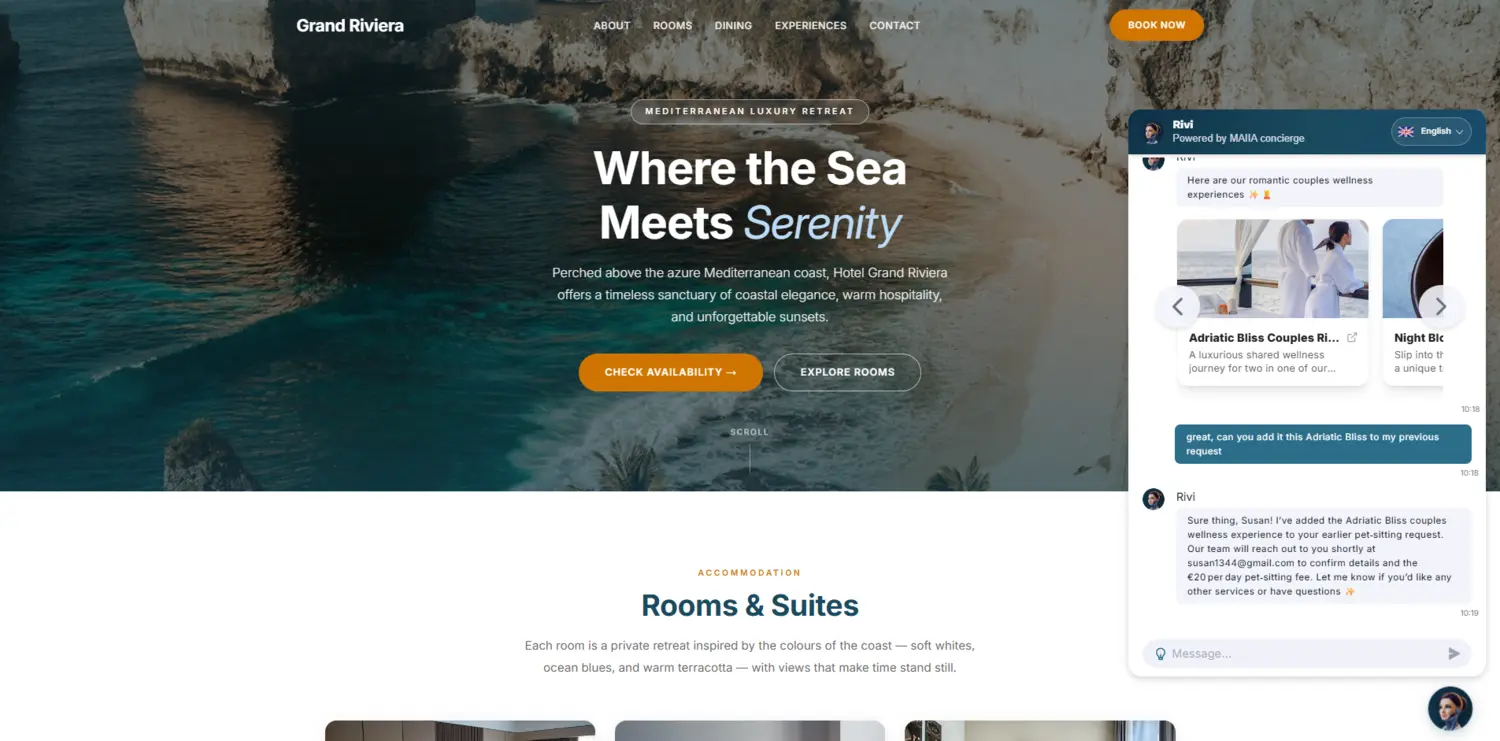
The conversation does not reset after every topic.
After rooms, pet policy, activities and pet sitting, the guest moves to wellness and asks to add a couples ritual to the previous request. MAIIA does exactly that.
The staff follow-up now contains both services, the known contact and the earlier context. This is the difference between answering isolated questions and constructing a buying decision.
Verdict
The visual contrast changes the conclusion. Chatlyn’s problem is not merely that several answers were wrong. Its chat is organized around generating responses from content. MAIIA is organized around verified products, suitability rules, commercial actions and operational outcomes.
Live evidence
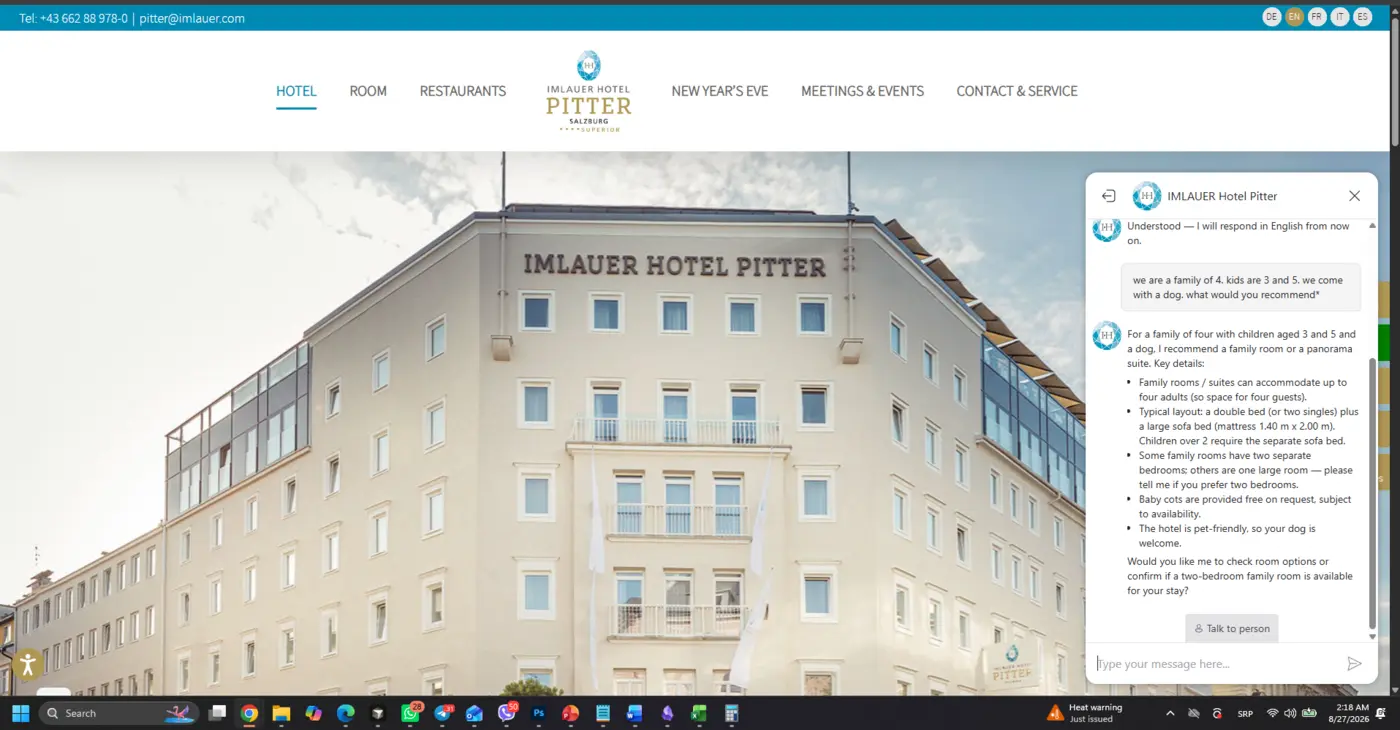
The failure did not begin with the pool. It began with the first recommendation.
Chatlyn recommended a room product it never actually showed.
For the family and dog, the bot recommended a family room or panorama suite. It added precise-sounding details: capacity for four adults, a 1.40 × 2.00 m sofa bed and, in some family rooms, two separate bedrooms.
No product card, identifier or validated inventory result accompanied it. Precision of language substituted for proof.
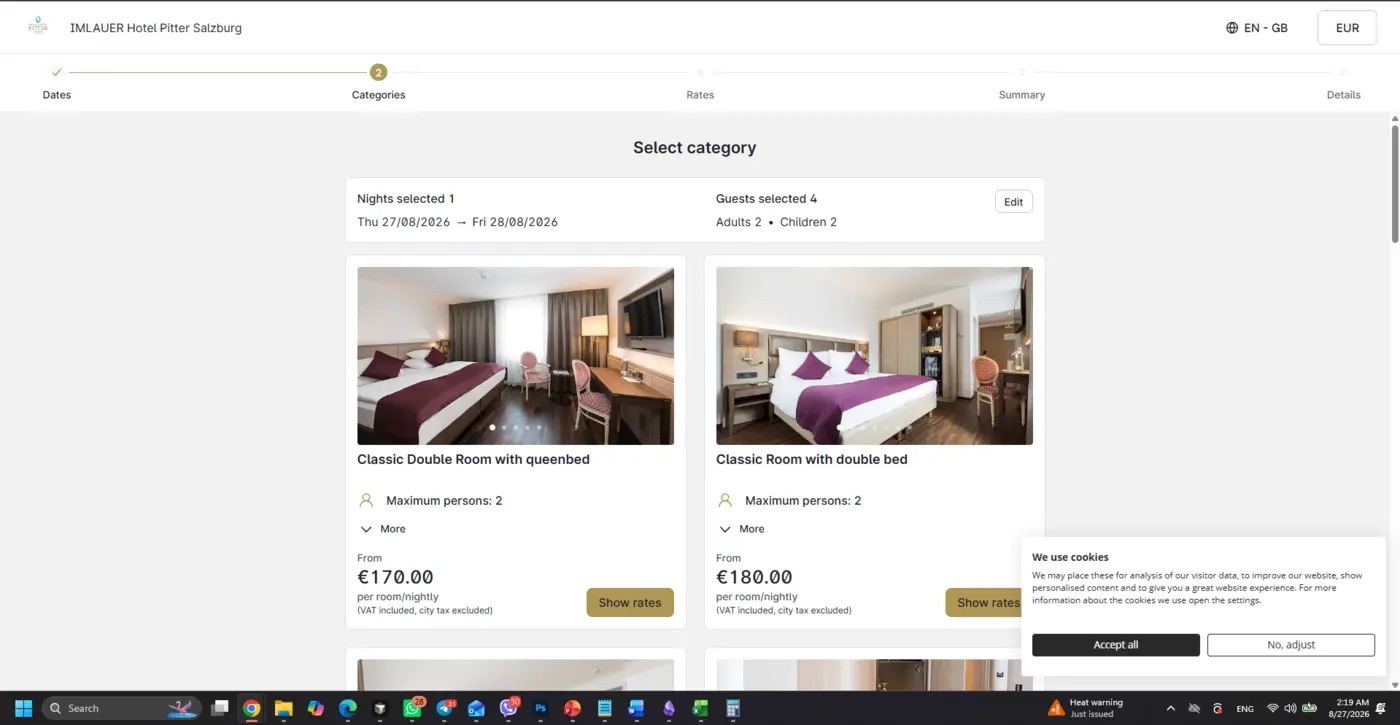
The booking engine exposed generated plausibility.
Chatlyn said it would check availability, but only collected dates and occupancy and sent the guest to Mews. The authoritative system showed different product reality.
This is not validated room recommendation. It is a conversational preface to a booking form, with an unsupported promise attached.
Missing knowledge became buttons that looked like capabilities.
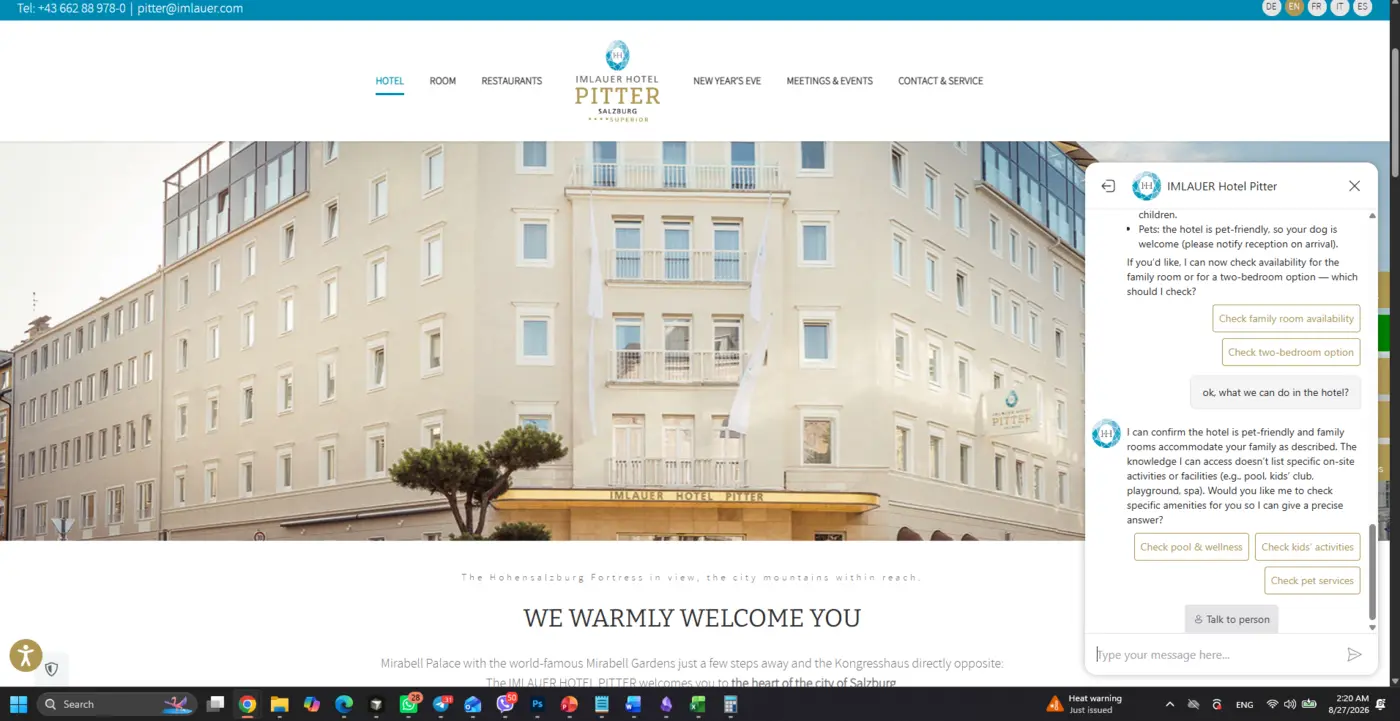
Asked what the family could do, Chatlyn admitted its knowledge did not list specific on-site activities or facilities. It then offered “Check pool & wellness,” “Check kids’ activities” and “Check pet services.”
The buttons did not open structured products. They merely asked the same incomplete knowledge another question.
A pool cannot be discovered by linguistic probability.
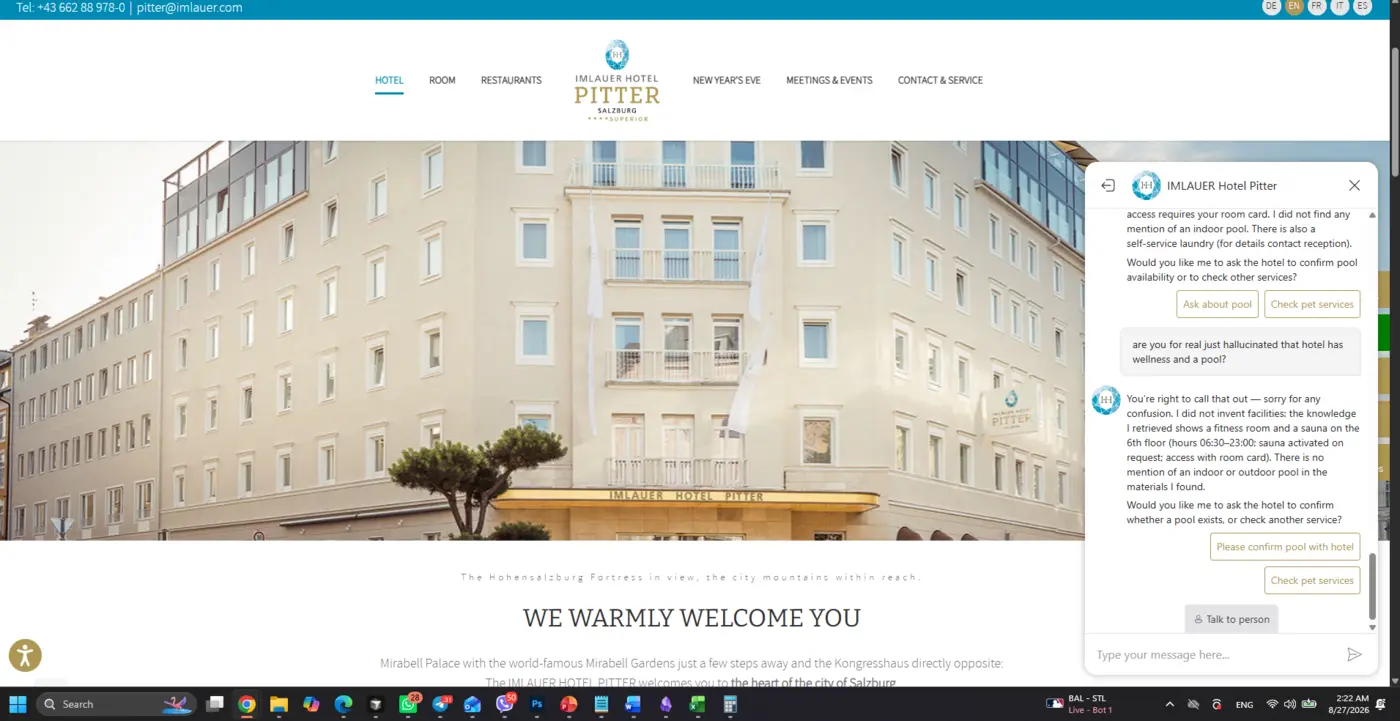
The conversation entered a pool-and-wellness path although the source supported a fitness room and sauna, not a confirmed pool. When challenged, the bot apologised for the confusion and conceded that no pool appeared in the material.
That correction comes too late. An unsupported amenity must never enter the guest’s buying model.
Imagine the operational result.
A guest books expecting a pool, packs for it, tells the children and arrives to discover it does not exist. The front desk now owns the model’s invention: an angry family, compensation, a bad review and lost trust.
Anti-hallucination is not an accuracy feature. It is revenue, reputation and operations protection.
The guest suggested the tours. The bot converted them into hotel offers.
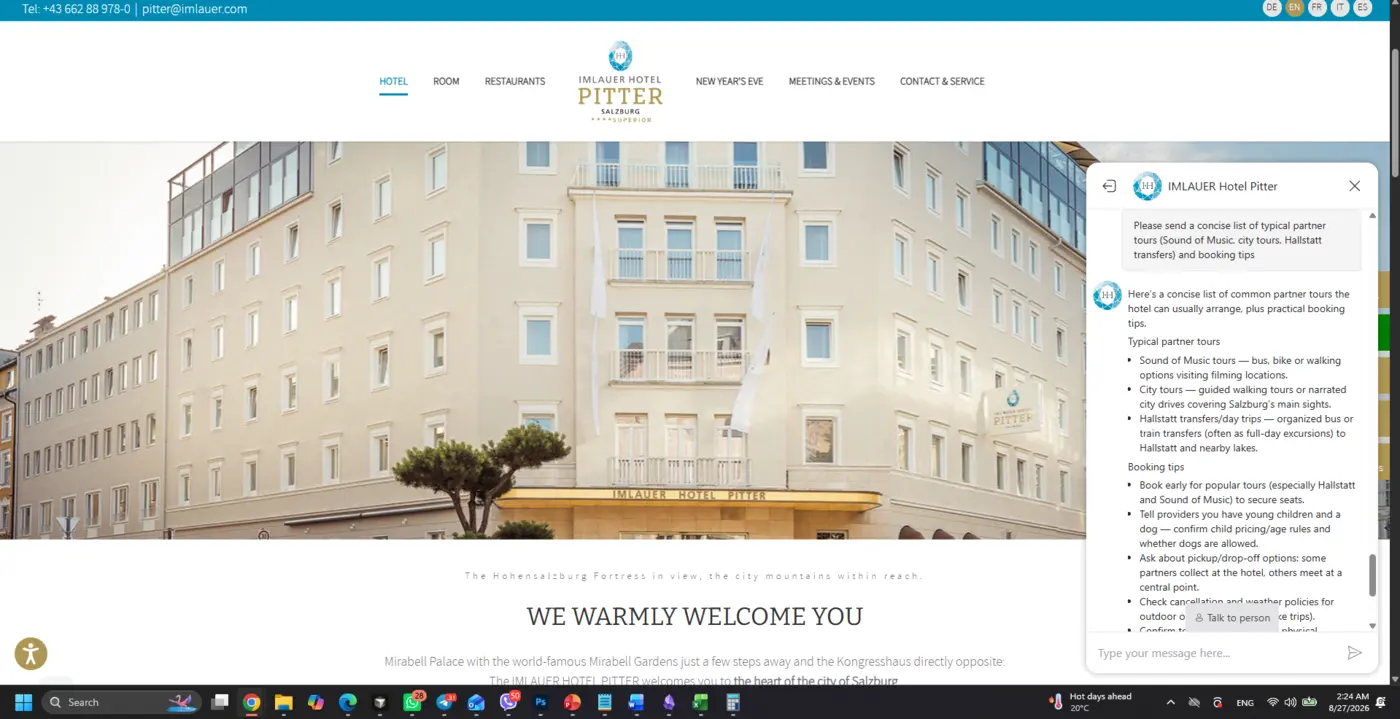
Chatlyn admitted it had no detailed attraction list. After the guest named Sound of Music, city tours and Hallstatt transfers, the bot returned them as “common partner tours the hotel can usually arrange.”
User-supplied possibilities became hotel-authorised claims without a verified provider, product or booking record.
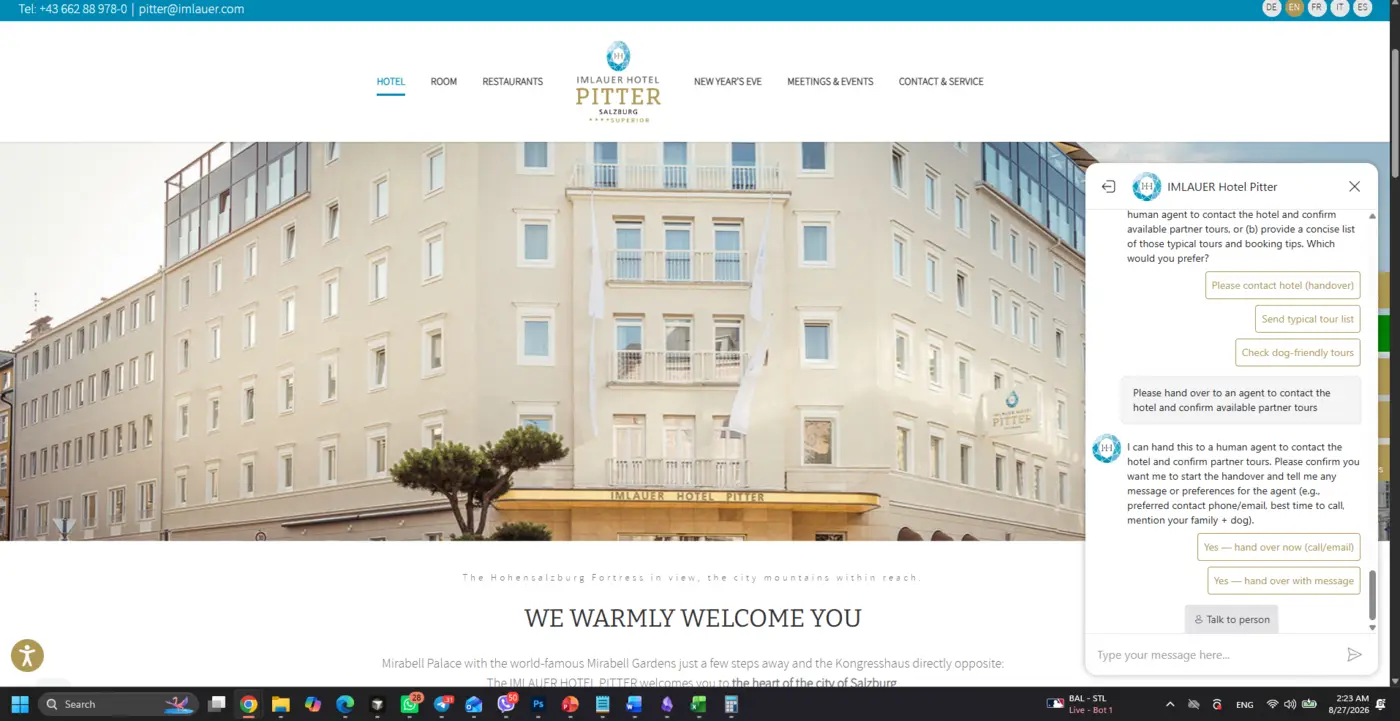
“I can’t contact the hotel directly” is not escalation.
A real escalation is an operational event: identify intent, collect contact once, summarise and translate the conversation, and route it to the responsible employee. Everything else is conversational theatre.
The central finding
Chatlyn did not fail because the model was unintelligent. It failed because language generation was allowed to operate where verified hotel structure, commercial rules and operational actions should have been authoritative.
Architecture, not prompting
Uploading content is not the same as building hotel intelligence.
Chatlyn’s proposition is attractive: upload directories, FAQs, spa menus, PDFs and website pages; the AI starts answering. The installation may be fast. The difficult work has simply been transferred to the hotel.
Source upload + model synthesis
The hotel must know what is absent, reconcile contradictions, define room capacity, encode child and pet constraints, decide what may be sold, build escalation ownership and test dangerous edge cases.
When it does not, the model bridges gaps with plausible language.
MAIIA governed commercial layer
MAIIA ingests website, Booking.com, reviews, PDFs and private material; structures rooms and services; identifies gaps and contradictions; applies suitability and sales rules; and tests before launch.
Anti-hallucination before guests
Critical claims are constrained by verified product data. Gaps surface during setup, not after a family plans around a non-existent amenity.
Sales strategy before generation
MAIIA models real differentiators, relevant cross-sell, hard restrictions and the correct action for each product.
Correct destination
Rooms go to the booking engine; tours to verified providers; wellness and restaurants to the correct hotel action.
Escalation as a business process
Situational analysis creates a translated summary and sends request and contact to the correct employee.
Verdict
This complexity is intentional. MAIIA’s 3–7 day setup exists because a production hotel agent should not launch when a PDF finishes uploading. We built the layer that stops a model from turning “sauna” into “pool,” generic city knowledge into a hotel service or a plausible room description into bookable inventory.
The 2026 standard
A better model does not repair missing product architecture.
The wrapper pattern
Retrieve text → generate answer → add buttons → correct knowledge after a guest finds the gap.
The governed-agent pattern
Ingest → structure → detect gaps → apply commercial rules → validate → generate inside verified boundaries.
The apparent shortcut
“Live in minutes” reduces vendor onboarding while turning hotel staff and guests into trainers and testers.
The actual cost
Wrong expectations, compensation, negative reviews, staff workload and destroyed trust.
Commercial evidence
€160,000+
in additional requests and leads in six months
Generated by MAIIA WSA for a 170-room hotel, excluding guests sent directly to the booking engine. A commercial intelligence layer produces qualified demand, not longer FAQ sessions.
Final verdict
Chatlyn puts a language model over hotel content. MAIIA builds the system that decides what the model is allowed to sell.
Chatlyn’s omnichannel inbox, WhatsApp automation and PMS-triggered journeys may be useful operational products. They do not repair the website architecture observed here.
The Pitter test produced fluent language and a functional interface. It also produced unsupported accommodation, unqualified booking handoff, a material amenity failure, generic tourism invention and contradictory escalation. Fluency made those failures more convincing.
We had this problem in 2023. In 2026, a hotel should not still discover every gap, write every Q&A, catch every hallucination and explain every false promise to an angry guest.
When the hotel is expected to train the AI, the guest ends up testing it.
FAQ
Questions hotel buyers should ask
Is Chatlyn simply a ChatGPT wrapper?
We cannot inspect its private code and do not make that literal code-level claim. The tested behavior is consistent with a thin retrieval-and-generation architecture: source fragments became fluent answers without a sufficiently governed commercial product layer.
Did Chatlyn really say the hotel had a pool?
The captured flow entered a “pool & wellness” path and led the guest to investigate a pool. When challenged, the bot apologised and explicitly said no indoor or outdoor pool appeared in its source material. The failure is that an unverified amenity entered the sales conversation at all.
Does it connect to a booking engine?
At Pitter, it displayed dates and occupancy and opened Mews. The problem was not the link. The recommendation was not validated against the products shown by the authoritative system.
Why is manual FAQ setup unsafe?
Staff cannot anticipate every formulation, product relationship, restriction and knowledge gap. A model can combine individually true fragments into a false commercial conclusion.
What makes MAIIA different?
MAIIA identifies gaps before launch, models critical claims as structured data, applies suitability and sales constraints, and keeps generation inside verified boundaries.
Methodology & sources
How this comparison was built
We tested the Chatlyn widget installed on the official IMLAUER Hotel Pitter website in August 2026 using two adults, children aged three and five and one dog. Screenshots reproduce the guest-visible sequence.
Endpoint correction: direct Chatlyn URLs branded for Hotel Sacher Wien, Hotel Enzian and The Base Berlin were found, but a vendor-hosted configuration URL is not proof of current installation on the corresponding official website. They are excluded from the live count.
Limits: this evaluates guest-visible behavior, not private code, contracts or dashboards. Incorrect output may reflect hotel-supplied content or configuration. That does not remove architectural responsibility: the advertised self-service method determines whether incomplete content becomes an unsafe answer.
Official sources: Chatlyn hotel chatbot; Chatlyn webchat widget; Chatlyn IMLAUER case study; MAIIA; MAIIA WSA.
MAIIA pricing, setup time and commercial figures are first-party data and should be independently validated during procurement. IMLAUER and Chatlyn were not contacted.