
Full hospitality platform comparison · 2026
MAIIA vs Canary Technologies: software suite vs commercial intelligence.
Canary digitizes a long list of hotel transactions and communication workflows. MAIIA builds one commercial intelligence layer and uses it across website sales, the guest journey, staff decisions and external AI agents. Both are “hospitality platforms.” They solve fundamentally different problems.
Mobile check-in, messaging, digital compendium, upsells, tipping, checkout, payments, AI channels and operational agent templates.
Website Sales Agent, Concierge Guest App, A2A interface, Business Assistant, automated commercial knowledge and unified analytics.
The decision in one paragraph
Canary is broader. MAIIA is deeper where guest decisions create revenue.
If a hotel wants mobile check-in, digital authorizations, payment links, tipping, mobile keys and standardized messaging in one vendor stack, Canary has the broader operational catalogue. MAIIA does not pretend to replace those systems.
If the hotel wants an AI layer that actually understands its products, differentiates them, sells them visually, remembers the guest, detects knowledge gaps, routes complex intent and exposes the same intelligence to ChatGPT, Gemini, Claude and other agents, the live evidence places MAIIA in a different category.
Scope of this review
Canary gives the hotel builders, forms, toggles, templates and editable knowledge. MAIIA delivers the finished commercial intelligence. Canary makes configuration easy; MAIIA removes most of the work that must be configured.
Platform map
What each suite actually contains
Canary Technologies
- Digital arrivals — Mobile check-in, tablet registration, kiosk and mobile key.
- Guest engagement — Guest messaging, Digital Compendium, Dynamic Upsells and F&B Mobile Ordering.
- Departures — Smart Checkout and Digital Tipping.
- Canary AI — AI Webchat, AI Guest Messaging, AI Voice and Agent Studio.
- Sales, payments and security — Sales Coordinator, contracts, deposits, payment links and digital authorizations.
MAIIA Hospitality
- Website Sales Agent — Contextual discovery, visual merchandising, cross-sell, lead qualification and booking-engine handoff.
- Concierge Guest App — Personalized in-stay discovery, services, restaurants, wellness, tours and contextual recommendations.
- A2A — Standards-based, machine-callable hotel commercial intelligence for external AI agents.
- Business Assistant — Unified query, click, funnel, lead and service intelligence for hotel staff.
- Commercial knowledge system — Automated ingestion, structured content, sales strategy, translation, knowledge-gap control and analytics shared across every agent.
Complete comparison
Suite vs suite — capability by capability
A checkmark means the capability is real. “Partial” explains the boundary. “Canary advantage” is used where Canary clearly provides an operational product that MAIIA does not claim to replace. Category winner is marked with .
| Capability | Canary Technologies | MAIIA Hospitality |
|---|---|---|
| Platform purpose | Confirmed Digitize guest operations and communications across arrival, stay and departure. | Confirmed Build and activate hotel commercial intelligence across human and machine channels. |
| Website sales | Partial — Q&A-led AI Webchat answers property questions and can return reservation links. Tested deployments did not complete a qualified sales journey. | Native WSA Intent → fit → visual product → relevant booking or staff action. |
| Website cards | Not observed Live tests returned text and generic links, not room, activity or offer cards. | Confirmed Rooms, facilities, wellness, tours, restaurants and destination experiences. |
| Booking workflow | Partial — link capability Pro package advertises custom reservation links; tested bots opened generic lodging or room-list pages. | Qualified handoff Recommends first, then opens the booking engine designed for inventory, rates and payment. |
| Mobile check-in | Canary advantage Dedicated contactless check-in, identity and registration workflows. | Not a MAIIA module MAIIA can link to the hotel’s check-in solution but does not replace it. |
| Tablet / kiosk registration | Canary advantage Dedicated front-desk and self-service products. | Not offered |
| Mobile key | Canary advantage Dedicated mobile-key product and integrations. | Not offered |
| Guest messaging channels | Canary advantage Unified inbox across SMS, WhatsApp, LINE, WeChat and other channels. | Focused escalation MAIIA routes qualified requests and summaries; it is not positioned as a mass-messaging inbox. |
| AI guest messaging | Confirmed product Automated responses, ticket creation and translation in higher bundles. | Within WSA/CGA Conversational intelligence is native to the sales and in-stay agents rather than sold as a separate inbox response layer. |
| In-stay guest interface | Digital Compendium A configurable mobile web hub: reservation, property information, messaging, tipping and linked modules. | Concierge Guest App A personalized discovery and service environment that adapts to the guest and the evolving trip context. |
| Digital hotel information | Confirmed Modern replacement for the paper room binder. | Confirmed Structured hotel and destination knowledge expressed through cards, search and conversation. |
| Digital menu / store | Confirmed Dream Inn live store provides image, name, description, price, quantity and checkout. | Service discovery and requests CGA focuses on relevant service, restaurant, wellness and tour discovery; exact transaction method follows hotel operations. |
| Personalized journey onboarding | No public evidence found No demonstrated onboarding for interests, trip purpose, dietary profile or desired experience. | Confirmed Language, name, interests, reason for travel, diet and allergies shape the guest experience. |
| Persistent trip context | PMS/CRM segmentation Canary markets personalized messaging and offers; no public evidence found of one evolving experiential memory across the Compendium. | Confirmed Questions, selections, completed experiences and requests remain part of the active journey context. |
| Avoid repeated recommendations | Not demonstrated | Confirmed MAIIA does not keep promoting an experience the guest already completed or rejected. |
| Complementary next experience | Not demonstrated | Confirmed Recommendations can build on what the guest has already enjoyed. |
| Dynamic upsells | Canary advantage in transaction automation Dedicated upsell catalogue, PMS/payment integrations and approval workflow. | Intelligence-led cross-sell WSA and CGA recommend the next relevant product from live conversational context. |
| F&B mobile ordering | Canary advantage Dedicated ordering module. | Requests/reservations CGA supports restaurant discovery and hotel-defined actions but is not presented as a universal POS replacement. |
| Smart checkout | Canary advantage Dedicated departure workflow. | Not offered |
| Digital tipping | Canary advantage Dedicated QR/in-app tipping product. | Not offered |
| Payments / authorizations | Canary advantage Payment links, digital authorizations, deposits and contracts. | Not a replacement MAIIA uses the hotel’s transactional systems. |
| Human escalation | Product claim; weak WSA evidence Canary supports ticketing and staff workflows, but Palazzo’s Webchat promised escalation and then could not execute it. | Qualified routing Contact + translated summary + sentiment/situation + correct employee. |
| Sales strategy | Hotel-configured agents and campaigns Templates and builder exist; live Webchat output showed isolated answers rather than hotel-specific commercial strategy. | Built during setup Strategy adapts to hotel type, positioning, constraints and differentiators. |
| Knowledge creation | Hotel-led configuration Canary emphasizes customizable builders, templates, toggles, edits and hotel-managed knowledge sources. | MAIIA-led automation Website, Booking.com, reviews and PDFs are ingested and transformed into structured commercial knowledge. |
| Knowledge-gap detection | No equivalent publicly demonstrated Easy editing helps after the hotel knows what is missing. | Pre-launch control Missing facts, contradictions and unsafe recommendation gaps are identified before go-live. |
| Anti-hallucination | Safe refusal observed Palazzo sometimes admitted missing information; the missing information remained visible in production. | System and process Grounding, structured content and knowledge-gap validation reduce both invention and commercially useless refusals. |
| Automated setup | Fast software activation Compendium installation is advertised as under 10 minutes; meaningful content, distinctions and workflows still belong to the hotel. | 3–7 days Activation includes ingestion, structuring, strategy, gap detection, validation and launch. |
| Staff setup burden | Potentially high The easier the builder, the easier it is to publish incomplete hotel thinking at scale. | Minimized Staff validate exceptions and missing facts rather than authoring the intelligence one Q&A at a time. |
| Group knowledge | Multi-property platform Central tools and integrations serve hotel groups. | 100+ hotels per group account Unlimited structured knowledge with property-level and group-level sales logic. |
| Analytics | Reporting Operational, messaging, upsell and guest-management reporting. | Unified commercial analytics Queries, language, clicks, funnel, requests, leads and A2A/WSA/CGA origin. |
| External AI access / A2A | No public equivalent found Integrations connect Canary to hotel systems, not external AI agents to hotel commercial intelligence. | Standards-based A2A Agent card, declared skills and authenticated machine calls. |
| Pricing transparency | Core / Advanced / Pro; custom quote No public monthly amount. | Public module logic WSA €100–€150 for typical properties; CGA €2.50–€5 per room; A2A currently has no separate charge. |
The hidden platform cost
Canary sells an easy builder. The hotel still has to know what it is building.
Canary’s configuration model
- Select templates and modules.
- Add property information and knowledge sources.
- Customize agents, tools, triggers and workflows.
- Build the Compendium and upsell catalogue.
- Define room differences, policies, escalation ownership and selling logic.
- Discover missing knowledge when guests expose it in production.
- Keep every component current.
MAIIA’s implementation model
- Ingest hotel website, booking pages, reviews and documents.
- Structure rooms, facilities, restaurants, treatments, tours and offers.
- Generate useful sales descriptions and comparisons.
- Apply hotel-type sales strategy.
- Identify contradictions and missing decision-critical facts.
- Ask staff only for exceptions and unresolved gaps.
- Validate and launch in 3–7 days.
The difference Canary’s “10-minute setup” does not measure
Installing a digital binder in ten minutes is possible. Creating the hotel knowledge, product distinctions, safety constraints, commercial priorities and escalation logic that make the binder intelligent is not. Canary reduces the time required to publish. MAIIA reduces the work required to know what should be published.
Why the live output matters
The Venetian bot is not an edge case. It is the configuration model made visible.
The hotel filled what it knew. The bot exposed everything it did not know.
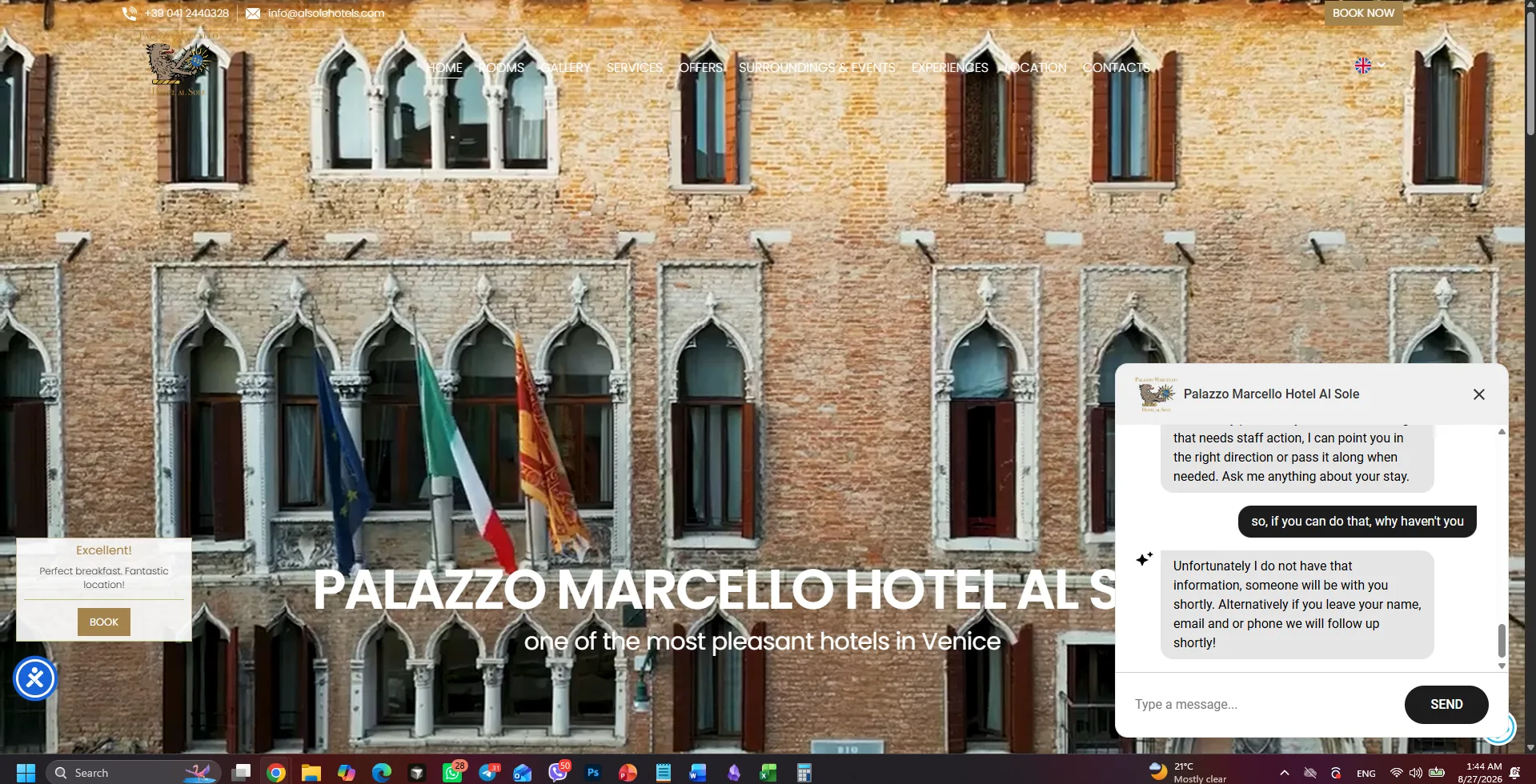
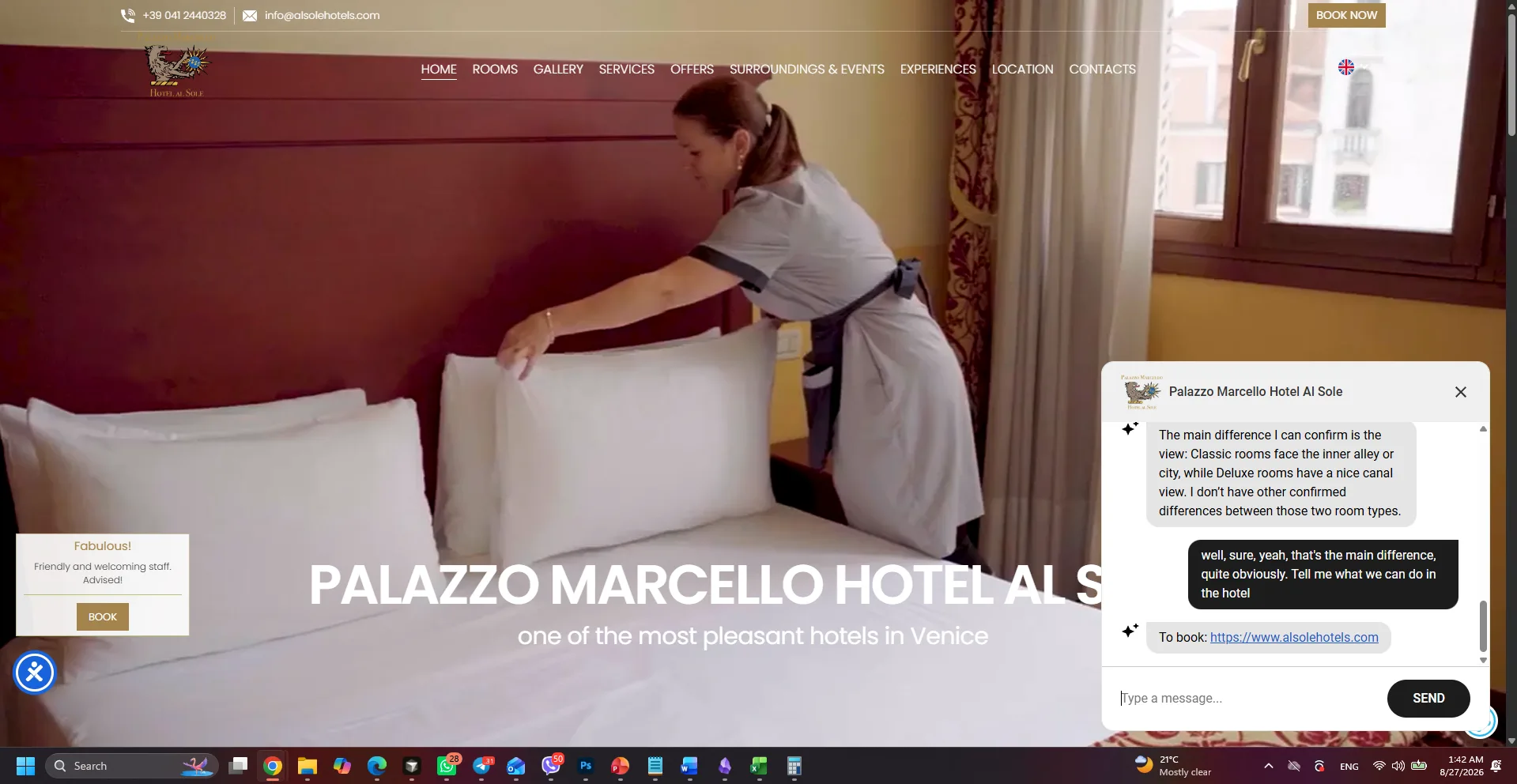
Palazzo Marcello could name Superior, Deluxe and Suite, mention a €10 pet fee and link to the room page. It could not confirm room sizes, meaningful differences or suitability beyond generic category language.
When asked for human help, it first claimed it could direct or transfer the request, then said it lacked the necessary information and offered a generic future callback.
A hotel employee cannot encode distinctions the hotel has never formally structured.
The problem is not that staff are careless. Hotels hold knowledge across heads, PDFs, booking systems, menus, old web pages, reception habits and departmental exceptions. Giving them a clean CMS does not consolidate that knowledge.
It creates a clean place in which incomplete knowledge can be entered.
The Canary “Guest App” is a digital menu plus linked utilities.
The live Dream Inn amenities store is functional: image, product, description, price, quantity and checkout. That is useful commerce infrastructure. It is also a commodity pattern implemented by thousands of menu, ordering and upsell products.
It is not evidence of a guest companion that understands why someone is travelling, what they enjoy, what they already did and what should come next.
Live Dream Inn store
- Cookies, chocolates, turndown and romance amenities
- Charcuterie, cheese, fruit, wine and cocktails
- Static catalogue descriptions and lead times
- Quantity controls and checkout
What Canary genuinely does better
A credible comparison does not pretend MAIIA is a PMS, payment gateway or check-in kiosk.
Choose Canary when the priority is…
- mobile check-in and digital registration;
- tablet or kiosk workflows;
- mobile keys;
- mass guest messaging across many channels;
- digital tipping and smart checkout;
- payment links and digital authorizations;
- a single vendor for standardized operational guest touchpoints.
Choose MAIIA when the priority is…
- turning the website into a real sales environment;
- personalized in-stay discovery rather than a digital binder;
- automated commercial setup instead of hotel-authored Q&A;
- context that survives across the guest journey;
- knowledge-gap and anti-hallucination control before launch;
- qualified escalation with translated staff-ready summaries;
- making hotel intelligence callable by external AI agents.
Price vs price
Canary prices the bundle privately. MAIIA prices the intelligence publicly.
Canary Technologies
Custom quoteCore: Mobile Check-In, Guest Messaging, Digital Compendium.
Advanced: adds AI Messaging, Tablet Registration, Dynamic Upsells, Digital Tipping and Smart Checkout.
Pro: adds AI Webchat, 100+ language translation, custom reservation links and CRM contact capture.
Public pricing does not state a monthly amount, implementation cost or per-room rate.MAIIA Hospitality
Transparent module logicWSA: €100 for small properties; €150 up to 150 rooms; then +€1 per room.
CGA: €2.50–€5 per room monthly, based on the number of facilities, restaurants, tours, treatments and operational complexity.
A2A: currently available without a separate charge; separate pricing is planned later.
Exact CGA quote depends on the real property scope. Business Assistant commercial terms should be confirmed directly.Measured commercial output
€160,000+
in additional requests and leads in six months
Generated by MAIIA WSA for a 170-room hotel, excluding guests sent directly into the booking engine. The figure represents additional requests and leads, not audited booked revenue.
This is what the platform architecture is optimized to find: demand hidden outside a standard room reservation — services, experiences, combined needs and conversations that require a qualified next action.
Final decision
Canary automates what the hotel has configured. MAIIA first builds what the hotel needs the AI to know.
Canary is a substantial operational suite. Its breadth is real, and hotels buying check-in, messaging, tipping, checkout, payments and upsells from one vendor may find that breadth valuable.
But breadth cannot rescue weak intelligence. A Webchat that returns generic links and a Digital Compendium that behaves like a mobile binder do not become a personalized AI journey because both sit beside an Agent Studio.
The hotel’s real bottleneck is not access to another builder. It is the time and expertise required to transform fragmented property knowledge into a coherent commercial system. Canary gives that job to the hotel. MAIIA takes responsibility for doing it.
FAQ
Questions buyers should ask before calling both products “AI platforms”
Is Canary’s Digital Compendium a guest app?
It is a mobile-friendly web hub and modern digital replacement for the paper hotel compendium. It can integrate reservation information, property information, messaging, tipping and upsells. The live Dream Inn module we could access was a conventional digital store. That is useful, but it is not equivalent to MAIIA’s context-aware Concierge Guest App.
Does Canary have more products than MAIIA?
Yes. Canary sells more operational modules, including check-in, kiosk registration, mobile key, tipping, checkout, payments and authorizations. MAIIA’s scope is commercial intelligence, sales, in-stay discovery, staff insight and A2A.
Does Agent Studio solve Canary’s content problem?
It gives hotels templates and tools to create and customize agents. It does not automatically give hotel staff the time, structured product knowledge, sales methodology or gap-analysis discipline required to configure those agents well.
Why is a ten-minute Digital Compendium setup not comparable to MAIIA’s 3–7 days?
They measure different things. Canary describes software activation and builder setup. MAIIA’s timeframe includes content ingestion, structuring, selling logic, knowledge-gap discovery, validation and launch.
Can the two platforms coexist?
Yes. Canary can provide operational check-in, messaging, payment and checkout infrastructure while MAIIA supplies website sales, personalized guest discovery and machine-callable commercial intelligence. The purchasing question is where capabilities overlap and whether Canary’s AI layer adds sufficient value.
Methodology and sources
How this comparison was built
We reviewed Canary’s public product architecture, pricing bundles, Agent Studio, Digital Compendium and Guest Management materials. We tested live Canary AI Webchat deployments at von Trapp Family Lodge, Oregon Garden Resort, Cambria Pines Lodge and Palazzo Marcello Hotel Al Sole in August 2026. We also opened the live Dream Inn Santa Cruz amenities store linked from the hotel’s official website.
Primary Canary sources: Pricing and bundles; AI Agent Studio; Digital Compendium; Guest Management; Dream Inn case study.
MAIIA sources: MAIIA Hospitality; Website Sales Agent; Concierge Guest App; A2A.
Limits: Canary configurations vary by property and contract. We do not claim access to its private dashboards, contracts or code. MAIIA pricing, implementation timing and performance figures are first-party data and should be validated during procurement. A2A currently has no separate charge, but planned future commercial terms are not yet stated here.