
Hotel Website AI comparison · two live installations · August 2026
Chatislav gives hotels the tools to build an AI agent. That does not mean the hotel can build a good one.
We tested two public Chatislav hotel installations. One was a reasonably informed Q&A bot. The other understood an international guest perfectly — then explicitly refused to continue in English.
Hotel Hammeum in Prokuplje and Vila Borova on Zlatibor.
Content, rules, languages, actions and quality depend on what the hotel configures.
An illustrative public-price stack for Standard, booking, catalog, resync, summary and hidden branding.
The short answer
The model understood English. The product was configured to refuse the sale.
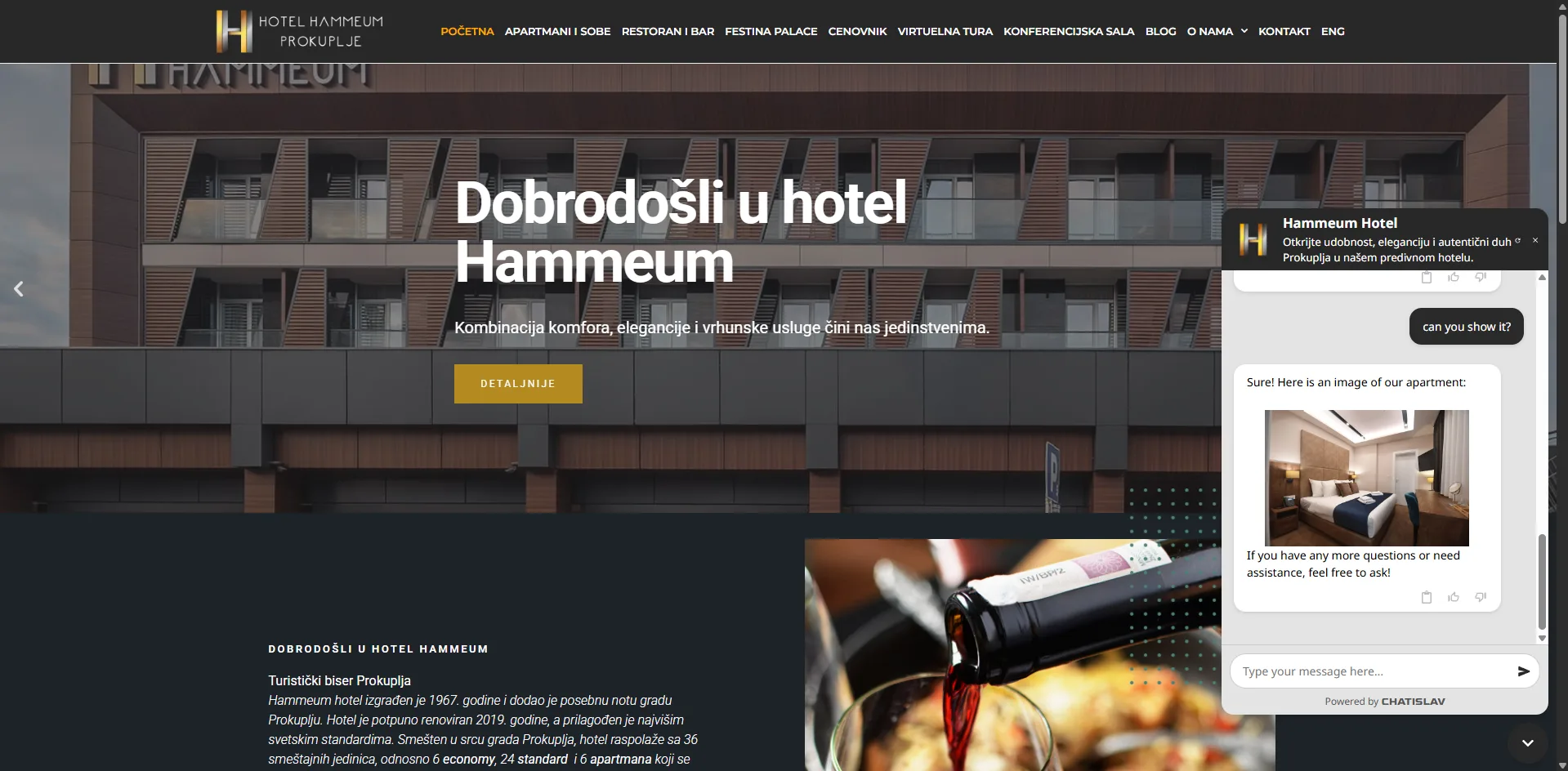
We live tested two public Chatislav hotel installations in August 2026. One — Hotel Hammeum — was a reasonably informed Q&A / FAQ bot: narrower sales capability, but it answered ordinary guest questions without blocking the conversation.
The other one, at Vila Borova hotel, understood an international guest perfectly — then explicitly refused to continue in English.
At Vila Borova, the agent answered “English please” in fluent English, stated that it was available exclusively in Serbian/Latin, and directed English inquiries to phone and email. When the guest then described a family of four, children aged three and five and a dog, the agent understood the request — but again refused to answer it in English.
Why this matters
Chatislav’s official hotel page says one agent automatically detects and answers different languages — including English — without separate configuration. The tested production behavior demonstrates the opposite outcome at Vila Borova. A hotel buyer should therefore ask not only what the platform can do, but who configures it, who validates it and who is accountable when the configuration blocks revenue.
Buyer path
How to decide without drowning in feature lists
-
Name the job
Website sales agent — multilingual conversion, cards, booking handoff — not a FAQ widget.
-
Test live installs
Ask what production guests actually get: language, product cards, escalation, booking.
-
Buy the outcome
Prefer a managed sales system over an agent builder the hotel must invent.
Complete comparison
Chatislav hotel chatbot vs MAIIA Website Sales Agent
A checkmark means the capability exists or was observed during real testing in August 2026. Partial entries explain exactly what exists and what is missing. Category winner is marked with .
| Website-sales criterion | Chatislav | MAIIA WSA |
|---|---|---|
| Natural-language Q&A | Confirmed Both installations understood ordinary questions; Hammeum produced useful hotel-specific descriptions. | Confirmed Natural conversation connected to structured products, suitability and actions. |
| Multilingual sales | Partial — deployment can block languages Hammeum answered in English. Vila Borova understood English but explicitly refused to serve the guest in it. | Consistent multilingual layer Hotel-selected languages apply to the conversation, recommendations and cards. |
| Complex guest context | Partial — understood, not converted Vila Borova parsed family size, children’s ages and dog, but language policy stopped the recommendation. | Persistent context Family, ages, pet, preferences and previous requests remain active through the journey. |
| Room recommendation | Partial — textual category Hammeum described its two-bedroom apartment, size, capacity and amenities. | Product-level recommendation Shows concrete suitable rooms and explains why each fits. |
| Room cards | Partial — image in message Hammeum displayed a room photograph after being asked, but no named product card, price or action. | Visual sales cards Named rooms with imagery, fit, relevant attributes and a direct booking destination. |
| Hotel and destination content | Confirmed Q&A Hammeum listed hotel amenities and nearby attractions in text. | Merchandised discovery Rooms, facilities, restaurants, wellness, tours and destination experiences appear as contextual cards. |
| Booking-engine handoff | Marketed; not observed live Official materials promise real-time availability and complete booking; neither tested installation demonstrated it. | Qualified handoff The recommendation card leads to the relevant booking engine destination for authoritative rates and availability. |
| Lead collection | Possible through actions/workflows No structured lead capture was observed in either tested guest flow. | Built into sales flow Contact attaches to the qualified request instead of becoming an isolated message. |
| Human escalation | Partial — Enterprise handoff Vila Borova displayed phone/email. Public pricing places “Handoffs” in Enterprise; correct-person smart routing was not observed. | Correct-staff routing Situational and sentiment analysis create a translated summary for the responsible employee. |
| Anti-hallucination architecture | Content-grounded Q&A Can train on hotel sources; public evidence does not establish MAIIA-equivalent critical-fact and suitability controls. | Governed knowledge Critical facts remain inside verified boundaries; knowledge gaps are identified before go-live or routed safely. |
| Automatic setup | Tools and optional services Hotel or implementation partner supplies content, rules, links, actions and QA. Production quality reflects that work. | 3–7 days MAIIA ingests, structures, enriches, identifies gaps, creates strategy and validates. |
| Automatic data updates | Partial — paid separately Auto data resync costs €39/month unless included in Business. | Part of managed knowledge method The hotel edits approved content without rebuilding the initial knowledge architecture. |
| Hotel-specific sales strategy | Depends on configuration The platform can be tailored, but hotel knowledge and commercial judgment must be supplied and tested. | Built in Strategy adapts to property type, real differentiators, commercial priorities and hard constraints. |
| Staff setup burden | High unless outsourced Staff or an external implementer must prepare, structure, translate, validate and maintain the agent. | Low Hotel reviews and approves structured output instead of authoring an AI knowledge system. |
| Published price | Platform + add-ons + hotel quote €0–€529 base tiers; booking, catalog, resync, summaries, branding and APIs are separate. Hotel solution also has an undisclosed one-time fee. | Simple WSA pricing €100 small properties; €150 up to 150 rooms; then +€1 per room above 150. |
Architecture in one glance
Builder stack vs managed sales agent
Same capability list can produce opposite guest outcomes. The difference is who owns knowledge, languages, merchandising and QA.
- 01
Hotel authors knowledge
Staff or partners structure rooms, rules, languages and actions.
- 02
Config decides languages
A capable model can still refuse English if production says so.
- 03
Add-ons stack the bill
Booking, catalog, resync, summaries and branding are separate modules.
- 04
QA is the hotel’s job
Edge cases and sales strategy live or die in local configuration.
- 05
Phone is the “handoff”
Guest restarts the journey; structured lead continuity is not guaranteed.
- 01
Structured ingestion
MAIIA researches, structures and enriches hotel knowledge in 3–7 days.
- 02
Consistent multilingual layer
Selected languages apply to conversation, cards and recommendations.
- 03
Cards + booking handoff
Named product cards lead to the correct booking destination.
- 04
Governed critical facts
Anti-hallucination boundaries and gap discovery before go-live.
- 05
Correct-staff routing
Translated summary reaches the responsible employee with context intact.
Live evidence · Hotel Hammeum
A capable hotel Q&A implementation — but still Q&A
It could describe the room and show a photo. It never turned that into a sellable product.
Hammeum answered in English, described its two-bedroom apartment and listed capacity and amenities. When asked to show it, the bot returned a real photograph.
That is useful and substantially better than a broken FAQ widget. But the image has no product identity, price, availability, comparison or booking CTA. The guest still has to translate the answer into a buying decision.
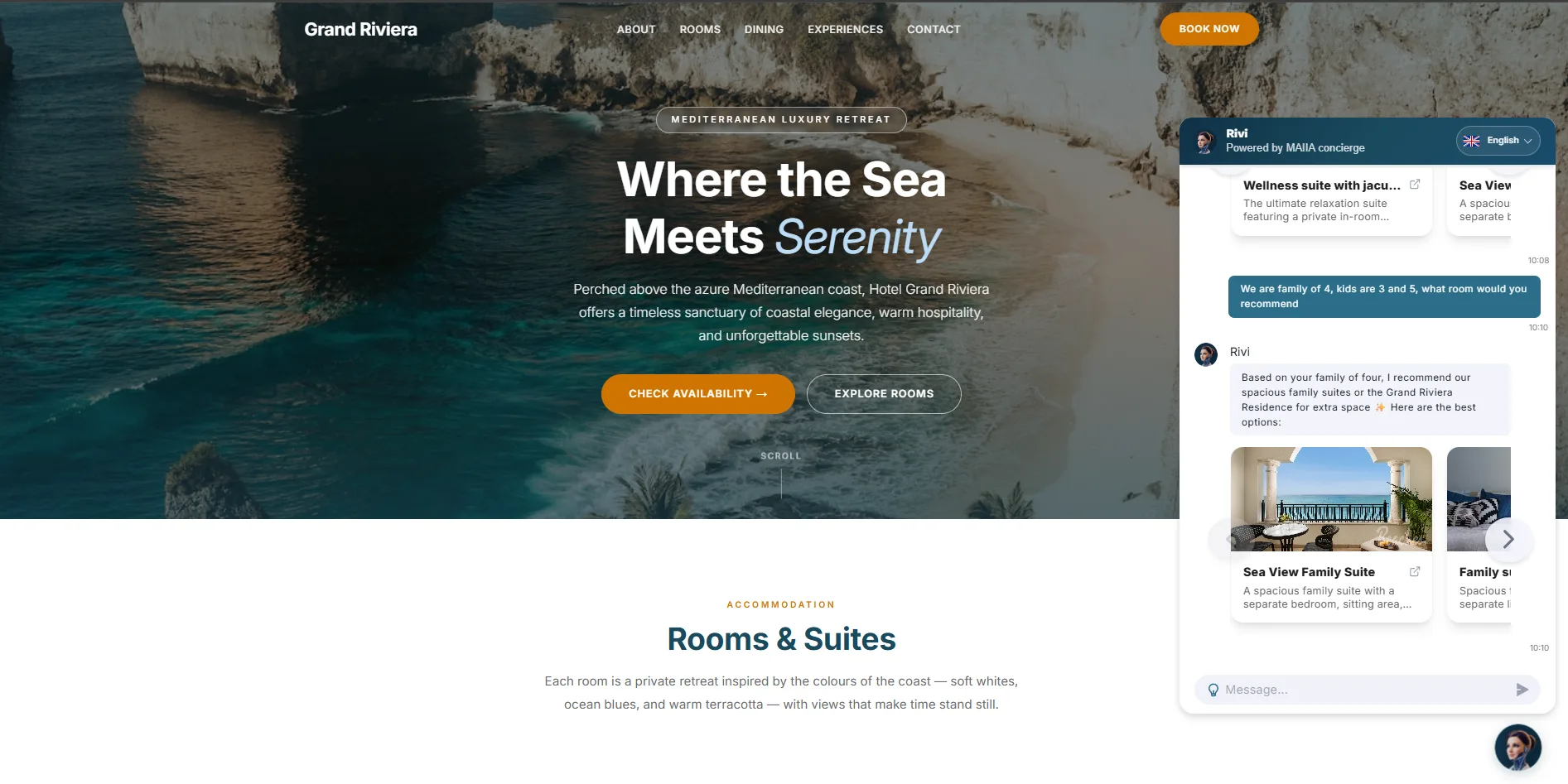
MAIIA treats the answer as inventory, not a paragraph
The same conversation becomes a set of visual, translated and actionable options. A room card is not decoration: it preserves product identity and sends the guest directly to the correct booking destination.
Live evidence · Vila Borova
The agent understood the buyer — then rejected the language
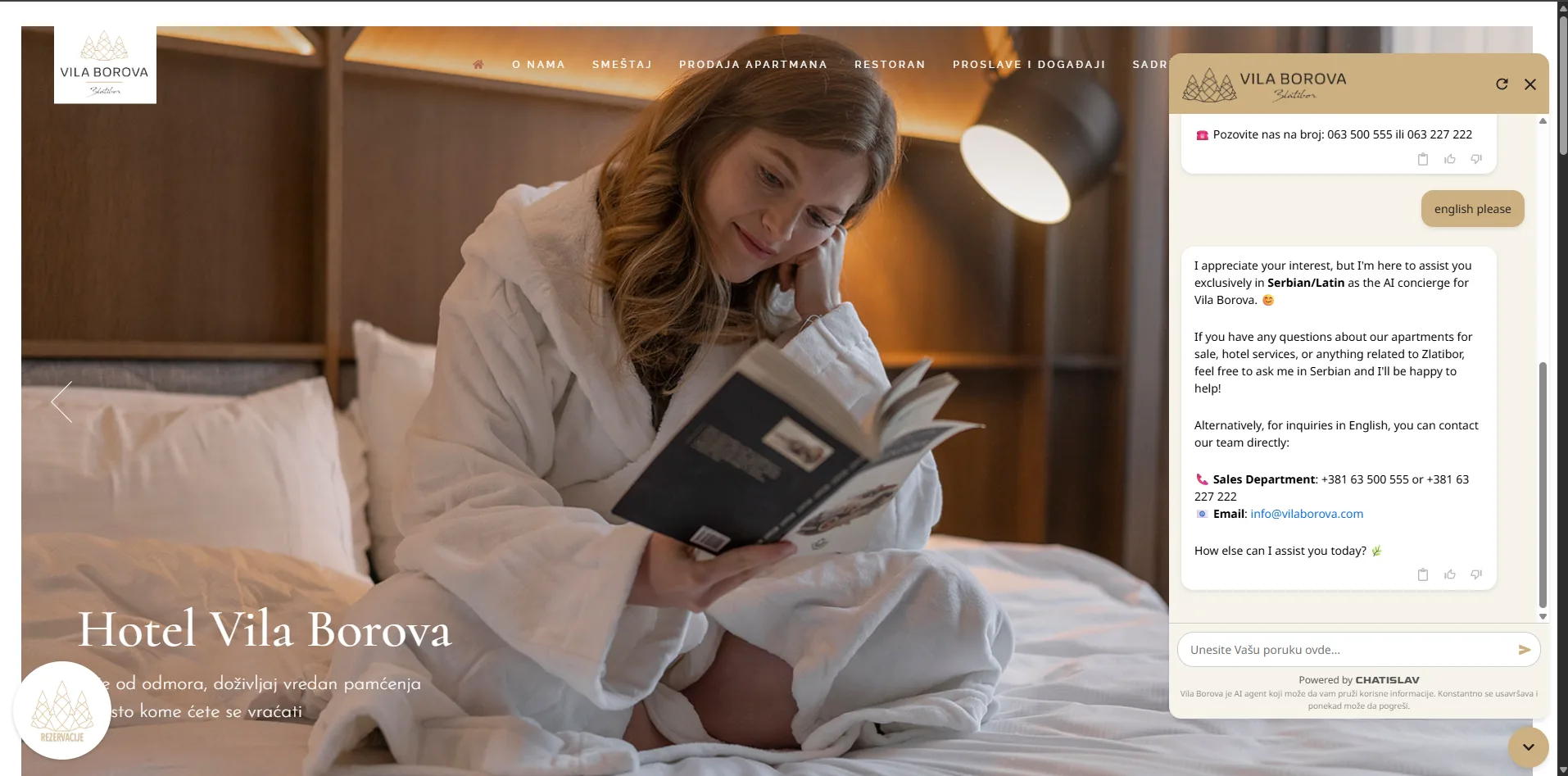
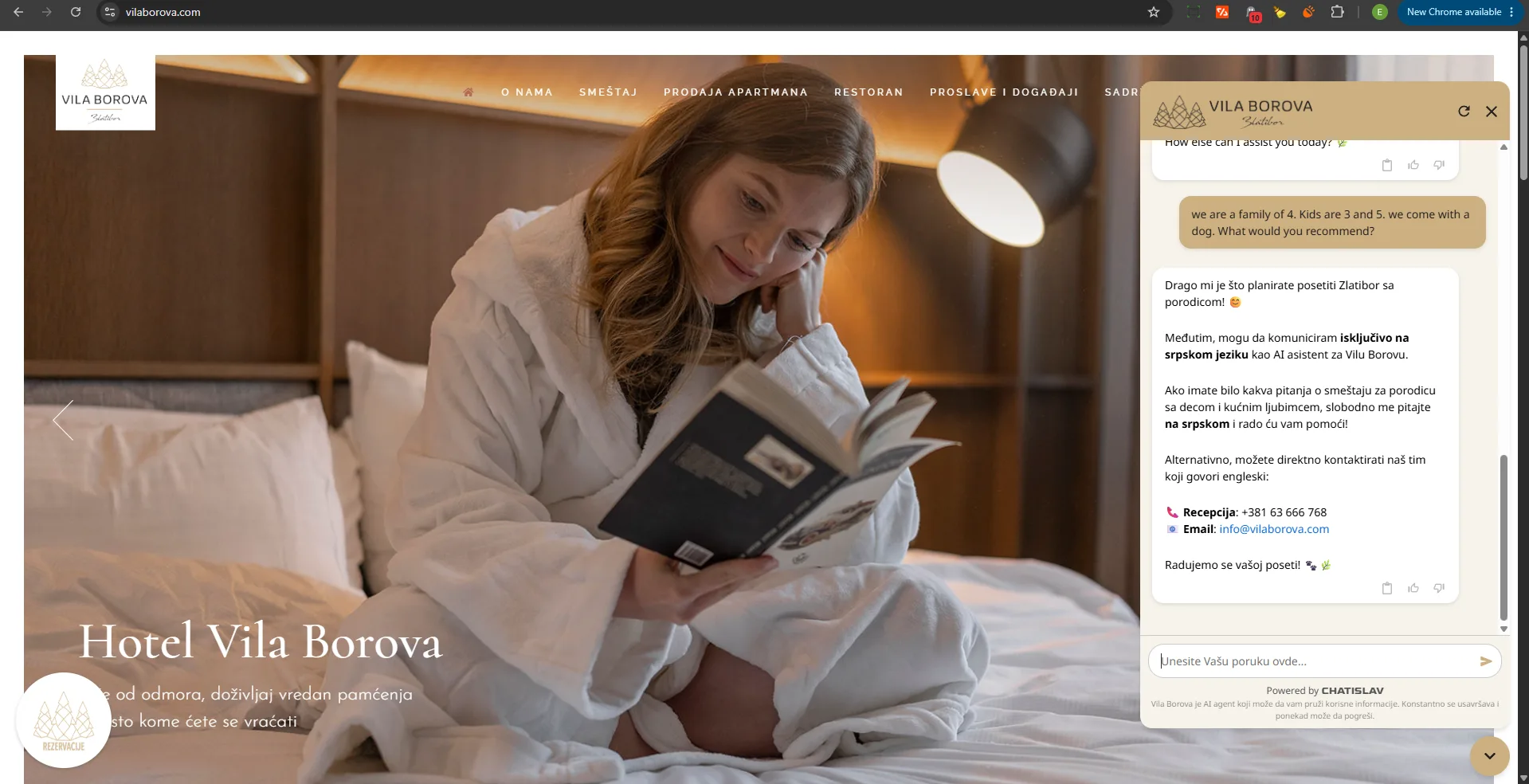
The system did not fail to detect the language. It detected the revenue and declined it.
A telephone number is not smart escalation. The guest must initiate a new interaction, repeat the request and hope the appropriate person is available. There is no demonstrated structured lead, translated summary, ownership or continuity.
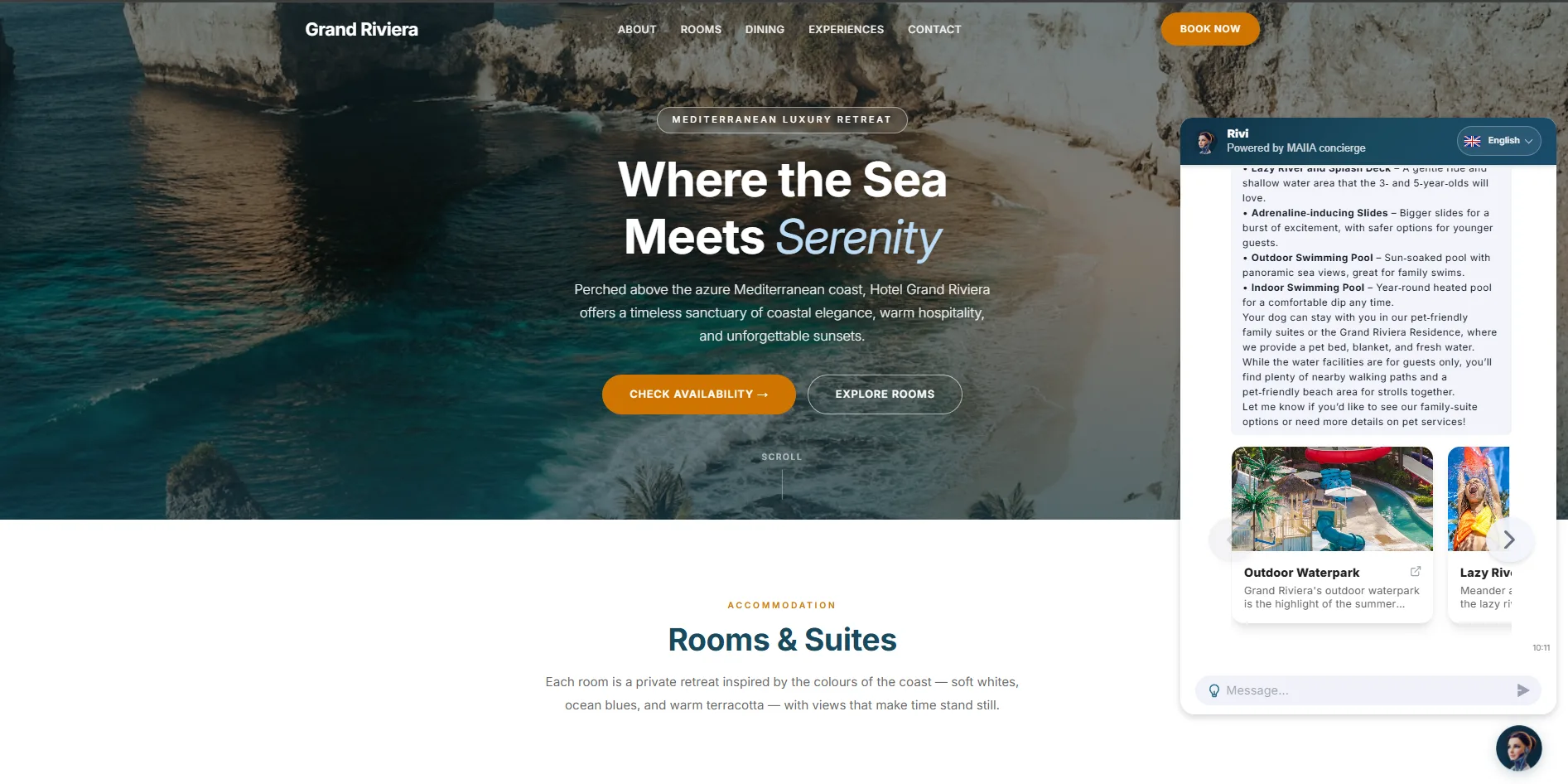
What MAIIA does with the same context
Keep the guest, build the decision, route the outcome
Visual discovery beyond rooms
MAIIA keeps family and pet constraints active while moving into waterparks, outdoor activities, tours, wellness and service requests. It does not require the hotel to hand-author every question and answer.
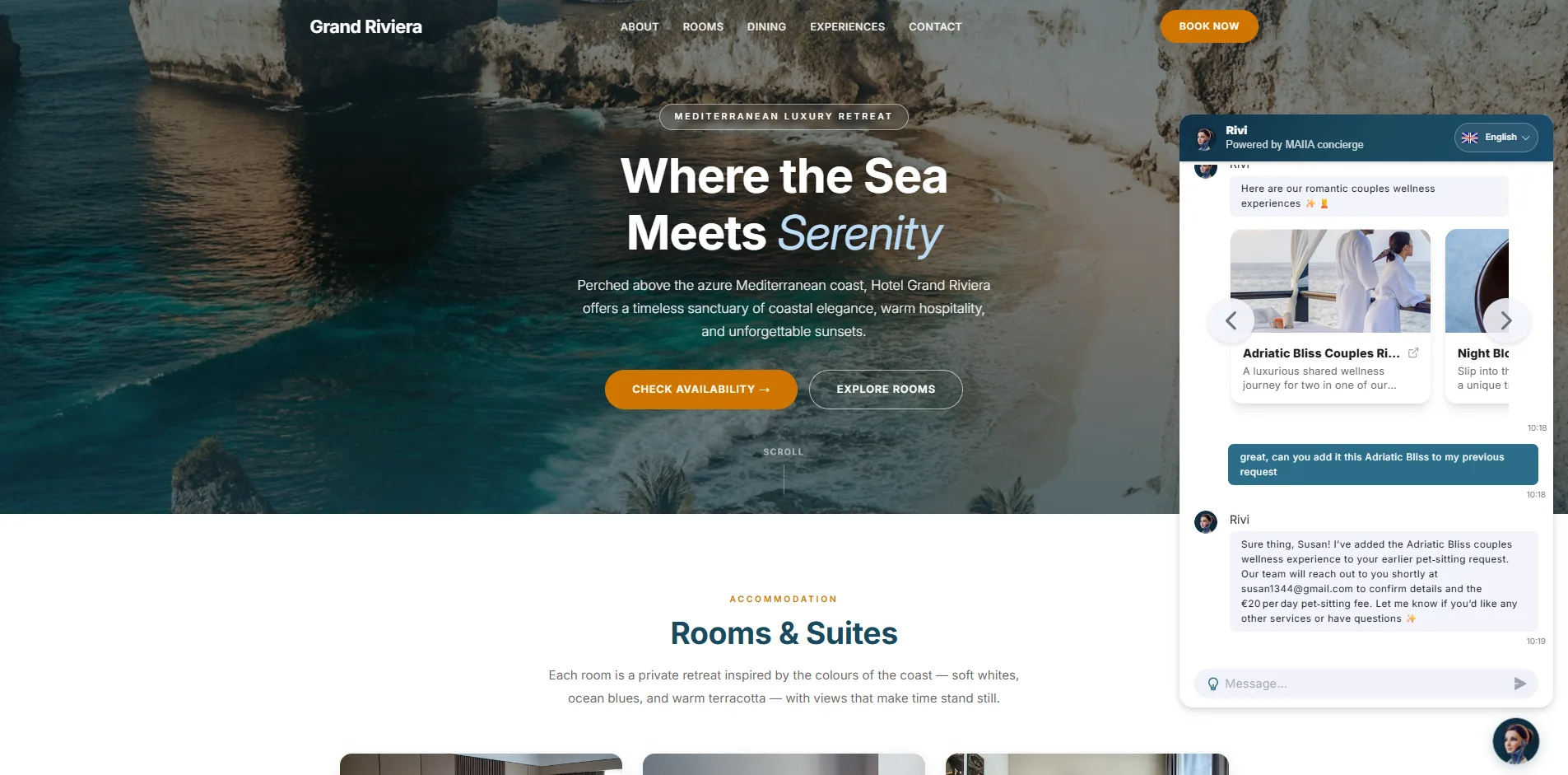
One commercial context, not disconnected chats
Contact is collected once. Later requests can be attached to the existing context, summarized and delivered to the correct employee. This is where staff time is actually saved: nobody has to read and reconstruct every conversation.
The largest hidden cost is not an add-on, it is the hotel’s time
Finding every fact, cleaning website content, structuring rooms and services, writing rules, translating, matching images, configuring actions, testing edge cases and maintaining the agent. If the hotel lacks AI product expertise, it pays twice — once for the software and again through weak production behavior.
| Hidden cost | Chatislav consequence | MAIIA method |
|---|---|---|
| Hotel implementation | Official hotel pricing includes an undisclosed one-time implementation fee. | Automatic setup is part of the defined 3–7 day process. |
| Knowledge maintenance | Auto-resync is €39/month or Business; otherwise stale answers become an operational risk. | Structured hotel knowledge and editing workflow are part of the product architecture. |
| Conversion functions | Booking and catalog are separate €79+ and €99+ modules. | Product cards and booking destinations are core WSA behavior. |
| Escalation | Handoffs appear only in Enterprise; a phone/email fallback loses structured context. | Qualified request, translated summary and correct-person routing are built in. |
| Usage | Plans alternate between “message credits” and “interactions”; actions can consume additional capacity. | Simple room-based WSA pricing avoids a conversion tax on deeper conversations. |
The architectural difference
A platform can expose controls. It cannot transfer product judgment to an unprepared hotel.
Multilingual sales
Advertised languages must appear in production guest flows — not only in marketing copy.
Visual merchandising
Rooms and experiences should surface as actionable inventory cards.
Setup ownership
Who builds the architecture: hotel staff, a partner, or a managed 3–7 day method?
Price honesty
Compare the illustrative stack (€470+) to MAIIA WSA room-based pricing.
Procurement stress tests
Five checks before you trust a hotel chatbot demo or price sheet.
-
01 Live language test
Open the hotel widget in English. Does it sell — or politely refuse?
-
02 Complex guest context
Family, ages, pet. Does the agent keep context and recommend products?
-
03 Product, not paragraph
Look for named room cards with imagery and a booking action — not only a photo.
-
04 Escalation quality
Phone/email alone is not smart handoff. Ask who receives a translated summary.
-
05 True monthly cost
Add booking, catalog, resync, branding and hotel time — not only the base tier.
Feature evaluation
Five levels that separate a FAQ bot from a sales agent
- 01
Basic fit
Natural-language Q&A on hotel facts.
- 02
Language layer
Production serves the languages you sell in.
- 04
Operations
Correct-staff routing with translated context.
Our conclusion
Chatislav can be used to build a competent hotel Q&A bot. Hammeum proves that. Vila Borova proves the accompanying risk: a system capable of speaking to the buyer can still be configured to refuse the buyer. MAIIA was designed after years spent solving precisely this failure mode — the hotel should approve its commercial intelligence, not be expected to invent the AI architecture that delivers it.
Chatislav gives the hotel an agent builder. MAIIA delivers the hotel a sales agent.
Evidence
Two live Chatislav hotels: Hammeum proves capable Q&A; Vila Borova proves configuration can refuse the sale.
Observed risks
- Platform potential ≠ guest experience
- Language policy can kill international conversion
- Hidden cost is hotel time and judgment
MAIIA approach
- The hotel approves content & sales strategy — MAIIA brings-in the agent architecture
- Cards, strategy, gaps and routing are the product
- Simple WSA pricing without hidden costs and unlimited knowledge
FAQ
Questions hotel buyers should ask
Is Chatislav only a basic FAQ bot?
No. The platform exposes agents, actions, workflows, catalogs, booking information and integrations. However, the two tested hotel deployments behaved primarily as Q&A bots, and neither demonstrated the complete booking experience claimed on the hotel product page.
Does Chatislav support English and other languages?
The official site claims automatic multilingual communication in more than 50 languages without separate language configuration. Hammeum answered in English. Vila Borova understood English but explicitly refused to serve the guest in it, proving that production configuration can negate the advertised capability.
Can Chatislav show images?
Yes. Hammeum showed a relevant room photograph when requested. What was not observed was a structured room card with product name, fit, price, availability and direct action.
What does Chatislav cost for a hotel?
Public base tiers range from €0 to €529 per month. A plausible Standard-based website-sales stack reaches €470+ per month after public booking, catalog, resync, summary and branding add-ons. Chatislav separately states that hotel deployments include a one-time implementation fee and a monthly fee, but does not publish that implementation amount.
Why is hotel self-configuration a commercial risk?
Because a hotel employee can unintentionally publish incomplete data, poor recommendations, outdated facts or restrictive rules. Vila Borova demonstrates the most direct version: a multilingual model was configured to reject an international sales inquiry.
Is the test representative of every Chatislav deployment?
No. It documents two public production installations on one date. Configuration varies, which is itself central to the conclusion: the platform’s potential and the guest’s actual experience are not the same thing.
Methodology & sources
How this comparison was built
We tested live Chatislav widgets on the official Hotel Hammeum and Vila Borova websites on 27 August 2026. The scenario included English-language service, room discovery and a family of four with children aged three and five and one dog. Screenshots reproduce the guest-visible results.
Evidence boundary: observed production behavior is separated from Chatislav’s marketing and pricing claims. We did not inspect private code, dashboards, contracts or unpublished integrations. A feature not observed in these conversations is described as “not observed,” not universally absent.
Official Chatislav sources: Plans and add-ons; Hotel solution, language, booking and implementation claims. Live installations: Hotel Hammeum; Vila Borova. MAIIA: MAIIA Hospitality AI.
Prices and public product claims were checked on 27 August 2026. The €470 figure is an illustrative sum of published components, not a Chatislav quotation. MAIIA scope and prices are first-party information and should be validated during procurement. Neither Chatislav nor the hotels were contacted.